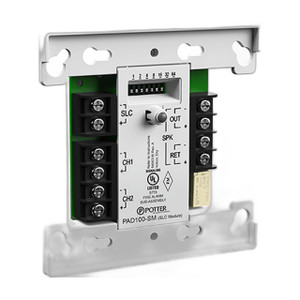
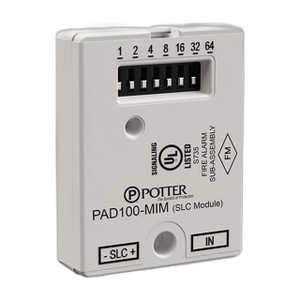
Potter PAD100-DIM Dual Input Module
The Potter PAD100-DIM is a dual input module engineered to expand credential reading and access control capacity within Potter access control systems. This module addresses a common deployment constraint: when a single control panel's reader inputs reach capacity, you face a choice between upgrading to a larger panel or adding a slave module. The PAD100-DIM (often searched as PAD100 DIM) solves this by providing two independent reader connections that consolidate separate credential streams into one management point—eliminating the need for additional control panels and keeping your credential database unified.
Key Features
- Dual Independent Reader Inputs: Two separate RJ-45 reader connections allow you to wire two distinct access points to a single module. This matters because it means you can handle two separate credential readers—say, a proximity card reader at one door and a smart card reader at another—without consuming a second panel's worth of resources.
- Wiegand and Serial Protocol Support: Accommodates both legacy proximity readers (Wiegand output) and modern smart card systems (serial output), so retrofitting mixed-credential environments doesn't require replacing older readers or forcing a single technology choice across all entry points.
- Multi-Credential Type Compatibility: Works with proximity cards, smart cards, and keypad PIN entry, giving you flexibility in how credentials are issued and managed across the system. Different departments or access zones can use different credential methods on the same module.
- Networked Integration Ready: Communicates with Potter control panels over standard network protocols, integrating directly into your existing Potter management platform without requiring intermediate gateway hardware or separate software licensing.
- 12V DC Powered with Supervision: Draws power from standard low-voltage 12V DC supplies (compatible with Potter panel power infrastructure or UPS systems). Built-in supervised circuit monitoring detects reader line faults or tampering—if a reader line goes open or shorted, the module signals an alarm condition to the panel.
- Compact Wall or Panel-Mount Form Factor: Space-efficient design fits into security operations centers and existing panel enclosures without major footprint expansion, critical when floor or rack space is already constrained.
- Field-Installable Retrofit: No system rebuild required. Connect the reader lines, plug in 12V power, and configure reader parameters through the Potter panel interface. Certified integrators can deploy this into live systems with minimal downtime.
- LED Status Indicators: Visual feedback for power, communication, and reader activity speeds troubleshooting and confirms the module is functioning correctly at a glance.
Integration & Compatibility
The PAD100-DIM operates as a slave module to a Potter control panel, meaning it extends the panel's reader capacity without operating independently. Reader configuration and credential management happen through the Potter panel interface—no separate software or control point. The module supports both Wiegand and serial reader protocols, making it suitable for deployments that mix older and newer reader technology. Installation requires certified integrator expertise to wire reader lines correctly and configure reader parameters in the Potter panel, but the actual physical installation is straightforward: terminate reader outputs to the module's RJ-45 connectors, connect 12V DC power, and configure the panel to recognize the new readers.
For a complete access control system deployment, consult Potter documentation for specific access control wiring diagrams and panel compatibility matrices to confirm which Potter control panels support slave module expansion. The PAD100-DIM is designed for mid-to-large scale installations where reader count and credential diversity are operational requirements.
Frequently Asked Questions
Q: Can I use the PAD100-DIM with non-Potter readers or control panels?
A: No. The PAD100-DIM is engineered specifically for Potter access control systems and functions as a slave module to a Potter control panel. It is not compatible with other manufacturers' panels or standalone operation.
Q: What's the maximum distance I can run reader wires from the PAD100-DIM to the actual card readers?
A: Wiegand reader lines typically support runs up to 200–300 feet depending on cable quality and electrical noise in the environment. Serial reader lines are more sensitive to distance and noise. Consult your specific reader manufacturer's documentation and Potter's wiring guidelines for your deployment environment.
Q: Does the PAD100-DIM require any additional software licenses?
A: No. The module integrates into your existing Potter control panel and management software without additional licensing. Reader configuration and management happen through your existing Potter panel interface.
Q: What happens if one of the reader inputs fails—does the entire module stop working?
A: No. The two reader inputs are independent. If one reader input fails, the second reader continues to function normally. The module's supervised circuit monitoring will report the fault to the panel, allowing you to diagnose and repair the failed reader line without disrupting the other reader.
Q: Is the PAD100-DIM suitable for outdoor installations?
A: The module itself is designed for indoor mounting (wall-mount or panel integration in a security operations center or protected enclosure). If you need to place readers outdoors, you would mount the readers themselves in weatherproof housings, while the PAD100-DIM remains indoors connected via the reader wires.
Ted PerryPerspective based on aggregated IP Security Depot and affiliated engineering team experience.
The Potter PAD100-DIM has proven valuable in deployments where reader capacity and credential type diversity create planning constraints. During system expansion projects, this dual-input module eliminates the need for an additional control panel while maintaining consistent credential handling across multiple reader types—a critical advantage when retrofitting access control into existing facilities without disrupting ongoing operations or forcing a wholesale technology refresh.
Technical Highlights:
- Dual Independent Reader Inputs: Two RJ-45 connections mean you can consolidate two separate reader streams into a single management point. On a 100-door facility where doors are grouped by credential type (proximity on the north wing, smart card on the south), this cuts the number of panels required and simplifies the credential database architecture.
- Supervised Circuit Monitoring: The module detects open or shorted reader lines and reports faults to the control panel—catching a cut reader cable or corroded connector before it becomes a security blind spot. This matters more than it sounds in busy warehouse or manufacturing environments where mechanical damage to wiring is common.
- Compact 12V Architecture: Uses standard low-voltage DC power that integrates with Potter panel UPS systems. No separate power supply or conditioning required, reducing both installation complexity and single points of failure in the power chain.
Deployment Considerations:
- The PAD100-DIM is a slave module only—it requires a compatible Potter control panel to operate. Verify panel compatibility and maximum supported slave modules before planning multi-module expansions; some panels have limits on how many slaves they can support simultaneously.
- Reader wiring distance matters more than you might think. Wiegand readers tolerate 200–300 feet, but serial readers are sensitive to line noise and distance. In noisy industrial environments (warehouse forklifts, high-amp machinery nearby), keep runs short or use shielded twisted-pair cabling.
- Configuration happens through the Potter panel interface, not through a separate web UI or software application. This keeps the system unified but also means you need panel-level access to add or modify readers—no distributed management.
Deploy the PAD100-DIM when your existing Potter panel has hit its reader input limit and you need to consolidate multiple credential types (proximity + smart card) without upgrading to a larger panel. It's especially effective in retrofits where downtime is constrained and you can't pull the control system offline for a full replacement.