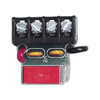
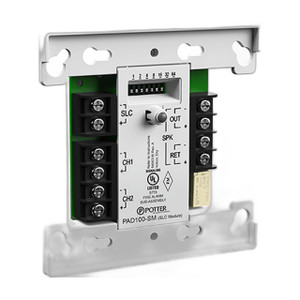
Potter CAM Class A Output Module
Overview
The Potter CAM is a Class A output module engineered for integration within access control and security systems. Designed to interface with control panels and credential readers, the CAM module provides relay-based output functionality for door strike control, request-to-exit sensors, and alarm state management. This module is commonly deployed in small-to-medium installations where streamlined output management and hardwired integration reduce complexity and support reliable operation in multi-door environments.
Key Features
- Class A rated output module for professional access control installations
- Relay-based output architecture for door strike and accessory control
- Designed for integration with standard access control panels
- Support for credential reader connectivity and wiegand protocol compatibility
- Hardwired input/output structure eliminates network dependency for critical door functions
- Compact form factor suitable for in-cabinet mounting or wall installation
- Standard 12V or 24V DC power options to match panel voltage specifications
- LED status indicators for output state confirmation and troubleshooting
- Field-configurable output assignments for flexible deployment scenarios
Integration & Compatibility
The CAM module functions as a bridge between access control panels and field devices such as magnetic locks, electric strikes, and alarm sensors. It accepts wiegand output from readers and credential processors, converting digital commands into relay closure for door hardware actuation. Installation requires standard 22 AWG or larger conductors for signal and power lines, with typical panel connection via DB9 or RJ45 connectors depending on control panel manufacturer. The module operates across standard access control voltage ranges, supporting both 12V and 24V DC architectures without modification. Integrators should verify panel compatibility and relay contact rating against strike amperage requirements—typical electric strike current draw ranges from 0.5 to 2.0 amps at rated voltage.
Typical Deployment Scenarios
The Potter CAM is well-suited for single and dual-door control in office buildings, retail facilities, server rooms, and light-industrial environments. Its Class A rating and hardwired architecture provide deterministic operation without network latency, making it preferred for life-safety applications and areas where network availability cannot be guaranteed. Common configurations include front-entrance credential control with request-to-exit integration, back-of-house access combining reader input with badge-in egress, and multi-zone installations where zone-based output scheduling is required. The module's relay logic supports timed strikes, held-open modes, and alarm-state interlocks without additional PLC or gateway hardware.
Ted PerryPerspective based on aggregated IP Security Depot and affiliated engineering team experience.
I've specified the Potter CAM in several mid-market access control refreshes, and it remains a reliable workhorse for hardwired door control. The Class A output rating and straightforward relay logic eliminate many integration headaches that crop up with IP-based alternatives in mixed-network environments. Its deterministic operation—no cloud dependency, no network failover logic—is a genuine asset when you're retrofitting into facilities with legacy panel infrastructure.
Technical Highlights:
- Class A Output Architecture: Relay-based command execution ensures consistent door strike control even during network instability or panel resets.
- Wiegand Protocol Support: Native compatibility with standard credential readers and keypads reduces converter requirements and simplifies commissioning.
- Voltage Flexibility: Single module operates across 12V and 24V DC systems, reducing inventory and streamlining spare-parts logistics.
Deployment Considerations:
- Verify relay contact amperage against your strike and solenoid load before final specification. Most installations fall comfortably within 5-10 amp contacts, but high-draw magnetic locks may require external relay banks.
- In multi-door environments, confirm that your panel provides adequate output channels; CAM modules are typically paired one-per-door or one per access zone depending on your control strategy.
For integrators who prioritize availability and straightforward diagnostics, the CAM delivers. It's not the newest option in the market, but it's proven in thousands of installations and requires minimal training overhead for your field teams.