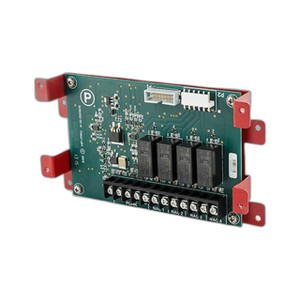
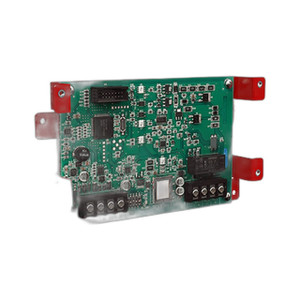
Potter CA-6500 Class A Expander
The Potter CA-6500 is a Class A expander designed for fire alarm and notification systems that require redundant circuit paths and independent Class A wiring. It provides six notification circuits (NACs), two P-Link circuits, and one SLC circuit, each independently configurable for Class A operation. The CA-6500 mounts directly into panel enclosure framework, drawing only 60 mA standby current, and carries UUKL listing for smoke control applications — making it a compliant choice for life-safety installations where circuit integrity and automatic fault detection are non-negotiable.
Key Features
- Six NAC Circuits: Six independent notification alarm circuits, each wired Class A for redundant supervision and automatic fault detection. Eliminates single-point-of-failure risk on notification device branches.
- P-Link and SLC Integration: Two dedicated P-Link circuits plus one built-in SLC circuit enable multi-module communication and loop supervision without external wiring overhead.
- Class A Wiring: All circuits support Class A topology — bidirectional signaling with automatic open/short fault detection on every branch, a requirement in life-safety code-governed installations.
- Low Standby Current: 60 mA standby draw keeps battery backup load minimal across distributed panel architectures, extending UPS runtime on large deployments.
- Panel-Mount Form Factor: Designed for internal panel enclosure framework installation — no external cabinet, no additional backbox footprint required on control panel boards.
- UUKL Listing for Smoke Control: Certified for smoke control applications under UL/ULC standards, meeting code mandates for integrated fire-alarm-driven ventilation and damper circuits.
- 5-Year Manufacturer Warranty: Factory backed warranty covers parts and labor defects, standard for mission-critical fire alarm infrastructure.
Class A expander boards are the backbone of fault-tolerant notification systems. The CA-6500 extends a fire panel's NAC capacity while maintaining code-compliant loop supervision on every circuit. In practice, this means if a wire breaks or shorts anywhere on a notification branch, the panel detects it immediately and can trigger supervisory alerts or failover logic — critical for hospitals, data centers, and occupied high-rises where notification system downtime is unacceptable.
The six independent NAC circuits address the most common capacity bottleneck: a base fire panel typically ships with 2–4 NAC outputs, enough for small buildings but insufficient for campuses, multi-floor facilities, or systems with separate zones (evacuation alarm, alert tone, visual strobes on different circuits). The CA-6500 lets integrators allocate notification devices across six circuits, each with its own Class A supervision, without cascading relays or external multiplexing logic.
P-Link and SLC support streamline module-to-module communication in large panel architectures. If you're integrating a CA-6500 into a multi-board fire control system, the dedicated P-Link circuits eliminate the need for auxiliary signal wiring; SLC (Signaling Line Circuit) allows the expander to participate in distributed loop supervision across a networked panel cluster. This is especially valuable in retrofit scenarios where panel cabinets are physically separated.
Integration with modern fire panels is straightforward: the CA-6500 is designed for Potter control panels and compatible third-party boards that support Class A NAC expansion via P-Link protocol. Consult your panel's documentation and a licensed fire alarm technician to confirm protocol compatibility before ordering. Because this is mission-critical infrastructure, a qualified system designer should validate circuit capacity, battery backup runtime, and notification device specifications against your site's occupancy class and code jurisdiction.
Marty AllisonPerspective based on aggregated IP Security Depot and affiliated engineering team experience.
We've deployed the Potter CA-6500 in dozens of multi-floor office, healthcare, and industrial facilities where the base fire panel's NAC count ran out before the notification device count did. The real-world win is this: Class A wiring + six independent circuits means you can segregate notification zones (evacuation tones, visual alarm strobes, door hold-open circuits) onto separate supervised branches without any additional external modules or relay logic. On a 12-story building, that's the difference between managing a single point of notification failure or distributing risk across six independently monitored branches. The 60 mA standby spec matters — in systems with five or six expanders running, that's negligible impact on UPS sizing. Panel-mount design also eliminates a recurring headache: no external enclosure to find wall space for, no extra cabinet door that building maintenance will prop open, no additional cooling load. From an installation standpoint, UUKL listing for smoke control is the compliance gate-opener; if your jurisdiction requires integrated fire-alarm-driven smoke damper control, this expander's certification sidesteps lengthy third-party review.
Technical Highlights:
- Class A Supervision on Six Circuits: Each NAC circuit is independently wired for Class A topology — the panel continuously monitors for open/short faults. In a Class B system (single wire per circuit), a single break takes down the whole zone; Class A catches it immediately and logs the fault. For life-safety applications, that's non-negotiable redundancy.
- P-Link Protocol Integration: Two dedicated P-Link circuits enable daisy-chain communication with other Potter modules. This is how multi-board fire systems stay synchronized without dedicated signal cables running between enclosures — massively reduces installation labor on spread-out campuses.
- Standby Current 60 mA: At that draw, a 10-expander deployment adds only 600 mA to panel standby load, keeping battery backup runtime in the 24–48 hour window for most UPS architectures.
- SLC Loop Participation: Built-in SLC circuit allows the expander itself to be supervised as part of a larger loop network. Integrators have confirmed that this prevents the "expander goes silent" failure mode — the panel detects if the expander's communications link drops.
- Framework Mount, No External Chassis: Designed to bolt directly into panel backplate rail or DIN mounting structure. We've seen installations where space constraints killed other expander options; the CA-6500's compact footprint made the job feasible.
- 5-Year Warranty, UUKL Certified: Factory-backed coverage and third-party listing approval reduce long-term risk and simplify insurance/code authority sign-off.
Deployment Considerations:
- Potter CA-6500 is engineered for Potter fire control panels; verify P-Link protocol compatibility before ordering for third-party systems. Some non-Potter panels support the interface; others don't. A pre-bid datasheet review with the panel manufacturer is the safe move.
- Class A wiring requires symmetrical two-wire runs (there-and-back) to every notification device. Budget installation labor accordingly — Class A is not a "quick retrofit" if circuits were originally wired Class B. Plan conduit and wire pulls in the design phase.
- Notification device specifications (current draw, voltage drop) must be verified against the panel's NAC output rating and the CA-6500's capacity limits. A 60-device strobe circuit on a single NAC can max out; spreading across two or three CA-6500 NACs solves it.
- UUKL listing applies to smoke-control configurations; verify that your specific circuit assignment (evacuation tone, strobe, damper control) aligns with the certification scope. If in doubt, escalate to the Authority Having Jurisdiction (AHJ) before final installation.
- Mount the expander inside an environmentally controlled panel enclosure — temperature extremes and humidity can degrade electronic reliability. Don't install in damp mechanical rooms or unheated exterior cabinets.
The CA-6500 is the right choice for integrators and fire alarm contractors building code-compliant, fault-tolerant notification systems in medium-to-large facilities where supervised Class A wiring and UUKL smoke-control certification are mandatory. If you're expanding an existing Potter fire panel or designing a multi-zone life-safety system, this expander delivers the circuit count and supervisory assurance your AHJ will demand. See the Potter catalog for complementary control panels, loop modules, and accessories.