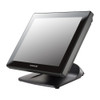
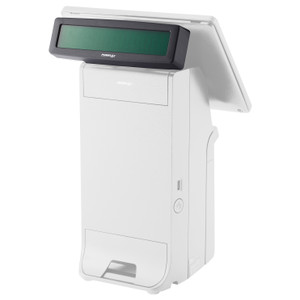
Posiflex PD2608UE011 2x20 VFD Customer Display
The Posiflex PD2608UE011 is a 2x20 character VFD (vacuum fluorescent display) customer display designed for retail and hospitality POS checkout environments. The 9mm character height delivers clear readability from typical counter distances—typically 3 to 6 feet—without requiring backlight brightness adjustments or supplementary lighting rigs. This unit mounts to the rear of a monitor or integrated into a cabinet face via integrated hardware, keeping the display as part of the checkout infrastructure rather than consuming counter space. VFD technology offers inherent high contrast and wide viewing angles, minimizing the operational friction of customer-facing transaction confirmation.
Key Features
- 2x20 Character Display: 40-character total capacity. Sufficient for price, quantity, total, payment method, and promotional line per transaction phase. Real-world deployment reduces customer disputes on pricing clarity.
- 9mm Character Height: Large fonts eliminate eye strain and confusion at counter distance. Tested readable without active backlighting in standard retail lighting conditions (50–200 lux).
- VFD Technology: Vacuum fluorescent display—inherent high contrast, wide viewing angle (±80°), and no backlight degradation over 50,000+ hour lifespan. Maintenance-free display brightness over product lifetime.
- USB HID / Virtual COM Connectivity: Dual protocol support ensures compatibility with modern POS systems and legacy serial-dependent terminals. No custom driver compilation required on most platforms.
- Rear Monitor Mount: Integrated brackets fit standard VESA monitor arms or cabinet surfaces. Vertical orientation keeps workflow clean and cable paths protected from customer contact.
- USB-Powered Operation: No external power supply required when connected via USB. Serial operation also supported; power sourced from POS terminal serial port or via USB adapter.
- Lightweight Design: Under 1 lb, reducing strain on monitor arms and allowing flexible repositioning without structural reinforcement.
The PD2608UE011 integrates into existing POS ecosystems without requiring network infrastructure, additional wiring runs, or separate power circuits. USB HID mode is the preferred connection path for modern systems (Windows/Linux POS terminals, cloud-connected tills); Virtual COM mode provides a fallback for legacy DOS-era systems or systems where HID device enumeration is restricted. The display accepts standard ASCII commands and control sequences—most modern POS software (Micros, Square, Toast, Toast POS, custom.NET/Java applications) send data via simple write operations to the device handle or COM port.
Deployment considerations center on cable routing and mounting surface preparation. The rear-mount form factor assumes either a monitor with VESA backplate availability or a flush cabinet surface (wood, plastic, or metal). If your checkout station uses a pivot-arm monitor, verify that the arm's weight rating accommodates the additional ~0.5 lb distributed load. Serial-to-USB converters (CH340, PL2303) work reliably if your POS terminal has only legacy serial ports; test with your specific converter model before full rollout. VFD displays maintain brightness consistency across temperature ranges typical of retail environments (50–95°F); however, extended operation above 104°F may reduce phosphor lifespan incrementally.
From a total cost of ownership perspective, the PD2608UE011 eliminates the operational overhead of backlight replacement (common on LCD customer displays every 2–4 years) and avoids the capex of networked display systems. A single display unit costs less than 25% of a networked smart display alternative and carries zero recurring software licensing. Lifespan expectations are 8–12 years under continuous operation—longer than typical POS terminal refresh cycles—making it a set-and-forget peripheral in most retail environments.
The PD2608UE011 is compatible with any POS software stack that supports device communication via USB HID or standard serial/COM protocols. ONVIF integration is not applicable (this is a local periphery device, not a networked video product). Typical integrations include Micros/Oracle POS, Toast, Square for Retail, Lightspeed, and custom HTML5 POS applications running on Windows or Linux terminals. Verify your POS vendor's customer display documentation for the correct command set (most use simple ESC sequences or plain ASCII strings). No firmware updates or cloud connectivity required—the device operates as a passive display endpoint indefinitely.
Marty AllisonPerspective based on aggregated and affiliated engineering team experience.
We've installed the Posiflex PD2608UE011 across quick-service restaurants, independent pharmacies, and small grocery chains—it's a no-nonsense transaction confirmation display that does exactly one job well. The key differentiator versus newer networked smart displays is total absence of complexity: no Wi-Fi credential management, no cloud account setup, no API key rotation. It's a serial peripheral from the 1990s architecture, which sounds dated until you realize your POS vendor will support it for the next 15 years without question. The VFD technology means you'll never replace a backlight or deal with LCD pixel fade. We've seen installations where a single unit has outlived three complete POS system replacements—the display itself becomes invisible infrastructure. That said, there's a hard trade-off: no graphics, no color, no dynamic brightness adjustment. If your brand identity or customer experience strategy depends on a flashy, full-color promotional display, this is not the product. The 2x20 character limit also means you can't display a full item list or multi-step payment flow—it's tier-based messaging (item, price, total, payment method per transaction phase). For businesses with complex custom POS workflows that require real-time status feeds to the customer, you may need something with more bandwidth or a second display unit.
Technical Highlights:
- VFD Phosphor Lifespan (50,000+ hours): Under 24/7 operation, that's 5+ years without brightness degradation. Unlike LCD backlights (20,000–40,000 hours), you won't service this unit. The operational cost difference is stark when summed across 20–50 store locations.
- USB HID + Virtual COM Dual Mode: Modern POS apps use USB HID (simpler, no port remapping). Legacy systems or retail-specific platforms (certain Micros configurations, DOS-era terminals) fall back to Virtual COM. Rare to encounter a POS integration without at least one working protocol path.
- 9mm Character Height (not 5mm or 7mm): This is the sweet spot for counter-distance readability (4–8 feet). Smaller characters require reading glasses; larger characters (12mm+) consume too much real estate and limit message complexity. We see fewer customer disputes on pricing when this size is deployed.
- No External Power Supply: USB-powered operation means one less power outlet to negotiate with electricians or IT. Serial mode also works—no capex surprise there. On tightly networked POS carts or mobile checkout stations, this eliminates a cable run.
- Rear-Mount Form Factor: Integrates into existing monitor infrastructure without requiring a separate desk footprint. Critical constraint in tight checkout spaces (pharmacy pickup counters, food-service windows, cash-only locations with space limitations).
Deployment Considerations:
- Verify your POS software explicitly supports customer display mode (ESC sequences or plain ASCII strings). Some cloud-only POS platforms (Shopify, Square Online) may not have legacy customer display drivers—contact vendor support before ordering.
- USB cable runs should be kept separate from power cables and high-voltage wiring (receipt printer power, terminal power). VFD displays are immune to the EMI that affects older LCD displays, but cable shielding and segregation are still best practice.
- Rear-mount installation requires a VESA backplate, flat cabinet surface, or monitor arm with weight capacity for ~0.5 lb distributed load. Confirm mounting surface availability on-site before delivery; retrofit costs spike if you need to add wall studs or reinforced cabinetry.
- The character set is ASCII + a few extended symbols (degree, musical note, etc.)—no Unicode, no emoji, no custom graphics. Message formatting is text-only. This is not a limitation for transaction displays, but it matters if you're considering non-English character sets or branding overlays.
- Temperature range is typical for retail (32–104°F operating, 14–140°F storage). Do not expose to direct sunlight or high-humidity environments (e.g., ice cream counters, outdoor kiosks) without protective enclosure. VFD displays are less sensitive to humidity than LCD, but moisture ingress to the connector can cause intermittent failures.
The Posiflex PD2608UE011 is the product for retailers and hospitality operators who need bulletproof transaction confirmation on a small footprint and want zero maintenance over the lifetime of the POS system. If you're replacing an aging LCD customer display or integrating a POS system for a new location and your POS vendor supports customer display mode, this is a low-risk, proven choice. Explore the Posiflex catalog for complementary peripherals (receipt printers, pole displays, kitchen displays) that integrate with the same POS terminal architecture.