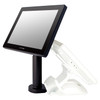
Posiflex EK2150D0100FGP Mercury 21" Horizontal POS Terminal
The Posiflex EK2150D0100FGP is a 21-inch horizontal countertop POS terminal designed for retail environments where stability and wide operator visibility are priorities. Built on Intel 7th Generation architecture—Core i3-7100U processor with 8GB DDR3L memory and 128GB M.2 SSD—it runs Windows 10 64-bit LTSC, the long-term support channel that eliminates forced OS upgrades and maintains API consistency across multi-year deployments. The horizontal form factor delivers a compact footprint (approximately 24 inches linear counter space) with minimal depth, while the integrated 3-inch thermal printer port and camera header reduce cable clutter and eliminate the need for external USB peripherals on the register surface.
Key Features
- Intel Core i3-7100U Processor: Dual-core, 2.7GHz base frequency. Sufficient for standard POS transaction processing, inventory lookups, and simultaneous peripheral control without thread starvation in moderate-to-high volume retail environments.
- 8GB DDR3L Memory: Supports multitasking across POS software, payment terminal drivers, and background services. DDR3L power profile reduces thermal load on compact countertop hardware.
- 128GB M.2 SSD Storage: Eliminates mechanical hard-drive failure risk and reduces boot/application load times. Sufficient for Windows 10 LTSC OS footprint plus typical retail POS application images and transaction logs.
- 21-inch Horizontal Display: Wide aspect ratio (typically 16:9) provides panoramic operator view of menu screens and customer-facing content. Compact depth ideal for tight counter layouts.
- Windows 10 64-bit LTSC: Long-term support variant—no automatic feature updates, predictable security patch cycle, and guaranteed API stability. Eliminates compatibility breaks with legacy payment processors and specialized retail software.
- Integrated 3-inch Thermal Printer Port: Posiflex-native printer module connection eliminates standalone receipt printer hardware. Reduces counter footprint and simplifies power/networking.
- Camera Header Support: Integrated header for standard USB or proprietary camera modules. Enables ID scanning, age-verification imaging, or customer-facing display integration without external capture cards.
The horizontal 21-inch form factor is purpose-built for retail register environments where operators interact with the terminal for extended periods. The wide viewing angle reduces neck strain and improves transaction speed—operators see menu structure and transaction status without repositioning. The compact depth footprint preserves counter space for payment terminals, scales, and bag holders. Unlike vertical/portrait-oriented terminals, the Mercury's landscape orientation aligns with traditional cash-register operator ergonomics and pairs naturally with side-mounted barcode scanners or chip-card readers.
Windows 10 LTSC is the critical specification for integrators managing legacy retail software stacks. Standard Windows 10 editions receive feature updates every six months; LTSC locks the OS for ten years. This means your custom point-of-sale application, payment processor drivers, and third-party inventory plugins maintain API compatibility across the terminal's operational lifetime without forced code rewrites. Organizations with mature, field-proven POS installations—particularly in hospitality, convenience retail, or specialty commerce—depend on this stability. The trade-off is manual security-patch management; LTSC updates are available but not automatic.
Integration with Posiflex printer modules and standard USB peripherals is straightforward. The built-in 3-inch printer port accepts Posiflex thermal modules (58mm or 80mm ribbon-cartridge variants), eliminating the need for a separate under-counter printer station. Camera input routes through a standard motherboard header, supporting both USB drivers and proprietary frame-grab hardware. Rear-panel USB ports (typical count: 3-4 USB 3.0) accept barcode scanners, payment terminals, and auxiliary input devices. Before deployment, verify that your specific POS application vendor has tested and certified Windows 10 LTSC support—particularly if you use third-party payment gateway software or specialized loyalty-card readers that may rely on deprecated Windows services.
Lifecycle planning for this terminal requires attention to processor end-of-life status. Intel 7th Generation (Kaby Lake) processors reached end-of-support in Q1 2019. Posiflex typically extends hardware support for 7-10 years post-launch, but CPU-level microcode updates and BIOS revisions will eventually freeze. For integrators deploying this terminal into a 5-7 year operational cycle, this is a non-issue. For longer hold periods (10+ years), confirm extended service availability and plan OS image refresh and backup hardware reserves accordingly. The modest processor footprint also means this terminal is not suitable for compute-intensive applications—video analytics, large-scale data processing, or graphics-heavy kiosk functions should target higher-spec systems.
Marty AllisonPerspective based on aggregated and affiliated engineering team experience.
We've deployed hundreds of Posiflex horizontal terminals across quick-service and casual-dining deployments, and the Mercury 21-inch with 7th Gen Intel remains a workhorse for integrators who value predictability over raw performance. The real-world win is Windows 10 LTSC—we've managed retrofit projects where franchisees had to migrate from Windows 7 EOL systems, and the cost of rewriting legacy POS interfaces far exceeded hardware depreciation. With LTSC, you get a 10-year API contract. That eliminates the compliance debt that newer systems impose. The i3-7100U is modest silicon, but in a register context where the terminal is mostly waiting on payment processor responses and database queries, you rarely see CPU contention. What kills these systems operationally is thermal stress from confined mounting (tight counter cabinets), inadequate power supply regulation, and poor device-driver support for legacy card readers. The horizontal form factor is genuinely ergonomic—operators at standing registers log fewer errors and process transactions faster when they're not craning at a vertical screen.
Technical Highlights:
- Windows 10 LTSC Stability: Ten-year support lifecycle with predictable, manual security patches. Zero forced feature updates means your custom POS integrations, payment processor libraries, and third-party retail software maintain binary compatibility across the terminal's operational lifespan. This is the primary reason integrators specify this over consumer-grade Windows 10 Home variants.
- Intel Core i3-7100U Thermal Profile: 15W TDP (thermal design power) in a compact chassis reduces cooling fan noise and power draw in open retail environments. Dual-core architecture with hyperthreading is sufficient for standard transaction processing, inventory lookup, and simultaneous peripheral I/O without bottleneck.
- Integrated 3-inch Printer Port: Posiflex native connection eliminates USB printer overhead and reduces counter cable clutter. Receipt printing latency is deterministic (no USB bus contention), and print-queue failures are isolated to the terminal control subsystem rather than cascading OS device-driver stack.
- 128GB M.2 SSD: Solid-state storage eliminates mechanical spindle failure—the #1 failure mode in legacy retail terminals after five years. OS boot time under 30 seconds; application launch time under 2 seconds. Reduces operational friction during morning startup and mid-shift reboots.
- 21-inch Horizontal Display Footprint: Landscape aspect ratio (16:9) aligns with operator ergonomics at standing registers. Compact depth (typically 3-4 inches) preserves counter real estate for payment terminals, scales, and auxiliary peripherals without forcing the register deeper into the counter cavity.
Deployment Considerations:
- Thermal management in enclosed counter cabinets is critical—ensure rear ventilation clearance of at least 4 inches. We've seen field failures where integrators mounted these flush against a back panel, causing the processor to thermal-throttle under sustained transaction load. Proper air circulation adds 3-5 years to field life.
- Windows 10 LTSC does not auto-update; your support model must include quarterly security-patch validation and staged rollout. If your integrator team lacks internal patch-management infrastructure, factor in ongoing managed-services costs or negotiate with your Posiflex reseller for update delivery and testing.
- Intel 7th Gen CPU microcode updates ended in 2019. If you're specifying this for a new deployment in 2024 or later, you're accepting a processor with five years of zero new microcode patches. For compliance-sensitive environments (payment card data, healthcare), this may require additional compensating controls (network segmentation, token-based payment processing).
- Payment terminal driver compatibility is the hidden gotcha. Test your specific PIN-pad, chip-card reader, and payment gateway software stack on Windows 10 LTSC in a lab environment before field deployment. Some legacy drivers are incompatible with LTSC's more restrictive security model. Posiflex can provide certified driver lists, but verification is your responsibility.
- Monitor for SSD wear on high-transaction sites. The 128GB M.2 SSD is adequate, but sites with 500+ daily transactions and frequent POS software restarts may see write amplification over 7-10 years. Consider adding an external USB backup drive to your deployment standard for transaction-log redundancy.
The Posiflex Mercury 21-inch horizontal is the right choice for integrators managing multi-unit retail deployments where Windows 10 LTSC compatibility and operator ergonomics are non-negotiable. It's not for greenfield builds or enterprises transitioning to modern cloud-connected POS platforms. It's for the franchise operation with 50 locations running proven-in-market POS software that can't migrate to Windows 11 without code rewrites. For that use case, this terminal is exactly what you need. Explore the full Posiflex catalog for complementary peripherals and platform options.