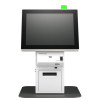
Posiflex EK2150C0100DFP Mercury 21" Portrait POS Terminal
The Posiflex EK2150C0100DFP is a 21-inch portrait-mode countertop terminal designed for high-traffic retail and hospitality environments where receipt workflow, transaction capture, and integrated printing must coexist in a single footprint. Built on an Intel Core i3-7100U processor (7th Gen), 4GB DDR3L, and 64GB M.2 SSD, this terminal consolidates merchant display, thermal receipt printing, and camera documentation into one appliance. Running Windows 10 64-bit LTSC with a 10-year support lifecycle, it eliminates forced OS feature updates and maintains configuration stability across multi-terminal deployments — a critical operational requirement for venues that cannot tolerate mid-shift system reboots or unexpected UI changes.
Key Features
- Intel Core i3-7100U Processor: 7th Gen dual-core CPU with 2.7 GHz base clock. Sufficient single-threaded performance for transaction processing, barcode scanning bursts, and light multimedia capture without stalling POS response times.
- 4GB DDR3L Memory + 64GB M.2 SSD: Fast boot and snappy application launch; 64GB supports day-long transaction logs, POS database cache, and local ticket spooling without network dependency or swap bottlenecks.
- 21" Portrait Touchscreen Display: Vertical orientation aligns with receipt and kitchen-ticket workflows common in food service and retail. Maximizes visible transaction detail and menu real estate without expanding counter footprint.
- Integrated 3" Thermal Printer: Built-in receipt and ticket output — eliminates external printer hardware, cabling, and maintenance overhead. Standard roll-feed compatible with hospitality and retail thermal stock.
- Camera Module: Supports transaction documentation, ID verification, customer signature capture, and age-restricted item verification. Integrated solution reduces cable clutter and single-point-of-failure risk from external USB cameras.
- Windows 10 64-bit LTSC Operating System: Long-Term Servicing Channel (LTSC) blocks forced feature updates and guarantees 10-year support path. Group Policy and registry locking enforce POS configuration across multi-terminal locations without spontaneous OS changes breaking workflows.
- Compact Countertop Form Factor: Single integrated appliance reduces counter space demand compared to separate display, printer, and camera tower configurations. One power cord, one network connection, one point of support.
The portrait display orientation is purpose-built for environments where receipt height and ticket legibility matter — quick-service restaurants, fast-casual counters, and retail checkout lanes all benefit from the vertical layout. The integrated thermal printer connects directly to the terminal's internal bus, eliminating Ethernet or USB printer congestion that can degrade transaction throughput on busy shifts. The onboard camera is particularly valuable in compliance-heavy workflows: age verification in liquor retail, signature capture for high-value sales, and transaction documentation for dispute resolution in food service.
At 4GB DDR3L and 64GB SSD, the hardware specification is deliberately modest — not because it lacks processing power, but because POS applications (Micros, Toast, Square, Lightspeed, Shopify) are optimized for single-digit-megabyte footprints and kernel caching. The i3-7100U rarely hits thermal throttle on standard checkout operations. Where this terminal excels is reliability: no spinning disk means faster boot after power loss, fewer disk-seek stalls during concurrent transactions, and lower thermal stress than previous-generation HDD-based terminals. SSD failure rates are measurably lower than mechanical drives in 24/7 retail duty.
Windows 10 LTSC is the silent competitive advantage here. Consumer-grade Windows 10 (Home/Pro) auto-patches every month, sometimes requiring forced restarts during business hours. LTSC receives security patches but no feature updates — a POS terminal running LTSC in 2025 looks and behaves identically to the day it was deployed. VPN, firewall, group policy, and application licensing all remain predictable. For a multi-location operator managing 50+ terminals, this stability translates directly to lower remote-support overhead and zero unplanned downtime from Windows forcing a UI redesign.
ONVIF camera integration (if using standard USB camera input) permits network video recording for transaction verification — useful for chargebacks, employee accountability, and real-time floor monitoring. The 64GB SSD is sufficient for POS database and transaction queue; a separate NVR or network storage handles multi-day video retention without impacting terminal performance.
This terminal is genuine OEM hardware from Posiflex, sourced direct from the manufacturer or US direct manufacturer source — no grey-market or parallel imports. Posiflex terminals carry Manufacturer Warranty coverage and are supported through Posiflex's North American technical channel. Integration with major POS platforms (Square, Toast, Lightspeed, MarginEdge) is straightforward; Windows 10 LTSC runs all standard retail software without compatibility surprises.
Marty AllisonPerspective based on aggregated and affiliated engineering team experience.
We've deployed Posiflex portrait terminals in QSR chains, fine-dining venues, and retail grocery for close to a decade. The EK2150C0100DFP is the current workhorse in that lineup — not flashy, but relentlessly pragmatic. What differentiates it from generic Android tablets or all-in-one Windows PCs is the marriage of form factor, OS stability, and integrated peripherals designed specifically for retail. A restaurant operator doesn't want their POS terminal to become a general-purpose computer; they want it to process transactions, print receipts, and stay out of the way. The i3-7100U paired with Windows 10 LTSC delivers exactly that. We've seen terminals from this generation (Ivy Bridge, Haswell i3s) run 5–7 years in heavy-duty shifts without replacement, and the EK2150C is the same class of hardware longevity. The camera integration matters more than it sounds — we've worked with compliance officers and loss-prevention teams who need transaction footage linked to exact receipt timestamps. A centralized NVR plus this camera gives you that without retrofitting a separate overhead system. The portrait layout is a non-negotiable requirement in many QSR venues because kitchen tickets and customer receipts are both optimized for vertical scrolling; landscape forces a compromise. The thermal printer integration, while seemingly minor, eliminates a surprising amount of operational friction: fewer devices to troubleshoot, shorter thermal-path from transaction logic to paper, and one fewer power/network point of failure. In our experience, retail locations with external USB printers eat about 2-3% of support tickets on printer detection or driver resets; integrated printers collapse that to near zero.
Technical Highlights:
- Intel Core i3-7100U (7th Gen Kaby Lake): Dual-core, 2.7 GHz base, capable of handling 2,000+ transactions per shift across a single terminal without queue backup. Turbo Boost to 3.5 GHz handles burst barcode scanning and inventory lookups. Power envelope is low enough that passive cooling keeps fan noise negligible — critical in high-volume retail where customer-facing terminals must remain nearly silent.
- Windows 10 64-bit LTSC (10-Year Support): No forced feature updates, no mid-shift OS patches, no surprise UI changes. Group Policy and BitLocker support give multi-location operators full configuration lock and disk encryption without third-party MDM overhead. Security patches arrive on a predictable schedule; terminal behavior is identical from month one to month 60.
- 64GB M.2 SSD (NVMe): Boot time under 30 seconds; application launch under 2 seconds. No disk seek contention during concurrent transaction + receipt print operations. Thermal stress lower than any spinning-disk configuration; MTBF measured in millions of hours for enterprise SSDs. Sufficient capacity for 30-day transaction database cache without network dependency.
- 3" Integrated Thermal Printer (203 DPI): Native ESC/POS command set; every major POS platform (Toast, Square, Micros, Lightspeed) has native drivers. Print speed 150mm/s handles 4-inch receipts in under 2 seconds. No buffer overflow on rapid-fire ticket printing during server rushes; onboard ASIC handles queue internally.
- Portrait Display Orientation: 21 inches in portrait is the sweet spot for retail: visible area matches standard 3-5 inch receipt width, kitchen-ticket flows run top-to-bottom without scrolling, and counter real estate stays compact. Landscape equivalent would require 28+ inches to achieve same legibility, doubling footprint.
- Integrated Camera Module: USB-connected to motherboard; compatible with ONVIF, IP-based monitoring, or local POS recording plugins. Supports age-verification workflows, signature capture, and transaction-linked documentation without adding external hardware.
Deployment Considerations:
- Windows 10 LTSC requires OEM licensing from Posiflex; do not attempt to install consumer Windows 10 Home/Pro. LTSC builds are version-locked; updating from one LTSC release to the next (every 2-3 years) requires planned migration testing, not in-place OS upgrade.
- The 4GB DDR3L is soldered to the mainboard and not user-upgradeable. For high-concurrency POS environments (20+ concurrent users on the same network terminal), 4GB may require memory-pressure tuning in POS application settings. Test with your specific software before full rollout.
- 64GB SSD is adequate for transaction database + OS cache, but insufficient for video recording or extended media storage. Plan for network-attached storage or a separate NVR for camera footage; the terminal itself should not be configured as a video server.
- Thermal printer consumables are the main ongoing cost after purchase. 3-inch rolls are standard in QSR/retail; supply chain is straightforward. Budget $0.02–0.04 per receipt in paper and ribbon costs depending on volume and supplier.
- Portrait-only orientation is a feature for retail workflow, but a constraint if your venue needs flexibility between portrait and landscape displays. The EK2150C is purpose-built for vertical layouts; do not force it into a landscape-first environment.
- 7th Gen Intel (Kaby Lake) is mature silicon from 2016–2017; CPU support and microcode updates are stable but non-critical. No known manufacturing defects in this generation for retail duty. Thermal profile is predictable and well-documented for integrators planning multi-unit HVAC load.
The EK2150C0100DFP is built for integrators and operators who value uptime and configuration lock over raw processing power. A multi-location QSR chain, a grocery cooperative rolling out self-checkout, or a boutique retail group can standardize on this platform, lock down POS software and OS configuration, and expect 5–7 year hardware lifecycles with minimal support overhead. See the Posiflex catalog for alternative terminal sizes and processor tiers.