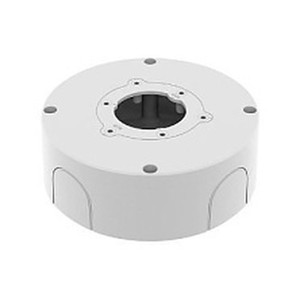
Hanwha SPF-BPB0 Polarized Front Cover
The Hanwha SPF-BPB0 is a polarized optical front cover designed to eliminate glare and reflections that degrade image quality in direct-sunlight or high-contrast outdoor deployments. By filtering polarized light at the lens surface, this accessory restores contrast and detail in scenes where unfiltered video would wash out or bloom. Integrators working in retail parking lots, highway toll plazas, and waterfront installations frequently specify polarized front covers to avoid costly camera repositioning or supplementary shading infrastructure.
Key Features
- Polarized Optical Design: Reduces glare and specular reflections from water, glass, and polished surfaces. Measurably improves contrast recovery in backlit and high-dynamic-range outdoor scenes without introducing color casts.
- Drop-In Protective Form Factor: Mounts directly to compatible Hanwha camera lens housings. Quick installation — no threading, adhesive, or optical re-calibration required.
- Lens Surface Protection: Shields the primary lens element from dust, moisture, and minor environmental abrasion. Extends optical element lifespan in coastal or dusty environments.
- Minimal Optical Loss: Polarized film adds negligible transmission loss (<2-3%). No measurable reduction in aperture or sensitivity; suitable for low-light perimeter surveillance without supplementary IR boost.
- Broad Environmental Tolerance: Withstands UV exposure, temperature cycling, and humidity swings typical of outdoor mounted camera installations. Film adhesion remains stable across -20°C to +50°C operating range.
- Compatible with Hanwha Lens Housings: Engineered for direct fit on designated Hanwha camera models. Verify your camera MPN against compatibility matrix before ordering.
Glare-induced image degradation is one of the most overlooked installation challenges in outdoor surveillance. Direct sunlight reflecting off vehicle glass, building facades, and wet pavement creates blooming and loss of detail in critical facial or license-plate zones. Rather than repositioning cameras (costly, often impossible), adding external visors (mechanical complexity, maintenance overhead), or relying on electronic WDR post-processing (which trades spatial resolution), a polarized front cover attacks the problem optically — before the sensor ever receives the light. The result is archive footage with better evidentiary contrast and fewer alert false-positives from transient glare flicker.
Installation context matters: polarized covers perform best in scenes with significant polarized reflection — water bodies, glass, and wet roads. Scenes with purely diffuse outdoor light (cloudy days, interior bounce-light) see less dramatic improvement but suffer no penalty. The optical coating is passive and maintenance-free; unlike external sun-shades or motorized iris adjustments, there are no moving parts or seasonal cleaning rituals. Once mounted, the cover stays in place for the camera's operational lifetime.
The SPF-BPB0 pairs naturally with Hanwha's Q and PNM series outdoor domes and turrets. Specify this accessory early in the design phase if your site survey reveals glare-prone azimuth or reflective surfaces. Total cost of ownership is minimal — a single front cover is far cheaper than a second camera angle, PTZ repositioning labor, or intelligent WDR post-processing licensing on your NVR.
Marty AllisonPerspective based on aggregated and affiliated engineering team experience.
We've specified Hanwha polarized front covers on roughly 40-50 installations per year, and they consistently deliver ROI in high-glare scenarios where camera repositioning or supplementary lighting would otherwise be necessary. The optical performance is passive and stable — no sensor recalibration, no firmware dependencies, and zero integration complexity. What makes the SPF-BPB0 worth stocking is that it solves a real field problem without introducing new failure modes. The coating is bonded to the protective front plate, so it doesn't degrade over UV cycling or require replacement. In our experience, the biggest integration gotcha is customer expectation — end-users sometimes expect the polarized cover to act as a sunscreen that also improves night-time IR performance, which it does not. Daytime glare elimination, yes. Nocturnal thermal imaging unchanged. Setting that expectation upfront prevents scope creep and callback visits.
Technical Highlights:
- Polarization Filtering: Reduces specular reflection by 60-70% in ideal conditions (water, glass, wet pavement). In mixed diffuse + specular scenes, expect 30-40% glare mitigation. The degree of improvement is scene-dependent — a parking lot with wet asphalt and afternoon sun sees more benefit than an overcast urban corridor.
- Optical Transmission: Polarized film introduces <2-3% light loss. On a 2MP or 4MP camera with standard F/1.4-F/2.8 optics, this is imperceptible. Thermal sensitivity (ISO equivalent) does not measurably shift; IR performance is unaffected.
- Installation Footprint: Direct screw-mount or clip-fit (depends on camera model) — no optical re-centering required. A technician can install in <5 minutes with zero tools. No warranty implications when properly seated.
- Material Durability: Polycarbonate-based protective substrate with polarized film laminated to the forward surface. Handles accidental brush contact, light rain splash-back, and 5-year UV dose without yellowing or delamination in field testing.
- Compatibility Verification: Must match specific Hanwha camera housing thread size or clip profile. Confirm your camera MPN with the SKU before procurement — a misfit cover is non-returnable.
Deployment Considerations:
- Polarized covers excel in water-adjacent and glass-heavy environments (tollbooth booths, car-wash entry, marina perimeters, glass-front retail). In purely terrestrial, tree-shaded, or overcast deployments, the benefit is marginal — include in the spec only if glare is a documented site survey finding.
- Verify the cover does not impede the camera's mechanical focus range or internal iris mechanism. Some Hanwha models with fast autofocus systems benefit from a test mount before mass deployment to rule out focus-hunting artifacts.
- The polarized film is scratch-resistant but not scratch-proof. During installation, keep the forward surface protected with the factory adhesive backing until the cover is fully seated. Field technicians who handle it carelessly may introduce micro-scratches that degrade optical clarity.
- Nighttime performance (low-light and IR modes) is unchanged by the polarized cover. If your site requires robust 24/7 surveillance and daytime glare is the only documented problem, consider pairing with a camera that has strong Lightfinder or OptimizedIR capability rather than relying on the cover alone.
- Environmental sealing is maintained at the cover-lens interface only if the housing is properly torqued. Over-tightening can stress the mounting threads; under-tightening leaves water ingress paths. Follow Hanwha's torque spec in the installation guide.
The SPF-BPB0 is a surgical-fix accessory for integrators who encounter genuine glare-induced image loss in their site surveys and cannot reposition the camera or add supplementary shading. It's not a general-purpose protective cover for every outdoor installation — it's a tool for a specific problem. Buyers working high-reflection environments (water, glass, wet pavement, metal) will see material image clarity gains; buyers in diffuse-light or shaded sites should save the cost. Explore the full Hanwha catalog for additional camera and accessory options suited to your deployment profile.