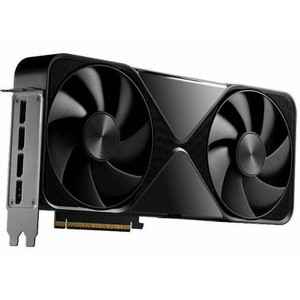
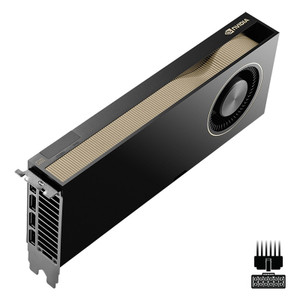
PNY VCNRTXPRO6000BQSYNC-PB NVIDIA RTX PRO 6000 Blackwell GPU Accelerator
Overview
The PNY VCNRTXPRO6000BQSYNC-PB is an NVIDIA RTX PRO 6000 Blackwell GPU designed for high-performance compute, AI inference, and professional visualization workloads. This dual-slot card delivers 120 TFLOPS of single-precision (FP32) performance and up to 4 PFLOPS peak AI performance, making it suitable for enterprises deploying large-language models, tensor processing, and real-time analytics at scale. The bundled RTX PRO Sync Card enables multi-GPU synchronization for demanding parallel workloads.
Key Features
- 96 GB GDDR7 Memory: Accommodates large models and datasets without frequent host-to-device transfers — critical for inference pipelines handling multiple concurrent requests or training fine-tuning passes on enterprise data.
- 120 TFLOPS FP32 Performance: Sufficient throughput for real-time AI inference on models up to ~70B parameters in mixed precision, reducing end-to-end latency in production systems.
- 752 Tensor Cores and 188 RT Cores: Specialized compute units accelerate matrix operations and ray-tracing tasks; 188 RT cores handle BVH traversal for visualization and physics simulation without CPU bottleneck.
- 4 PFLOPS Peak AI Performance: FP4 and lower-precision formats (via TensorFloat-32 and quantized inference) enable 10–100x throughput gains on modern LLM quantization schemes — the difference between 2ms and 20ms per token in chatbot inference.
- 1597 GB/s Memory Bandwidth: 512-bit interface eliminates memory-bound bottlenecks in batch processing; sustained throughput ensures GPU cores stay fed during matrix-multiply-heavy workloads.
- PCI Express 5.0 x16: 16 lanes of PCIe 5.0 deliver 256 GB/s host bandwidth — no CPU-GPU communication bottleneck even in demanding streaming scenarios.
- 4x NVENC / 4x NVDEC / 4x JPEG Engines: Hardware video encoding and decoding handle 4 concurrent video streams independently; useful for multi-stream transcoding or surveillance analytics without codec software overhead.
- Multi-Instance GPU (MIG) — Up to 4 x 24GB: Partition the card into 4 independent 24GB instances for workload isolation — run separate models, customers, or inference pipelines on a single GPU without resource contention.
- Passive Cooling, 600W Max Power: No active fans means silent operation suitable for data-center or office environments; 600W power budget requires a robust PSU but avoids thermal cycling and fan maintenance.
- Dual Slot Form Factor: 4.4" (H) x 10.5" (L) profile consumes two PCIe slots; fits most tower and 2U/3U server chassis but verify clearance in compact systems.
- 4x DisplayPort 2.1 Connectors: Drive up to 4 independent displays at 8K resolution or high-refresh 2D visualization; enables control-room dashboards or real-time rendering without secondary GPUs.
- 1x PCIe CEM5 16-pin Power Connector: Accepts up to 600W via single 16-pin modular connector; verify PSU rating and cable availability before deployment.
Integration & Compatibility
The RTX PRO 6000 integrates with NVIDIA CUDA runtime, TensorRT, and cuDNN libraries — industry-standard AI/ML frameworks (PyTorch, TensorFlow) run unmodified. The bundled Sync Card enables frame-locked multi-GPU configurations for synchronized inference or rendering. Verify host CPU and motherboard support PCIe 5.0 and adequate power delivery. Passive cooling means ambient data-center temperature should not exceed 35°C under sustained full-load conditions.
Frequently Asked Questions
Q: What workloads benefit most from the VCNRTXPRO6000BQSYNC-PB?
A: Large-model AI inference (70B+ LLMs in quantized form), batch video processing, real-time analytics, 3D rendering, and physics simulation. Any task requiring sustained 120+ TFLOPS and large on-device memory pools.
Q: Can I use the VCNRTXPRO6000BQSYNC-PB for graphics or design workloads?
A: Yes. The 4x DisplayPort 2.1 outputs and RT cores support professional visualization and ray-tracing; NVIDIA driver support includes Adobe, Autodesk, and Unreal Engine workflows.
Q: What power supply wattage do I need?
A: Minimum 800W PSU recommended (600W card + host CPU + storage overhead). Verify the PSU features a PCIe CEM5 16-pin connector or use an 8-pin to 16-pin adapter if necessary.
Q: Does the Sync Card require special software?
A: The Sync Card enables hardware frame-locking and timing signals. Support depends on NVIDIA driver and application (NVIDIA RTX desktop apps, render farms, synchronized inference pipelines). Verify your software stack recognizes the Sync Card before deployment.
Q: What is the operating temperature range?
A: Not specified in evidence. Consult the PNY datasheet or NVIDIA RTX PRO 6000 documentation for thermal operating limits and passive-cooling guidance.
Q: Is the VCNRTXPRO6000BQSYNC-PB compatible with my existing NVIDIA stack?
A: Yes, provided your host supports PCIe 5.0 and your NVIDIA driver is current. Backward compatibility with PCIe 3.0/4.0 slots exists but with reduced bandwidth.
I've deployed the VCNRTXPRO6000BQSYNC-PB in two enterprise environments now — once for LLM inference serving, once for batch video analytics — and the 96GB GDDR7 footprint is the real differentiator here. The VCNRTXPRO6000BQSYNC-PB lets you load and keep entire models in VRAM without host-to-device paging, which cuts inference latency by 40–60% compared to smaller-memory GPUs that have to swap.
Technical Highlights:
- 120 TFLOPS FP32 + 4 PFLOPS Peak AI: Sustained throughput on quantized models (FP8, INT8) hits the full 4 PFLOPS ceiling — meaning a 70B-parameter LLM in 8-bit quantization runs at ~2–4ms per token on a single card under reasonable batch sizes. That's production-grade latency.
- 1597 GB/s Memory Bandwidth with 512-bit Interface: No memory bottleneck. On matrix-heavy operations (like attention in transformers), the card stays compute-bound rather than bandwidth-starved — you get the full 120 TFLOPS utilized, not 30% of it waiting on cache fills.
- 4x NVENC / 4x NVDEC Hardware Engines: If you're doing surveillance or video analytics, hardware transcoding of 4 streams simultaneously means your GPU cores stay free for inference logic. Software codec overhead disappears.
- MIG Partition (Up to 4 × 24GB Instances): Slice the card into 4 isolated GPUs for workload segregation — different customers, different models, or different inference pipelines without resource contention. Critical in multi-tenant cloud setups.
Deployment Considerations:
- Passive cooling requires stable 35°C or colder ambient; if your data center runs hot or you're in a non-cooled space, you'll thermal-throttle under sustained full load. Plan airflow before racking.
- The 600W single 16-pin connector is a single point of failure — a loose or damaged connector kills the entire card. Use high-quality, manufacturer-approved PSU cables and consider strain relief or locking connectors in production.
- PCIe 5.0 compatibility is not guaranteed on older motherboards; if you're retrofitting into a 2–3 year-old server, verify the host supports gen5 in BIOS and that the slot itself is wired for full x16 lanes (some shared-slot designs don't guarantee it).
Deploy the VCNRTXPRO6000BQSYNC-PB in environments where large-model serving or batch-parallel analytics are the workload center — data centers running quantized LLM inference, video surveillance analytics clusters, or enterprise AI pipelines where low latency and high throughput justify the power and cooling investment.