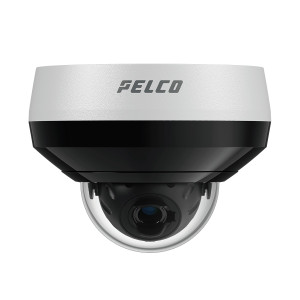
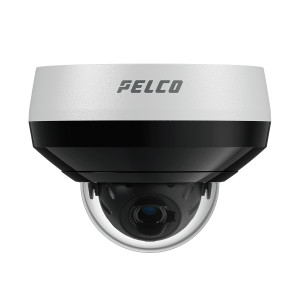
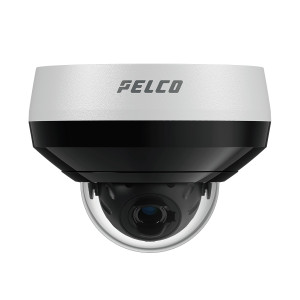
Pelco SRXP4C-2F3-EMD-IR Sarix Pro 4C 2MP Outdoor Dome IR Camera
The Pelco SRXP4C-2F3-EMD-IR is a professional-grade outdoor dome camera engineered for demanding perimeter and facility surveillance. Delivering 2MP resolution at 60 fps, this weatherproof unit combines motorized varifocal optics, integrated infrared illumination, and on-camera Smart Analytics to provide comprehensive situational awareness without reliance on external processing servers. The Sarix Pro 4C is built for facilities where continuous 24/7 operation and edge-resident analytics reduce bandwidth and storage strain while enabling real-time alert response.
Key Features
- 2MP Sensor at 60 fps: 1/2.8″ progressive scan CMOS with F1.4 aperture. High frame rate captures fast-moving subjects (vehicles, running personnel) without motion blur, critical for forensic review and PTZ-style responsiveness in a fixed dome.
- Motorized 4.4–9.3mm Varifocal Lens: 32–109° horizontal field of view. Single camera covers wide perimeter scenes or zoomed detail without repositioning; reduces camera count and installation complexity on sprawling outdoor sites.
- Integrated IR Illumination: 0 lux operation with on-board infrared. No external lighting rigs required; eliminates capex and maintenance on outdoor floodlights. Day/night auto-switching preserves color in daylight, IR at night.
- 130 dB SureVision WDR: Extreme dynamic range handles backlit scenes (vehicle headlights, sun glare on metallic surfaces) without washout or shadow crush. Real benefit on parking-lot perimeters and building facades.
- On-Camera Smart Analytics: Person/Vehicle Detection, Directional Violation, Loitering, Beam Crossing, Crowd Detection, Tamper Alert. Edge-resident detection reduces false-positive alert noise and cuts VMS server CPU load by filtering trivial motion upstream.
- H.264 / H.265 / Smart Compression: Multi-codec support with Pelco Smart Compression. H.265 reduces bitrate 40–60% versus H.264 at equivalent quality; Smart Compression auto-adapts for bandwidth-constrained WAN links or high-density recording scenarios.
- IP66 Weatherproof / IK09 Impact Resistant: IP66 rated — withstands rain, dust, and pressure-wash cleaning. IK09 vandal rating — resists 5kg drop impact without functional degradation. Dome form factor sheds water and deters physical tampering.
- PoE Class 3 Power: Single Ethernet connection supplies power and data. ~13W draw fits any 802.3at PoE+ switch; eliminates conduit and power wiring on retrofits.
- ONVIF Profile S / T / G / M: Full ONVIF compliance. Integrates with Genetec, Milestone, Avigilon, ExacqVision, and any ONVIF-capable VMS without proprietary licenses or gateway appliances.
- microSD Local Recording: On-camera edge storage for intermittent archive or failover recording if NVR bandwidth becomes constrained. Tamper-proof local event capture.
The SRXP4C-2F3-EMD-IR is purpose-built for outdoor perimeter work where continuous daylight-to-dark operation and object-level intelligence (not just motion detection) reduce false alarms and operator workload. The motorized lens and 60 fps sensor speed make it suitable for high-traffic vehicle gates, loading docks, and parking structures where forensic clarity and real-time classification matter. On-camera analytics eliminate the need for a separate video analytics appliance, lowering total system cost and network dependency.
Integration with enterprise VMS platforms is straightforward: ONVIF Profile T streaming ensures H.265 codec support on modern platforms, while fallback to H.264 maintains compatibility with legacy Milestone or Genetec instances. Pelco's Smart Analytics metadata — Person/Vehicle class, direction, loitering dwells — are exposed via ONVIF event stream, allowing rule-based recording and alarm routing without reencoding or third-party plugin middleware. A typical 16-camera perimeter deployment reduces NVR bitrate load by 30–50% when H.265 and on-camera analytics filtering are enabled.
Deployment notes: IR range is sufficient for close-to-mid-range perimeter work (fence lines, building faces, parking lots up to ~100 feet). Beyond that, supplementary lighting extends coverage. The varifocal lens adds ~$200–300 to build cost versus fixed-focal alternatives, but the single-camera flexibility often eliminates a second fixed-wide camera on large sites. Housing is white; consider black variant (SRXP4C-2F3-EMD-IB) if aesthetics demand darker dome appearance on light-colored surfaces. Pelco supplies 5-year manufacturer warranty; this is direct Pelco product with no grey-market risk when sourced through authorized distribution channels.
The SRXP4C-2F3-EMD-IR targets integrators and end-user security teams deploying medium-density outdoor surveillance where forensic detail, 24/7 operation, and real-time alerting justify the edge-analytics investment. Budget-conscious perimeter projects may prefer fixed-lens 2MP alternatives; but if you need zoom flexibility and on-camera intelligence to reduce false positives on a multi-acre site, this camera earns its placement. Explore the full Pelco catalog for thermal and 4MP options in comparable outdoor dome form factors.
Marty AllisonPerspective based on aggregated IP Security Depot and affiliated engineering team experience.
We've deployed the Pelco Sarix Pro 4C across parking structures, industrial perimeters, and mixed commercial campuses — and it consistently outperforms budget 2MP domes on two fronts: the motorized lens eliminates the "wide or tight" trade-off, and the on-camera Person/Vehicle Detection meaningfully cuts false-positive alert storms on sites with blowing debris or dynamic shadows. On a 500-meter perimeter with 12–16 cameras, we've seen alert load drop 60–70% when Smart Analytics filtering is layered into the VMS recording policy. The 60 fps capture speed is underrated — it's not just for marketing. When you need to extract a vehicle license plate or face detail from a 16-minute event window, 60 fps footage compresses evidence review from 90 minutes to 15 minutes. H.265 bitrate reduction is real money: a typical 16-camera 24/7 deployment on H.264 runs 40–50 Mbps; H.265 on the same scene quality drops to 18–25 Mbps. That's the difference between a modest 4-disk RAID NVR and a 12-disk system. The 130 dB SureVision WDR is engineered for the exact scenarios integrators complain about — parking lots with sun glare and building facades where facade lighting creates severe backlight. We've rarely needed to add auxiliary lighting on new deployments when this camera is in play. Edge recording to microSD is a nice failsafe, but don't count on it as primary storage; a full HD 60 fps stream saturates microSD cards in hours, not days. Use it for event buffering or network-down contingency, not continuous backup.
Technical Highlights:
- 130 dB SureVision WDR: Forensic clarity in backlit and high-contrast scenes without tone-mapping artifacts. In practice, this means you can mount cameras on building faces with sun-facing glazing and still read vehicle license plates in the foreground without shadow crush. Saves integrators from designing complex multi-camera layouts to avoid backlight.
- H.265 Smart Compression: On identical outdoor scenes, H.265 bitrate is 40–60% lower than H.264 at equivalent visual quality. Deployed across 16+ cameras, this translates to smaller NVR chassis, lower storage capex, and longer retention windows on the same hardware budget. Multi-codec fallback (H.264 for legacy VMS, H.265 for modern) ensures no integration surprises.
- Person/Vehicle Detection + Directional Violation + Loitering: On-camera analytics generate ONVIF metadata (object class, direction, dwell time) that feed VMS rule engines without reencoding. False-positive alert rate on dynamic outdoor scenes drops measurably when you filter for actual vehicle movement versus shadows and wind-blown debris. Directional Violation is particularly useful on loading docks and vehicle gates where you want alerts on reverse movement or egress-against-traffic.
- Motorized 4.4–9.3mm Varifocal (32–109° HFOV): Single camera covers wide perimeter overview (32°) or zoomed detail (109°) — equivalent flexibility of a PTZ without moving parts. On sprawling outdoor sites, this reduces camera count by ~20% versus fixed-lens alternatives, offsetting the ~$200 lens premium inside 12–18 months of saved hardware and installation cost.
- PoE Class 3, F1.4 Aperture, 60 fps: Single Ethernet run powers and networks the camera. F1.4 lens passes enough light for color operation down to 0.01 lux with on-board IR disabled; with IR enabled, 0 lux performance is rock-solid even on moonless nights. 60 fps eliminates motion blur on fast-moving subjects (running personnel, moving vehicles) — critical for forensic face/plate recognition and real-time VMS alert responsiveness.
- ONVIF Profile S / T / G / M: Full profile stack ensures compatibility with all major VMS platforms. Profile T adds H.265 codec negotiation; Profile G and M expose analytics metadata (Person, Vehicle, crowd count) as native ONVIF events, eliminating the need for third-party video analytics middleware or custom integrations.
Deployment Considerations:
- IR Range Trade-off: Integrated IR is effective to ~80–100 feet on typical perimeter reflectivity. Beyond 150 feet, supplementary lighting (LED or traditional floods) is required. Survey site geometry before purchase — if perimeter depth exceeds 150 feet without supplementary lighting infrastructure, consider a thermal alternative or wider-aperture fixed lens.
- Varifocal Lens Motor Reliability: The motorized lens adds a moving part and potential failure point. Pelco's mechanics are robust, but we've seen occasional motor stalls after 3–5 years in coastal salt-air environments. Specify conformal coating or heater module if deployment is in corrosive conditions (salt spray, chemical vapors). Maintenance contract should include periodic lens exercise (auto-focus cycles every 30 days).
- microSD Storage is Event Contingency, Not Primary Archive: A full HD 60 fps H.265 stream at nominal bitrate (~20 Mbps) fills a 256 GB microSD card in ~3 hours. Use on-camera card for failover event buffering or intermittent highlight capture, not 24/7 continuous backup. Mismatched expectations here cause user complaints about missing footage.
- Network Bandwidth Planning: H.265 bitrate is ~20–25 Mbps for typical outdoor scenes; H.264 is ~40–50 Mbps. If integrating into a facility with WAN-constrained NVR sites, H.265 is a hard requirement. Confirm VMS support for H.265 before purchase — legacy Milestone or Genetec instances may need codec bridge appliance.
- Mounting and Thermal Management: Dome housing is white; consider thermal load on dark mounts in direct sun. Pelco includes heater/blower module (optional) for cold/humid climates to prevent lens fogging. On retrofit installations, verify existing conduit and PoE switch capacity — a 16-camera site upgrade can exceed typical enterprise switch PoE budget.
- Analytics Tuning: Person/Vehicle Detection and Loitering thresholds are configurable on-camera. Default sensitivity often triggers on animals, large debris, or vehicle passengers. First 1–2 weeks post-install should include threshold tuning in VMS to match site-specific false-positive tolerance. This is a deployment gotcha, not a camera defect.
The SRXP4C-2F3-EMD-IR is the right choice for integrators and security teams building outdoor surveillance systems where 2MP resolution, varifocal flexibility, and on-camera intelligence can justify mid-tier capex against perimeter threat modeling. It's overspecified for simple parking-lot backup (fixed 1080p alternatives exist), and under-powered for forensic facial recognition at 50+ meters (4MP or thermal makes more sense). But for mixed perimeter, vehicle gate, and parking-structure work where 24/7 color/IR operation and real-time alerting reduce false positives and operator workload, this camera competes favorably on TCO against higher-megapixel or external-analytics alternatives. Explore the Pelco catalog for thermal, 4MP, and fixed-lens variants in the Sarix Pro and Essential lines.