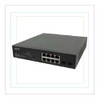
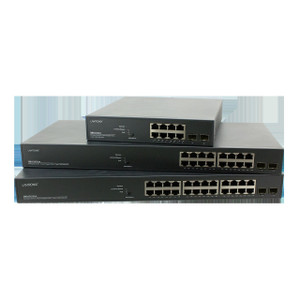
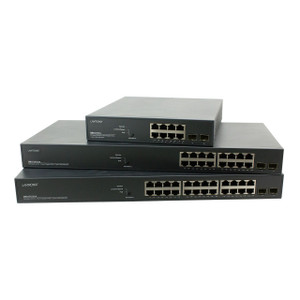
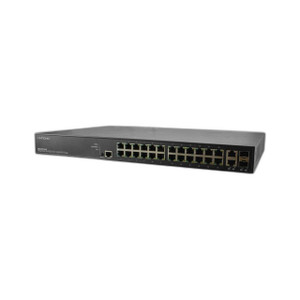
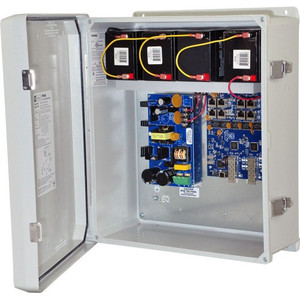
Pelco SM8TAT2SA-NA 8-Port GbE PoE+ Managed Switch
The Pelco SM8TAT2SA-NA is a purpose-built managed switch designed to centralize power and data distribution for networked IP camera systems. With eight Gigabit Ethernet ports, IEEE 802.3at PoE+ support rated at 30W per port, and a total 120W power budget, this switch eliminates the need for multiple individual power injectors and reduces infrastructure complexity in medium-scale surveillance deployments. The North American configuration includes full managed-switch capabilities—VLAN isolation, QoS, and port monitoring—making it suitable for both commercial security and industrial automation integrations where network segmentation and traffic prioritization matter.
Key Features
- 8 Gigabit Ethernet ports with IEEE 802.3at PoE+ — Each port supplies up to 30W of power, eliminating separate power supplies for eight devices. This simplifies installation and reduces cabinet clutter compared to passive PoE injectors or 802.3af-only switches.
- 120W total PoE power budget — Distribute across active ports based on your camera power draw. A 25W camera leaves 20W per remaining port; verify your exact device requirements before provisioning all eight ports simultaneously.
- Managed switch with VLAN support — Isolate camera traffic from corporate networks using 802.1Q VLANs. This protects critical business systems from surveillance bandwidth spikes and keeps security feeds on a dedicated segment.
- QoS (Quality of Service) prioritization — Assign priority queues to camera streams and ensure real-time video traffic doesn't get dropped when other network devices compete for bandwidth.
- Port monitoring (port mirroring) — Mirror traffic from any port to a central analyzer or NVR for visibility into network activity and troubleshooting without inline probes.
- NDAA Section 889 compliance — Certified for government and regulated sector installations where supply-chain traceability and foreign-component restrictions are mandatory.
- Designed for IDF and distribution-point deployment — Compact form factor fits standard network cabinets. Deploy at the intermediate distribution frame or secondary building node to fan out power and data to remote camera clusters.
- Native integration with Pelco IP camera systems — Tested and validated for Pelco IP cameras and compatible networked security devices, reducing integration risk and support complexity.
Integration and Deployment Considerations
The SM8TAT2SA-NA integrates directly into NVR and VMS environments supporting ONVIF and standard Ethernet. When planning power allocation, note that the 120W budget is shared across all active ports—if you deploy eight 25W cameras, you'll exceed budget and face port shutdown. Size your configuration conservatively: a typical deployment might run five 25W cameras (125W total) at 80% utilization. Cameras requiring 802.3bt (90W per port for high-power heating and lighting) cannot be supported on this switch; use a higher-capacity model or external midspan injectors for those devices. Review your camera selection guide to confirm power compatibility before provisioning.
VLAN configuration isolates surveillance traffic from production LAN, critical in enterprise environments where IT policy restricts broadcast domains. QoS ensures that a single high-bitrate camera stream (or a multicast event) does not starve other devices of bandwidth. Port monitoring enables non-invasive capture of camera traffic for codec analysis, troubleshooting, and bandwidth trending without affecting normal operation.
Applications
Ideal for commercial buildings, industrial facilities, and government installations deploying centralized Pelco camera infrastructure. Common scenarios include: office building IDF serving three to five floors of cameras, warehouse automation with distributed IP-based sensors, and regulated sites (healthcare, finance, federal) requiring NDAA-compliant network hardware. Scale this switch for 5–12 mid-power cameras; larger deployments (20+ cameras) warrant modular or higher-capacity switching fabrics.
Warranty and Support
Backed by a 1-year manufacturer warranty covering defects in materials and workmanship. Support is available through Pelco's professional service network and technical documentation.
Frequently Asked Questions
Q: Is the SM8TAT2SA-NA NDAA Section 889 compliant?
A: Yes. The SM8TAT2SA-NA is certified NDAA Section 889 compliant, meeting supply-chain and foreign-component restrictions required for government and regulated sector installations.
Q: Can I run eight cameras at full power simultaneously?
A: Only if each camera draws 15W or less (120W ÷ 8 = 15W per port). If your cameras require 20–30W each, you can only power four to six devices. Always total your actual camera power draw before deployment and plan for 80% utilization to avoid port shutdown due to overload.
Q: What happens if I exceed the 120W power budget?
A: The switch will reduce power to ports or disable them entirely to stay within the total power envelope. Over-subscription results in unpredictable camera behavior or dropped connections. Size your configuration conservatively based on actual power requirements.
Q: Does the SM8TAT2SA-NA support 802.3bt (90W per port)?
A: No. The SM8TAT2SA-NA supports IEEE 802.3at (30W max per port). Devices requiring 802.3bt high-power delivery need a higher-capacity switch or external midspan injectors.
Q: Can I isolate camera traffic from my corporate network using VLANs?
A: Yes. The SM8TAT2SA-NA is a managed switch supporting 802.1Q VLAN tagging, allowing you to segregate surveillance traffic onto a dedicated VLAN separate from production systems.
Q: What is the warranty on the SM8TAT2SA-NA?
A: 1-year manufacturer warranty covering defects in materials and workmanship, supported through Pelco's professional service network.
Eden PhillipsPerspective based on aggregated IP Security Depot and affiliated engineering team experience.
The Pelco SM8TAT2SA-NA is a solid choice if you're building a medium-scale surveillance backbone and need managed switching with genuine PoE+ delivery. The 120W budget and IEEE 802.3at per-port limit (30W max) are the constraints you must work around—this isn't a high-power switch for heater-equipped thermal cameras or extreme-range lighting systems. That said, for standard indoor and semi-outdoor deployments running 20–25W cameras, the power headroom and VLAN segmentation make this a practical centerpiece for a distributed Pelco camera network.
Technical Highlights:
- 120W total PoE+ budget across 8 ports: Forces discipline in power planning. A typical deployment with five 25W cameras sits right at the edge of the budget; add a sixth and you'll need external power or a secondary switch. This constraint is actually a feature—it prevents casual over-subscription that kills reliability.
- IEEE 802.3at (30W per port) maximum: Eliminates 802.3bt devices from this switch. Know your device list before purchase. If any camera or sensor exceeds 30W, you cannot attach it directly; you'll need a midspan injector or a higher-capacity switch model.
- Managed VLAN and QoS: Real network segmentation and traffic shaping. In environments where surveillance bandwidth can interfere with VOIP, ERP, or SCADA traffic, this managed capability is worth the administrative overhead. Passive PoE switches can't do this.
- NDAA Section 889 compliance: Non-negotiable for federal, defense, and sensitive-sector buyers. If you're selling into GSA or government contracting, this compliance unlocks procurement pathways that cheaper switches cannot access.
Deployment Considerations:
- Verify every camera's actual power draw (nameplate watts, not marketing estimates). A 25W camera plus an external heater can push 40W; that device will fail on this switch.
- The 120W cap means you cannot run eight 25W cameras simultaneously. Plan for five to six mid-power devices, or eight low-power (15W) cameras. Build a power allocation spreadsheet before installing.
- VLAN configuration requires switch management knowledge—you'll need to assign VLAN tags to ports and configure your upstream router/firewall to route between VLANs. Not a plug-and-play feature; budget IT time.
- Port monitoring (mirroring) is invaluable for codec troubleshooting and bandwidth analysis, but mirror traffic eats switch fabric bandwidth. Don't mirror all eight ports to a single analyzer port—use it selectively.
The SM8TAT2SA-NA shines in enterprise and government IDF deployments where you're consolidating five to eight Pelco cameras into a single distribution point and need NDAA compliance plus managed network isolation. It's not the right fit if you're scaling to 20+ cameras or if your device roster includes high-power thermal or PTZ cameras. For those scenarios, evaluate modular or stacked switching platforms with higher power budgets and higher port counts.