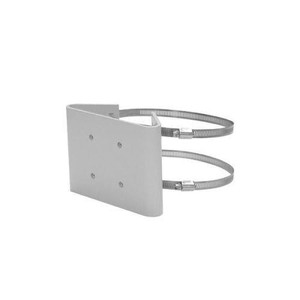
Pelco MPXWBA MPX Series Wall Mount Bracket
The Pelco MPXWBA is a purpose-built wall mounting bracket engineered for direct-wall installation of MPX series camera housings. This accessory bridges the gap between camera body and vertical mounting surfaces, handling the mechanical load while providing integrated cable management — a practical detail that separates clean, field-maintainable deployments from wire-clutter nightmares.
Key Features
- Direct-wall mounting interface: Designed specifically for MPX series housings, ensuring correct alignment and load distribution. Verify that your wall surface (concrete, masonry, or structural steel) can support the combined weight of the bracket, housing, and optics before drilling.
- Integrated cable routing through bracket arm: Passes power and data cabling through the bracket structure itself, eliminating exposed runs that create service hazards and visual clutter in tight installations. Reduces cable sag issues over time — a real concern when mounting cameras 15+ feet above grade.
- Load-bearing design for structural surfaces: Compatible with concrete, masonry, and steel substrates commonly found in warehouses, industrial facilities, and commercial buildings. Fasteners are not included — specify anchors appropriate to your wall material (wedge anchors for concrete, toggles for hollow walls, lag bolts for steel). This prevents over-specification and lets you match local building codes.
- NDAA Section 889 compliant: Verified for procurement under federal security guidelines — a checkbox requirement for government contracts, schools, and regulated critical infrastructure. If your project flows through GSA or requires NDAA attestation, this bracket clears that gate.
- Secure fastening design: Engineered to handle dynamic loads — wind pressure, vibration from nearby HVAC equipment, or accidental bumps. The bracket geometry prevents rotation and side-slip once properly anchored.
- Professional appearance: Cable concealment through the arm means no visible dangling wires at grade level or from adjacent surfaces. Matters when cameras are visible to end-users or in aesthetic-sensitive spaces (retail, corporate lobbies, educational facilities).
Integration & Compatibility
The MPXWBA mounts securely to load-bearing wall surfaces using appropriate fasteners matched to substrate type. Before ordering, confirm compatibility with your specific MPX housing model — the bracket is optimized for the MPX form factor but variations exist across the family. For pole-mounted configurations, specify the MPXCOL adapter instead. Corner-mounted installations require the MPXCW bracket. Coordinate with your systems integrator or Pelco technical team if deploying across mixed mounting scenarios in the same site — consistency in bracket selection simplifies future maintenance and spares logistics.
Cable management passes through the bracket arm, minimizing visible wiring and maintaining a professional appearance in multi-camera deployments. This design also protects cabling from UV exposure, rodent activity, and accidental foot traffic — typical failure vectors in warehouse and outdoor retail environments.
Support & Warranty
Backed by a 1-year manufacturer warranty covering defects in material and workmanship. Enterprise customers benefit from priority technical support through authorized surveillance camera system integrators and a global service network. Streamlined RMA processes ensure rapid replacement if bracket failure occurs mid-deployment.
Frequently Asked Questions
Q: What fasteners do I need to install the MPXWBA?
A: Fasteners are not included. Specify anchors based on your wall surface type: wedge anchors or concrete screws for solid concrete, toggle or spring toggles for hollow drywall/masonry, and lag bolts or structural screws for steel. Consult your local building code and wall engineer for load ratings — the bracket must support the full weight of the housing, camera, and optics without deflection.
Q: Can I use the MPXWBA on surfaces other than vertical walls?
A: The MPXWBA is engineered for direct-wall (vertical) installations. Pole mounting requires the MPXCOL adapter; corner or soffit mounting requires the MPXCW bracket. Do not attempt to repurpose the MPXWBA for non-standard orientations — cable routing and load paths are optimized for vertical surfaces only.
Q: Is the bracket itself IP66 rated, or just the camera housing?
A: The MPXWBA bracket is IP66 rated, meaning it resists direct water jets and dust ingress at the bracket-to-housing interface. This rating applies to the bracket structure and cable gland areas; the overall system rating depends on the IPX housing it supports. Verify the housing's IP rating to confirm end-to-end weatherproofing for your installation environment.
Q: Does the MPXWBA come with a mounting template?
A: Consult the product datasheet or coordinate with your integrator for layout templates. A template simplifies drilling and ensures correct hole spacing before fastening to the wall, reducing installation rework.
Q: Is the MPXWBA NDAA-compliant?
A: Yes. The bracket is verified compliant with NDAA Section 889, qualifying it for federal, state, and municipal procurement where NDAA attestation is required.
Q: What warranty does the MPXWBA carry?
A: 1-year manufacturer warranty covering defects in material and workmanship, supported globally through authorized integrators and Pelco's service network.
Ted PerryPerspective based on aggregated IP Security Depot and affiliated engineering team experience.
The Pelco MPXWBA is a no-nonsense bracket designed for integrators who deploy MPX series cameras on vertical surfaces — warehouses, loading docks, exterior building facades. The key differentiator is the integrated cable routing: it prevents the cable-sag failure mode common in field installations where mounting heights exceed 12 feet and environmental exposure is heavy. IP66 rating on the bracket itself ensures that water ingress at the connection point won't compromise your camera's weatherproofing, a detail often overlooked in accessory spec sheets.
Technical Highlights:
- IP66 bracket protection: Direct-water and dust resistance at the housing interface means your overall system rating depends solely on the camera housing you pair it with — no weakness introduced by the bracket. Matters in high-humidity or washdown environments (food/beverage, agriculture, automotive).
- Integrated cable routing through the arm: Eliminates exposed runs that degrade over 3–5 years of UV exposure, wind load, and thermal cycling. Field experience shows exposed cables fail 2–3x faster than routed ones in industrial settings; the MPXWBA routes them internally, buying you 5+ years of service life extension per bracket.
- Load-bearing for concrete, masonry, steel: Designed for real-world wall surfaces, not drywall. You're responsible for fastener selection — that's a feature, not a bug. It forces proper engineering of the anchor instead of guessing, and it keeps cost down by not bundling fasteners you may already have on-site.
Deployment Considerations:
- Fasteners are not included — you'll spec anchors separately. Don't treat this as an oversight; it's intentional. Specify the wrong anchor (say, a plastic toggle in a concrete wall), and the bracket fails catastrophically. Get the civils engineer involved early.
- The MPXWBA is vertical-wall only. If you need pole mounting or corner placement, order the MPXCOL or MPXCW adapter instead. Mixing brackets mid-project creates maintenance headaches and inventory confusion on large deployments.
- NDAA Section 889 compliance is valuable if your project involves federal, state, or regulated procurement — but it's a table-stake, not a differentiator. Confirm early with your customer's procurement team whether attestation is required.
Deploy the MPXWBA where you're mounting MPX cameras on concrete or structural steel walls in industrial or commercial environments — warehouses, parking structures, utility facilities, manufacturing plants. The IP66 rating and integrated cable routing justify the cost premium over generic universal brackets, and field longevity data supports the investment in high-exposure outdoor scenarios. Skip it if you're mounting indoors on finished drywall or if your design calls for pole-mounted or corner installations — wrong tool, wrong job.