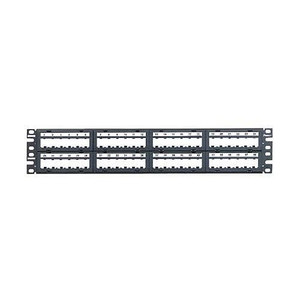
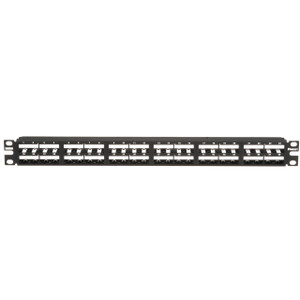
Panduit CPPA48HDWBLY Mini-Com 48-Port Angled Modular Patch Panel
The Panduit CPPA48HDWBLY delivers maximum port density in minimal rack space with its 1U angled design that accepts 48 Mini-Com modules. The angled configuration improves cable management and reduces strain on terminations by creating a more natural bend radius at the port interface. Built on a cold-rolled steel chassis with black finish, this flush-mount panel supports both 19-inch and 23-inch rack installations. Whether you're building out a new IDF closet, consolidating legacy infrastructure, or deploying a new data center row, this modular platform gives you the flexibility to deploy any combination of copper, fiber, or A/V connectivity in a single consolidated panel.
Key Features
- 48-port capacity in 1U footprint maximizes rack space efficiency
- Angled port orientation improves cable management and reduces bend stress
- Modular Mini-Com design supports copper, fiber, and A/V modules in any combination
- Cold-rolled steel construction provides structural rigidity under full load
- Flush-mount design compatible with 19-inch EIA and 23-inch telecom racks
- Black powder-coat finish integrates with modern rack aesthetics
- Tool-free module insertion and removal for field reconfiguration
- RoHS compliant for environmentally conscious installations
The angled design is the key differentiator in the CPPA48HDWBLY. Unlike traditional flat patch panels where cables make sharp 90-degree bends immediately at the termination point, the slanted port orientation creates a gradual transition from horizontal cable routing to vertical drops. This reduces mechanical stress on both the cable jacket and the termination itself—critical when you're running Category 6A or fiber where maintaining proper bend radius directly affects performance and TIA/EIA compliance. The 1.72-inch (43.68mm) overall height gives you adequate depth for the angled plane while still fitting within a standard 1U space, and the geometry naturally directs cables toward the front of the rack rather than forcing them to kink backward toward cable management rings.
The cold-rolled steel chassis is engineered to support fully loaded installations without flexing or bowing. When you populate all 48 ports and connect patch cables, you're applying significant lateral force every time a cable is seated or removed. Lesser panels with thin stamped-steel construction will develop a convex bow over time, making the outer ports difficult to access and creating stress concentrations at the mounting points. Panduit's CRS material specification ensures the panel maintains its geometry even in high-churn environments where MACs (moves, adds, changes) happen daily. The flush-mount design means the panel sits cleanly within the rack plane with no front overhang—important when you're working in tight rows, two-post relay racks, or enclosed cabinets where every millimeter of clearance matters.
The modular Mini-Com architecture is where this panel's flexibility becomes apparent. Each of the 48 positions accepts any Mini-Com module in Panduit's catalog, including RJ45 copper keystones (Category 5e, 6, 6A, shielded and unshielded), LC and SC fiber adapters (single-mode and multimode), BNC for video, F-connector for coax, HDMI, DisplayPort, USB, and even blanks for future expansion. This means you can build out a panel that matches the exact requirements of your installation rather than being constrained by a pre-terminated configuration. A typical deployment might include 40 copper ports for data and PoE, 6 fiber ports for uplinks, and 2 BNC ports for legacy analog cameras—all in a single panel.
In converged network environments where IP surveillance, access control, Wi-Fi, and traditional data all run over the same structured cabling system, this modularity is essential. You're not maintaining separate patch panels for copper and fiber, or separate blocks for A/V and data. Everything terminates in a unified panel that simplifies documentation, reduces rack space consumption, and makes troubleshooting more straightforward. When you need to add a fiber uplink or convert a copper port to fiber, you pull the existing module and snap in the new one—no panel replacement, no re-termination of adjacent ports, no downtime.
Each Mini-Com module seats into the panel without tools. The module's spring-clip mechanism locks it into the panel opening with a positive click, and extraction requires only a small flat-blade screwdriver or the Panduit extraction tool to depress the retention tab. This tool-free installation matters when you're populating a panel in the field or making changes after installation. There's no need to carry a nut driver, mounting screws, or special brackets—the modules are the mounting hardware. The openings are numbered for port identification, and the black finish provides high contrast for white or colored labels.
From a density planning perspective, fitting 48 ports into 1U is about more than just conserving rack space—it's about maintaining proper separation between active and passive layers in your infrastructure. In a typical IDF, you'll have network switches, patch panels, horizontal cable management, and possibly PoE injectors or media converters. Every rack unit you save on patch panels is a rack unit you can allocate to switching, cable management, or future growth. The CPPA48HDWBLY's 48-port density means you can support a full 48-port switch with a single patch panel, maintaining a clean one-to-one relationship that simplifies documentation and port tracing.
The 19-inch width fits standard EIA-310 racks, which are ubiquitous in enterprise and commercial installations. The panel also accommodates 23-inch telecom frames, which are common in carrier facilities, central offices, and older enterprise installations. This dual compatibility is valuable when you're working in mixed environments or retrofitting legacy infrastructure. The mounting hole pattern follows industry-standard spacing, and the panel ships with cage nuts and screws for immediate installation. The flush-mount design ensures the front edge of the panel aligns with the front edge of the rack rail, creating a clean vertical plane across multiple panels and switches.
For integrators managing large-scale rollouts—multi-floor office buildings, campus networks, retail chains, or hospitality properties—the modular approach simplifies inventory and logistics. Instead of stocking pre-terminated panels in every conceivable port count and connector type, you maintain a supply of blank CPPA48HDWBLY panels and individual Mini-Com modules. When you arrive at a site, you configure each panel to match that location's specific requirements. An IDF serving a high-density office floor might get 48 copper ports. An IDF serving a warehouse with sparse drops might get 24 copper ports and leave 24 positions blank for future expansion. An MDF with fiber uplinks might get a mix of 36 copper and 12 fiber. This configure-to-order approach reduces inventory carrying costs and eliminates the risk of deploying the wrong panel configuration.
The black powder-coat finish serves both aesthetic and practical purposes. Aesthetically, black is the dominant color in modern rack equipment—switches, routers, PDUs, and cable management are almost universally black, and a black patch panel integrates seamlessly into this environment. Practically, the dark finish helps conceal dust, fingerprints, and wear that accumulate in high-traffic telecom rooms. It also provides high contrast for white or yellow cable labels, making port identification easier during troubleshooting or MAC work. The finish is durable enough to resist chipping during installation and handling.
Cable management integration is straightforward with the angled design. The slanted port orientation naturally directs cables toward the front of the rack, where horizontal cable management rings or D-rings are typically installed. This means you're not forcing cables to make a sharp backward bend to reach the management hardware—they flow naturally from the port to the ring. When you're dressing a rack with 48 patch cables, this natural flow reduces the time required to achieve a clean installation and makes it easier to maintain bend radius compliance for Category 6A and fiber. The panel's 1.72-inch depth provides adequate clearance behind the ports for the module bodies and cable terminations without pushing cables into the equipment mounted in the rack unit below.
RoHS compliance ensures the panel meets European Union restrictions on hazardous substances, which increasingly matter in corporate and institutional environments with sustainability mandates. RoHS compliance means the panel is free of lead, mercury, cadmium, hexavalent chromium, and certain flame retardants, making it easier to dispose of or recycle at end of life. Many enterprise procurement departments now require RoHS compliance as a baseline specification, and the CPPA48HDWBLY meets that requirement without compromise in performance or durability.
Installation is straightforward for technicians familiar with rack-mount hardware. The panel ships with mounting screws and cage nuts. You insert the cage nuts into the square mounting holes on the rack rails at the desired 1U position, align the panel's mounting ears with the installed cage nuts, and drive the screws. The panel's weight when empty is minimal, so a single technician can handle installation. Once mounted, you populate the panel with Mini-Com modules—either pre-terminated modules brought to the job site or blank modules that you'll terminate on-site. Panduit's Mini-Com modules accept 110-style punch-down terminations for copper, so you can use standard punch-down tools for field termination.
For long-term reliability, the cold-rolled steel construction is the critical factor. Patch panels are subjected to repeated mechanical stress—cables inserted and removed, technicians leaning on the rack, equipment vibration from adjacent active components. A panel that flexes or bows under this stress will develop intermittent connection issues as the modules shift in their openings or as mounting screws loosen. The CPPA48HDWBLY's CRS chassis resists this flex, maintaining its geometry over years of service. The black finish is bonded to the steel, not merely painted on, so it resists chipping and wear even in high-traffic environments.
The CPPA48HDWBLY is built to Panduit's commercial-grade specifications and ships with manufacturer warranty. For network installations where uptime, performance, and future flexibility are non-negotiable, this panel delivers the mechanical design, modularity, and density required to support evolving connectivity demands. The angled port orientation's cable management advantage becomes more pronounced as port density increases—48 ports means 48 opportunities for cable kinks and bend radius violations if the panel geometry isn't optimized. Panduit's engineering addresses this at the hardware level, giving you a platform that supports best-practice installations whether you're building out a new facility or upgrading legacy infrastructure to current standards.