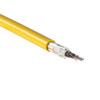
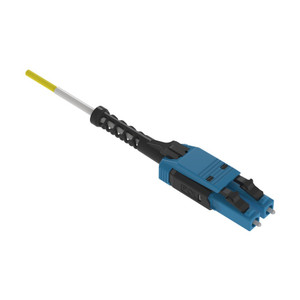
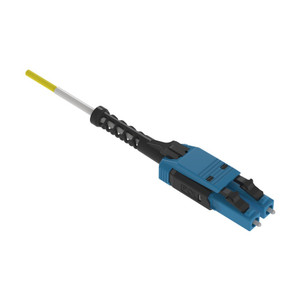
Panduit FFCDBX432-28M OS2 432-Fiber Indoor/Outdoor Cable OFNR-LSZH CPR Cca Flexible Ribbon, MT, 28m
The Panduit FFCDBX432-28M Opti-Core® cable delivers 432 fibers of OS2 single-mode capacity in a 28-meter indoor/outdoor rated assembly, purpose-built for high-density datacenter spine links, enterprise campus backbones, and hyperscale aggregation layers where fiber count and space efficiency are critical constraints. This central-tube flexible ribbon design combines OFNR riser and LSZH fire ratings with European CPR Cca-s1b-d1-a1 classification, making it compliant for both North American plenum-adjacent vertical runs and EU-occupied building installations where low-smoke, low-toxicity materials are mandated. The MT (MTP/MPO-compatible) interface supports 12-fiber or 24-fiber breakout configurations, enabling rapid deployment of 10G/40G/100G/400G links without field termination. For network architects planning multi-year capacity expansion or datacenter migrations requiring pre-staged fiber infrastructure, this cable eliminates the need for multiple parallel trunk runs—432 fibers provide enough strand count to support dense leaf-spine fabrics, storage-area-network isolated paths, and out-of-band management networks within a single physical cable route.
Key Features
- 432 fibers of OS2 9/125μm single-mode glass in flexible ribbon array—high strand count for spine aggregation and campus backbone trunking without multi-cable congestion
- OFNR (Optical Fiber Nonconductive Riser) and LSZH (Low Smoke Zero Halogen) dual ratings—meets NEC riser requirements and LSZH occupied-space mandates in single jacket construction
- CPR Euroclass Cca-s1b-d1-a1 classification—European Construction Products Regulation compliant for low flame spread (Cca), limited smoke (s1b), no flaming droplets (d1), and low acidity (a1) in EU building installations
- Flexible ribbon construction—easier handling and tighter bend radius compared to loose-tube or traditional rigid ribbon designs, critical for high-density cable tray and conduit fills
- MT connector interface—factory-terminated for MTP/MPO breakout cassettes, enabling 12-fiber or 24-fiber lane deployment with polarity management and zero field splicing
- Indoor/Outdoor rated jacket—UV-resistant and moisture-sealed for direct-burial conduit transitions, building-entrance pathways, and rooftop cable bridge crossings without splice vaults
- 28-meter length—optimized for floor-to-floor datacenter risers, inter-building campus links under 100 feet, or pre-staged rack-to-MDA (main distribution area) trunk pulls
- Yellow jacket color—industry-standard OS2 single-mode identification for instant visual fiber-type verification during troubleshooting and MAC (moves/adds/changes)
- Central tube design—all fibers housed in single gel-filled or dry loose tube core, reducing jacket diameter and weight compared to multi-tube constructions at same fiber count
- Opti-Core® sub-brand pedigree—Panduit's engineered fiber portfolio with third-party-validated insertion loss, return loss, and mechanical durability specifications
OS2 single-mode fiber is the backbone standard for all transmission distances beyond 550 meters and data rates above 10 Gbps, specified at 9μm core diameter with 1310nm and 1550nm wavelength windows. This cable's 432-fiber capacity represents thirty-six 12-fiber trunks or eighteen 24-fiber trunks when broken out via MT-interface cassettes, sufficient to support a 200-server leaf-spine fabric (assuming 2×100G uplinks per leaf switch with redundant spines) or a 400Gbps core aggregation layer using 8×100G breakout. The flexible ribbon construction—where twelve fibers are loosely bundled in a foldable array rather than rigidly bonded—reduces the minimum bend radius from 20× cable diameter (typical for hard ribbon) to 10-15× diameter, critical when routing high-fiber-count cables through 4-inch cable tray radius bends or 2-inch conduit elbows without exceeding the 0.05% strain limit that causes microbend attenuation. During installation, this translates to tighter turns in congested horizontal pathways and reduced risk of fiber breakage during pulls—rigid ribbon cables often require figure-eight storage loops or service coils to absorb stress, consuming rack space and introducing failure points.
The dual OFNR/LSZH rating addresses two distinct fire-code scenarios: OFNR satisfies NEC Article 770 for vertical riser shafts in North American commercial buildings (where the cable runs between floors but not through air-handling plenums), while LSZH meets the low-halogen emission requirements of IEC 60754-1 and the low-smoke-density limits of IEC 61034, both referenced in European CPR regulations and increasingly adopted in healthcare, transportation, and high-occupancy facilities where toxic fume evacuation is a life-safety concern. The CPR Cca-s1b-d1-a1 classification breaks down as follows: Cca = limited contribution to fire (self-extinguishes when flame source is removed); s1b = smoke production rate under 0.75 m²/s and total smoke production under 150 m² (low-visibility impairment during egress); d1 = no flaming droplets or particles that could ignite secondary materials; a1 = acidity under 2.5 pH and conductivity under 10 μS/mm (minimal corrosive damage to electronic equipment and structural steel). For datacenter operators subject to EU building codes or insurance underwriters requiring CPR-compliant materials, this cable eliminates the need for separate North American and European SKU inventories—one part number covers both regulatory frameworks.
The indoor/outdoor rating extends deployment flexibility to building-entrance pathways, rooftop cable bridges, and inter-building campus links where conduit runs transition between climate-controlled and exterior environments. Traditional indoor-only cables use PVC jackets that become brittle under UV exposure and freeze-thaw cycling; outdoor-only cables use PE (polyethylene) jackets that generate excessive smoke in building fires. This cable's I/O jacket—typically a flame-retardant polyethylene or modified LSZH compound—balances UV resistance (500+ hours per ASTM G154 without cracking), moisture seal (water-blocked central tube prevents wicking), and fire performance (OFNR vertical flame test per UL 1666). For integrators running fiber from a campus MDF (main distribution frame) to a remote building's IDF (intermediate distribution frame) via underground conduit and vertical riser, this single cable type eliminates the splice vault and transition enclosure typically required when joining outdoor-rated and riser-rated segments. The 28-meter length (approximately 92 feet) is pre-sized for common datacenter floor-to-floor heights (12-15 feet with 10-foot service loop), short campus hops under 100 feet, or rack-to-MDA trunk pulls in co-location facilities where cable is routed overhead through ladder rack, down a vertical riser, and into the meet-me room—pulling a single 28m run is faster and less error-prone than field-splicing two shorter segments, and the factory-terminated MT connectors ensure insertion loss under 0.5 dB per mated pair (vs. 0.75+ dB for field-fusion splices).
Panduit Opti-Core cables ship with third-party test reports validating insertion loss (≤0.35 dB typical at 1310nm), return loss (≥55 dB), and polarization accuracy per TIA-568-C.3 and IEC 61753-1 standards, ensuring compatibility with 100GBASE-LR4, 400GBASE-DR4, and emerging 800G coherent optics that require low-loss budgets under 2 dB for 10km campus links. The flexible ribbon architecture simplifies mid-span access for future breakouts—ribbon groups can be separated and re-routed to new cassettes without disturbing adjacent fiber groups, a critical advantage over loose-tube designs where fiber identification requires tone-and-trace or service interruption. For network teams managing long-term fiber inventory, this 432-count cable future-proofs against bandwidth exhaustion: each 12-fiber trunk can be upgraded from 10G (120 Gbps per trunk) to 100G SR4 (400 Gbps per trunk using parallel optics) to 400G DR4 (400 Gbps per trunk using 4×100G lanes) by simply swapping transceivers and breakout cassettes—no new cable pulls, no building-access permits, no after-hours downtime windows. The yellow jacket color-coding aligns with TIA-598-C single-mode fiber identification standards, reducing the risk of accidental cross-connection to multimode (orange/aqua jacket) infrastructure during MAC operations or emergency restoration.