Panduit FFCDBX144-28M 144-Fiber OS2 Indoor/Outdoor Riser Cable
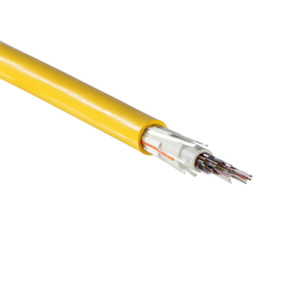
The Panduit FFCDBX144-28M Opti-Core® bulk fiber cable delivers 144 fibers of OS2 single-mode capacity in a flexible ribbon design built for high-density datacenter backbones, campus risers, and inter-building links. Rated for both indoor plenum/riser and outdoor aerial or duct applications, this OFNR-LSZH cable meets CPR Cca-s1b-d1-a1 flammability standards for European and international installations. The MT-compatible ribbon structure supports mass fusion splicing to MTP/MPO connectivity, cutting termination time on 12-fiber trunk deployments by up to 90% compared to simplex fusion. Yellow LSZH jacketing provides low-smoke, low-toxicity performance and instant single-mode identification in mixed-mode environments.
Key Features
- 144 fibers of OS2 9/125µm single-mode in compact central-tube design
- Flexible ribbon construction — 30% smaller bend radius than rigid ribbon, easier routing through crowded pathways
- Indoor/Outdoor rated (I/O) — one cable type for intra-building risers, inter-building campus links, and outside plant duct or aerial runs
- OFNR-LSZH flammability rating with CPR Euroclass Cca-s1b-d1-a1 compliance for EU Code of Practice installations
- MT-compatible ribbon array — direct mass fusion to MTP/MPO cassettes, panels, or trunk cables without individual fiber handling
- Yellow low-smoke zero-halogen jacket — IEC 60332-3C flame test, <0.5% HCl emission, <5% light transmittance per IEC 61034
- 9µm core diameter supports 10G/40G/100G Ethernet, 16G/32G Fibre Channel, and CWDM/DWDM wavelength multiplexing to 100+ km
- Central loose-tube design with water-blocking gel — fiber strain isolation during temperature cycling and mechanical stress
- Panduit Opti-Core® sub-brand — engineered connector compatibility, batch-tested insertion loss ≤0.30 dB typical at 1310/1550nm
- Supplied on bulk reels for custom-length deployments — no pre-term length constraints or factory lead times
OS2 single-mode fiber is the foundation of modern datacenter and campus networks carrying 10GBASE-LR, 40GBASE-LR4, 100GBASE-LR4, and Fibre Channel over distances from 300m to 40km without active regeneration. The 9/125µm core/cladding geometry supports tight wavelength control at 1310nm and 1550nm, enabling CWDM and DWDM multiplexing that scales a single fiber pair to 40+ channels of 10G/100G traffic. This FFCDBX144-28M cable provides 144 fibers in twelve 12-fiber ribbons, matching the industry-standard MTP/MPO connector pinout for plug-and-play compatibility with pre-terminated MTP trunk assemblies, breakout harnesses, and cassette modules. The flexible ribbon design trades the rigid epoxy matrix of traditional ribbon cable for a peelable separable construction — each 12-fiber ribbon can be separated for individual mass fusion operations, and the ribbon array flexes through tight bend radii without fiber buckling or attenuation spikes. Real-world benefit: routing a 144-fiber backbone vertically through a 4-inch j-hook or horizontally through a 2-inch innerduct no longer requires oversized pathway infrastructure or mid-span ribbon damage from overbending.
Indoor/Outdoor (I/O) rating eliminates the traditional handoff between indoor riser cable and outdoor OSP cable at building entry points, reducing splice count and failure points on campus fiber networks. The OFNR flammability rating meets NEC Article 770 requirements for vertical riser shafts and general building spaces, while the UV-stabilized polyethylene outer jacket survives continuous outdoor exposure in aerial lashed spans or innerduct pulls between buildings. Water-blocking gel-filled loose-tube construction isolates individual fibers from longitudinal moisture ingress and provides strain relief during thermal expansion/contraction cycles — critical when a cable transitions from conditioned indoor spaces (20°C) to outdoor aerial runs (summer peak 65°C, winter low -40°C). The LSZH (Low Smoke Zero Halogen) jacket material meets IEC 60332-1-2 flame propagation limits, IEC 60754-1 halogen acid gas emission <0.5%, and IEC 61034-2 smoke density <60% light obscuration — mandatory for installations under NFPA 130 (rail/transit), EN 50575 (EU Construction Products Regulation), or Euroclass CPR Cca-s1b-d1-a1 (limited flame spread, low smoke, no flaming droplets/particles). Practical implication: a single FFCDBX144-28M cable run can originate in a basement datacenter riser, transition through a building penetration to outdoor aerial cable tray, span 500 meters to an adjacent building, and terminate in that building's communications room — all without splicing to separate indoor/outdoor cable types or violating fire/safety codes in either environment.
MT ribbon termination is the mass fusion equivalent of MPO connectivity — instead of manually cleaving, stripping, and fusion-splicing 144 individual fibers (8–12 minutes per splice × 144 = 19–24 hours labor), a fusion splicer with MT ribbon clamp can align and fuse an entire 12-fiber ribbon array in a single 90-second cycle (12 ribbons × 90 seconds = 18 minutes total fusion time). When paired with Panduit FAP pre-terminated MTP cassette panels or FMT MTP trunk assemblies, the FFCDBX144-28M becomes a plug-and-play backbone: pull cable, mass-fuse the 12 ribbons to a fanout MTP module, insert module into patch panel, done. This workflow matches the speed and repeatability of pre-terminated copper trunk systems while preserving the distance and bandwidth advantages of single-mode fiber. The yellow LSZH jacket color aligns with TIA-598-C and IEC 60304 standards for OS2 single-mode identification, preventing accidental cross-connection with OM3/OM4 multimode (aqua) or OM5 (lime green) cables during adds/moves/changes. Panduit's Opti-Core sub-brand guarantees insertion loss ≤0.30 dB and return loss ≥50 dB at 1310nm/1550nm when fusion-spliced per Panduit TIA-758 guidelines, backed by batch Certificate of Compliance test data.