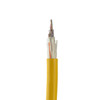
Panduit FFCDBX288-28M Opti-Core OS2 288-Fiber Indoor/Outdoor Cable
The Panduit FFCDBX288-28M delivers 288 fibers of OS2 single-mode capacity in a flexible ribbon design engineered for high-density datacenter backbone and campus trunk deployments. This 28-meter cable carries dual OFNR (riser) and LSZH ratings alongside European CPR Cca-s1b-d1-a1 certification, allowing a single cable assembly to transition from outdoor conduit entry points through indoor vertical risers to equipment rooms without splicing or break-out boxes at building penetration points. Flexible ribbon construction inside the central loose tube enables tighter bend radii than traditional rigid ribbon cables—critical when routing through congested cable trays, around structural steel, or into high-density patch panels where every inch of service loop matters. The MT (Mechanical Transfer) interface maps to industry-standard MPO and MTP trunk connectors, supporting 12-fiber or 24-fiber breakout cassettes for 40GBASE-SR4, 100GBASE-SR4, or 400G parallel optics architectures. Yellow jacket color follows TIA-598-C identification standards for single-mode OS2 fiber, reducing mis-patching risk during moves-adds-changes in multi-mode/single-mode mixed environments.
Key Features
- 288 fibers of OS2 9/125μm single-mode cable in flexible ribbon architecture—handles up to 10 km link distances at 10G, 40 km at 1G, or 40G/100G datacenter interconnects without mode conditioning
- Dual indoor/outdoor rating (I/O) with OFNR riser and LSZH flame certification—single cable type spans from outside plant conduit through building risers to equipment rooms, eliminating splices at building entry points and reducing labor cost
- European CPR Cca-s1b-d1-a1 fire classification meets Euroclass Construction Products Regulation for international datacenter projects, hyperscale builds, and colocation facilities with EU code compliance requirements
- Flexible ribbon tube construction allows 15× fiber diameter bend radius vs. 20× for rigid ribbon—routes through congested ladder rack, tight 90° vertical-to-horizontal transitions, and dense patch panel service loops without fiber stress or attenuation spikes
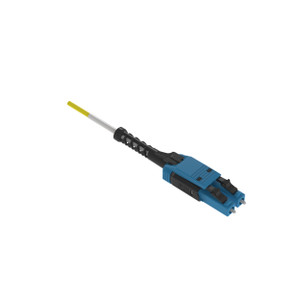
- MT mechanical transfer interface compatible with MPO/MTP-12 and MPO/MTP-24 trunk connectors—supports factory-terminated trunk assemblies, breakout cassettes, or fusion splice fanouts to LC/SC duplex connections
- LSZH jacket compound emits minimal smoke and zero halogenated acids during fire exposure—protects personnel in enclosed telecommunications rooms, under raised floors, and in air-handling ceiling spaces per NFPA 90A combustion product limits
- Yellow jacket per TIA-598-C single-mode color coding—prevents accidental cross-connection to 50/125μm OM3/OM4 multi-mode infrastructure during MAC work or emergency restoration
- 28-meter factory length pre-measured for specific datacenter row-to-MDA trunk runs—reduces field measurement errors, cut-to-length waste, and on-site termination labor compared to bulk reel deployment
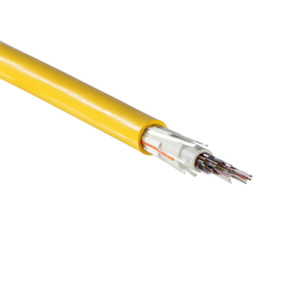
OS2 single-mode fiber supports 9μm core diameter with <0.4 dB/km attenuation at 1310 nm and <0.3 dB/km at 1550 nm, meeting ITU-T G.652.D low-water-peak specifications for CWDM and DWDM wavelength multiplexing. The 288-fiber count provides twelve 24-fiber groups or twenty-four 12-fiber groups when broken out to MPO trunk connectors—enough capacity for 24× 100GBASE-LR4 links (2,400 Gbps aggregate) or 288× 10GBASE-LR point-to-point connections in a single cable pathway. Flexible ribbon construction layers twelve 24-fiber ribbons inside a single loose tube filled with water-blocking gel compound; ribbons can be separated and routed individually during breakout or splicing operations, unlike rigid ribbon cables that require specialized mass-fusion splicers and cannot accommodate partial-count breakouts in the field. This flexibility matters when phasing datacenter build-outs—initial deployment might use 96 fibers for three spine switches, with the remaining 192 fibers reserved for future leaf switch expansion without pulling additional backbone cables.
The dual OFNR-LSZH rating addresses a common specification conflict in enterprise and colocation builds: outdoor-rated cables typically carry CMX or direct-burial jackets that fail NEC riser flame tests, forcing installers to splice from outdoor cable to indoor-rated cable at the building entrance. The FFCDBX288-28M eliminates that splice point by carrying both ratings in a single jacket—outdoor UV resistance and moisture blocking for conduit runs up to the building penetration, plus OFNR vertical riser flame spread performance and LSZH combustion properties for the indoor portion. This cuts installation time by 4–6 hours per trunk run (no splice closure hardware, no fusion splicing labor, no OTDR testing at the splice joint), reduces point-of-failure count, and simplifies as-built documentation. The CPR Cca-s1b-d1-a1 certification adds European fire classification per EN 13501-6: Cca flame spread, s1b smoke production, d1 flaming droplets, and a1 acidity. Colocation providers and hyperscale operators with European datacenter footprints specify CPR-compliant cable to meet local building authority inspections; using a single global cable part number across US and EU sites reduces procurement complexity and on-site inventory.
Central loose-tube construction protects the fiber ribbons inside a single large-diameter tube filled with water-blocking gel, surrounded by aramid yarn strength members and the outer LSZH jacket. This design isolates the glass fibers from jacket stress—thermal expansion, pulling tension during installation, and long-term building movement don't transfer to the fiber because the ribbons float inside the gel-filled tube. The result is stable attenuation performance across temperature swings (-40°C to +70°C operating range) and resistance to microbending loss that can plague tight-buffered designs in outdoor environments. Aramid yarn (Kevlar-type) strength members handle up to 2,700 N (600 lbf) pulling tension during installation—sufficient for 100-meter conduit pulls with multiple 90° bends—without transferring strain to the fiber. Yellow LSZH jacket material resists UV degradation for up to two years of aerial or above-ground exposure before final burial or building entry, providing installation schedule flexibility in phased construction projects.
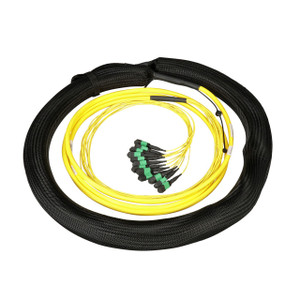
MT interface alignment uses two guide pins and a rectangular ferrule to position twelve or twenty-four fibers in a single connector body, achieving <0.35 dB insertion loss per mated pair when used with MPO or MTP brand connectors. This interface dominates high-density datacenter applications because it replaces twelve LC duplex connections (24 connectors, 24 alignment sleeves, 24 potential dirty-endface failures) with a single MPO-12 plug—reducing patch panel port count by 12:1 and cutting cleaning/inspection time proportionally. Trunk-and-breakout architecture is the standard deployment model: the 288-fiber backbone cable terminates to twelve MPO-24 connectors at each end (or twenty-four MPO-12 connectors), then breakout cassettes in the patch panel convert each MPO-24 to twenty-four LC simplex ports for connection to switch optics. This keeps the backbone cable intact as a permanent infrastructure element while allowing easy breakout reconfiguration—swapping a 12-fiber breakout cassette for a 24-fiber version takes 30 seconds and doesn't require re-terminating the backbone.
The 28-meter length suits specific datacenter topology use cases: main distribution area (MDA) to horizontal distribution area (HDA) trunk runs in TIA-942 Rated-3 or Rated-4 datacenters typically span 20–25 meters accounting for vertical riser distance, horizontal cable tray routing, and 1.5-meter service loops at each end. Custom lengths eliminate the waste and labor cost of cutting bulk cable to fit—no field measurement errors, no scrap fiber, no on-site termination labor. Installers stage the cable on pulling reels, attach pulling grip to the aramid strength member, and pull through conduit or cable tray in a single operation. Factory termination quality is another advantage: Panduit's automated MT ferrule polishing and endface geometry control delivers consistent <0.35 dB insertion loss and <-40 dB return loss across all 288 fibers, whereas field termination quality depends on technician skill level and site conditions. Pre-terminated assemblies also carry full factory warranty coverage on fiber performance; field-terminated cables shift performance risk to the installer and often require OTDR certification testing that factory cables don't.
This cable integrates into structured cabling systems designed around EN 50173 or TIA-568 backbone specifications, supporting IEEE 802.3 10GBASE-LR/ER/ZR, 40GBASE-LR4, 100GBASE-LR4/ER4, and 400GBASE-LR8 Ethernet standards as well as 16G/32G Fibre Channel storage networks. It pairs with Panduit's FMT cassette modules, FHD high-density panels, and NKFP fiber enclosures in a complete Opti-Core ecosystem—or integrates with third-party MPO infrastructure from Corning, CommScope, or Leviton using MT-compliant MPO adaptors. Typical deployment includes OTDR acceptance testing per TIA-526-7 to verify <0.35 dB per connector, <0.3 dB/km fiber attenuation, and <-40 dB return loss, with results documented in as-built records for future troubleshooting. The flexible ribbon design and dual I/O rating make this cable the backbone choice for network architects balancing high fiber density, installation labor cost, and future-proof capacity in datacenter, campus, and colocation builds where a single cable path must serve both outdoor and indoor environmental demands.