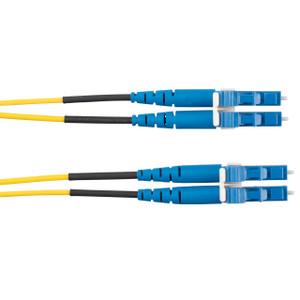
Panduit F92RLU1U1ONM004 Opti-Core OS2 LC Duplex Fiber Patch Cord, 4m, LSZH
High-density fiber deployments demand connectors that conserve front-panel real estate, cables that meet fire-safety codes, and insertion loss tight enough to preserve your link budget across 40G/100G/400G optics. The Panduit F92RLU1U1ONM004 Opti-Core patch cord addresses all three: LC Duplex Uniboot pull-boot connectors cut port footprint in half, LSZH jacketing satisfies IBC Chapter 8 plenum and riser requirements, and factory-optimized insertion loss (<0.15 dB typical) keeps attenuation below the threshold where you'd need to add a dB to your loss budget. At 4 meters, this yellow OS2 single-mode jumper fits the sweet spot for rack-to-rack or intra-rack cross-connects in datacenters, telecom rooms, and enterprise MDFs where every tenth of a dB and every square inch of panel space counts.
Key Features
- OS2 Single-Mode Fiber (9/125 μm): Supports 10G/40G/100G/400G transmission over distances up to 10 km (10GBASE-LR), 40 km (10GBASE-ER), or 80 km (100GBASE-ER4) depending on optics, making it the de facto standard for campus backbone, datacenter interconnect, and carrier aggregation links.
- LC Duplex Uniboot Pull-Boot Connectors: Uniboot design consolidates two fibers into a single boot assembly, reducing the connector footprint by approximately 50% compared to traditional duplex LC. Pull-boot tabs allow tool-free removal and polarity reversal in seconds—no need to re-terminate or swap patch panels.
- Optimized Insertion Loss (<0.15 dB Typical): Factory-polished to sub-0.15 dB ensures you won't blow your link budget on short jumpers. Critical when you're chaining multiple cassettes, cross-connects, or long backbone runs where every 0.1 dB matters.
- LSZH (Low Smoke Zero Halogen) Jacket: Meets IBC Chapter 8 plenum (CMP) and riser (CMR) flammability requirements without releasing corrosive halogen gases during combustion. Mandatory for installations in air-handling spaces, vertical risers, and European CENELEC EN 50575 Cca/B2ca environments.
- 2.0 mm Cable Diameter: Slimmer than legacy 3.0 mm zip-cord, the 2.0 mm jacket reduces bundle cross-section by ~55%, easing pathway congestion in ladder rack, overhead cable tray, and vertical managers.
- 4 Meter Length (13.12 ft): Optimized for adjacent-rack cross-connects in 42U cabinets or equipment-distribution-area (EDA) patching. Long enough to route cleanly through vertical managers and cross aisles; short enough to avoid excess coil accumulation.
- Yellow Jacket Color: Industry-standard TIA-598-C color code for OS2 single-mode fiber, preventing accidental cross-patching with OM3/OM4 multimode (aqua) or OM5 (lime green) jumpers.
- Factory Terminated & Tested: Pre-connectorized to TIA-604-3 (FOCIS-3) and TIA-604-10 (FOCIS-10) physical-contact polish specifications. Each jumper ships with insertion-loss and return-loss test data, eliminating field-termination labor and the risk of contaminated end-faces.
- RoHS Compliant: All materials and manufacturing processes conform to EU Directive 2002/95/EC, ensuring the patch cord can be imported, installed, and disposed of in RoHS-enforcing jurisdictions without exemption paperwork.
Why Uniboot Pull-Boot Matters in 2026 Datacenter Builds: Traditional duplex LC connectors occupy two side-by-side ports and require a clip tool or fingernail to unlatch. In a 144-port 1U cassette, that translates to 288 latches in a 19-inch width—dense enough that adjacent connectors physically interfere, making moves and changes a fingertip nightmare. Panduit's Uniboot design consolidates the two LC ferrules into a single molded boot, cutting the physical footprint in half and exposing pull-tabs that unlatch without tools. More importantly, the Uniboot boot is reversible: if you discover a polarity error during turn-up, you pull the boot off, rotate the duplex connector 180°, and reinsert—no patch-panel re-punch, no truck roll for a new jumper. For large-scale 400G spine-leaf fabrics where you're patching hundreds of links per deployment, Uniboot's space savings and polarity-flip capability can shave hours off installation time and eliminate an entire class of field termination errors.
Optimized Insertion Loss and What It Buys You: Panduit's Opti-Core line uses precision ceramic ferrules, controlled end-face geometry (8° APC or physical-contact PC depending on SKU—this SKU is PC), and factory-grade polishing to achieve <0.15 dB insertion loss on every mated pair. In contrast, field-terminated connectors often land in the 0.3–0.5 dB range, and low-cost offshore patch cords can hit 0.5–0.75 dB due to ferrule eccentricity or contaminated end-faces. That difference matters when you're running 10GBASE-LR over 9 km of outside plant: a 0.5 dB jumper at each end plus 0.35 dB/km fiber attenuation puts you at 4.15 dB total loss, right at the edge of the 10GBASE-LR 4.5 dB budget. Swap in Panduit's <0.15 dB jumpers and you drop to 3.45 dB, leaving 1 dB of margin for splices, future adds, and aging. For 40G/100G BiDi optics where the loss budget can be as tight as 1.5 dB, every tenth counts—using premium patch cords isn't a luxury, it's the difference between a link that passes BERT and one that flaps under load.
LSZH Jacket Chemistry and Code Compliance: LSZH compounds replace PVC's chlorine content with flame-retardant metal hydroxides (typically aluminum trihydrate or magnesium hydroxide). During combustion, these hydroxides release water vapor instead of hydrochloric acid, drastically reducing smoke opacity and corrosive gas emissions. The International Building Code (IBC) Chapter 8 and NFPA 70 (NEC) Article 770 permit LSZH cables in plenum (air-handling) spaces as a CMP-rated alternative to fluoropolymer jackets, and the European Construction Products Regulation (CPR) EN 50575 mandates Cca or B2ca ratings for permanent installations in public buildings. For datacenter operators running fiber through underfloor or overhead plenums, LSZH isn't optional—it's the only jacket type that satisfies both fire marshals and insurance underwriters. Panduit's LSZH formulation on this patch cord carries the CMP equiv rating, meaning you can route it through HVAC return plenums, vertical shafts, and ceiling spaces without pulling a code variance.
Deployment Context: Where 4-Meter OS2 LC Jumpers Fit: In a typical datacenter, the 4-meter length bridges adjacent cabinets in the same row (cabinet pitch is usually 1.2–1.5 m, so two cabinets apart = ~3 m of horizontal run + vertical slack). You'll deploy these jumpers for equipment-distribution-area (EDA) cross-connects between top-of-rack switches and spine switches in the next cabinet, for horizontal-distribution-area (HDA) patching from cassettes to active gear, or for main-distribution-area (MDA) backbone cross-connects where fiber enters the room on a wall-mount termination field and patches 2–3 meters across to the core router rack. The yellow jacket follows TIA-598-C convention for OS2 single-mode, preventing the all-too-common mistake of plugging a 10GBASE-SR multimode transceiver (aqua OM3 jumper) into a single-mode port and wondering why the link won't come up. In telecom central offices, 4-meter jumpers handle cross-connects between DWDM mux shelves and ODF panels, or between IP edge routers and the carrier handoff rack. The Uniboot form factor shines in these environments because CO equipment frames often have 288-fiber or 576-fiber density—trying to manage that with traditional duplex LC connectors results in a tangled mess; Uniboot's single-boot profile and pull-tab release keep the install clean and changes fast.
Standards Compliance and Factory Testing: Every Panduit Opti-Core patch cord is manufactured to ISO/IEC 11801 (generic cabling for customer premises), TIA/EIA-568-C.3 (optical fiber cabling components), TIA-604-3 (FOCIS-3, the SC/LC/MU connector interface standard), and TIA-604-10 (FOCIS-10, the MPO/MTP interface standard where applicable). Factory testing includes insertion loss and return loss across all mated pairs, with results logged and available on request for projects that require submittal documentation (think GSA federal builds, LEED-certified datacenters, or tier-III/IV Uptime Institute audits). This level of pre-ship validation eliminates the field-testing step that field-terminated connectors require—no need to rent an OTDR or light source/power meter, no need to re-polish a connector that fails initial insertion-loss checks. You unbox, verify the serial number matches your cut sheet, patch it in, and move on. For large deployments (500+ links), the labor savings alone can justify the premium over commodity patch cords, and the reduced failure rate (Panduit's factory reject rate is <0.1% vs. 2–5% for field terminations) means fewer truck rolls and faster turn-up.
Choose the Panduit F92RLU1U1ONM004 Opti-Core patch cord when your fiber infrastructure demands the trifecta of high density, low loss, and code-compliant materials. The LC Duplex Uniboot connector saves panel space and simplifies polarity management, the factory-optimized <0.15 dB insertion loss preserves your link budget for 10G/40G/100G optics, and the LSZH jacket satisfies IBC CMP and EN 50575 Cca fire-safety requirements without releasing corrosive smoke. Backed by Panduit's quality assurance and comprehensive test documentation, this 4-meter single-mode jumper is the professional-grade interconnect solution for datacenter equipment distribution, telecom cross-connects, and enterprise backbone patching where performance and compliance are non-negotiable.