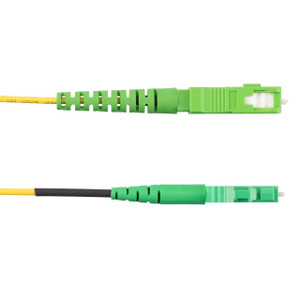
Panduit F92ELB1LNSNM015 Opti-Core OS2 Single-Mode Fiber Patch Cord
The Panduit F92ELB1LNSNM015 is a 15-meter OS2 single-mode fiber optic patch cord with LC/APC green connectors on one end and standard LC duplex on the other, built for long-haul datacenter, campus backbone, and security NVR uplinks. Part of Panduit's Opti-Core™ line, it uses 9/125μm OS2 fiber in a slim 1.6mm LSZH jacket—critical for plenum spaces and high-density rack environments where fire safety and cable management matter. The LC/APC angled connector reduces back-reflection for sensitive optical links, while the yellow jacket follows TIA-598-C color coding for single-mode fiber. At 49 feet, it handles inter-rack, cross-room, or building riser runs where standard copper falls short.
Key Features
- OS2 single-mode fiber rated for 10G/40G/100G over distances to 10km+ (far beyond this cable's length)
- LC/APC (angled physical contact) green connector on one end minimizes return loss to -60dB or better
- 1.6mm LSZH (Low Smoke Zero Halogen) jacket meets IEC 60332-1 and 60754 for enclosed-space safety
- 15-meter (49.2 ft) length bridges rack rows, cross-aisle uplinks, or floor-to-ceiling riser conduit
- Duplex 2-fiber design supports bidirectional 1GbE/10GbE links or redundant path routing
- Yellow jacket and green APC boot conform to TIA-598-C fiber identification standards
OS2 fiber is the workhorse of modern datacenters—9/125μm core/cladding dimensions support single-mode transmission at 1310nm and 1550nm wavelengths with insertion loss ≤0.35dB per connector and minimal chromatic dispersion. The LC/APC termination on one end uses an 8° angled polish to deflect back-reflected light into the cladding rather than back to the source, achieving return loss better than -60dB compared to -50dB for flat UPC polish—critical when connecting to DWDM gear, high-sensitivity IP camera encoders, or PON OLT equipment where reflection noise degrades BER. The opposing end uses standard LC duplex (UPC polish assumed), allowing direct mating with most SFP+/QSFP28 transceivers, media converters, and fiber patch panels without adapter hassle. At 1.6mm outer diameter, the cable routes easily through 1U horizontal managers, vertical D-rings, and 19mm innerduct without the stiffness of older 3mm zip-cord designs, and the LSZH jacket limits toxic smoke and corrosive halogen gas in fire scenarios—a requirement in occupied buildings, above drop ceilings, and air-handling plenums per NFPA 90A.
Deploy this cord when copper can't close the distance or bandwidth demand: backbone links between distribution switches in different server rows, uplinks from IP camera PoE switches to a core router two racks away, or fiber runs from a security NVR to a remote SAN array where 10GbE iSCSI or NFS traffic needs low latency and zero EMI risk. The 15-meter length is long enough for cross-room horizontal runs or short vertical riser pulls without splice points, yet short enough to avoid the coil management problem that plagues 30m+ cords in tight spaces. Because one end is APC and the other UPC, this is a conversion patch cord—use it to bridge APC-keyed outdoor fiber distribution (where APC is mandatory to protect against moisture-induced reflection spikes) to UPC-based indoor switch infrastructure. Installers appreciate the duplex LC form factor: it's the industry standard for transceivers, takes half the panel space of SC, and the push-pull tab is easier to release in dense 48-port cassettes than MPO or ST twist-locks. The yellow jacket isn't just aesthetic—it's immediate visual confirmation that the cable is single-mode, preventing the "wrong fiber type" troubleshooting loop when a tech accidentally grabs an orange OM3 cord from the same bag.
Panduit's Opti-Core™ cords ship with factory-terminated connectors and individual insertion-loss test reports in many SKUs, eliminating the field-polish variability that causes intermittent link flaps. LSZH compliance isn't optional in European installations or U.S. transit/airport projects governed by NFPA 130—this cord meets IEC 60332-1 flame propagation and IEC 60754 halogen-free acid gas limits. For integrators pulling dozens of links in a weekend cutover, the 10-pack carton quantity streamlines logistics: order in bulk, keep spares on the truck, and maintain color/length consistency across an entire switch stack without mixing vendors. This isn't a generic "yellow fiber cable"—it's a matched-impedance, factory-certified link component that behaves predictably under OTDR testing and holds up to the 200+ insertion cycles Panduit rates LC connectors for, ensuring your backbone links stay lit through years of moves, adds, and changes.