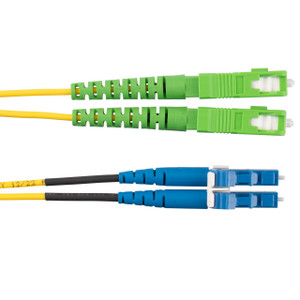
Panduit F91ERANB1SNM015 Opti-Core OS2 Single-Mode Fiber Patch Cord, SC/APC to LC/APC, 15m
The Panduit F91ERANB1SNM015 delivers precision single-mode connectivity for data center, telecom, and enterprise fiber networks. This 15-meter simplex patch cord terminates OS2 9/125µm fiber with SC/APC and LC/APC connectors—both featuring angled-polish end-faces that minimize back reflection to below -60dB, critical for 10G/40G/100G Ethernet, dense wavelength-division multiplexing (DWDM), and analog RF-over-fiber links in security/surveillance installations. The 1.6mm riser-rated (OFNR) cable jacket meets NEC requirements for vertical runs between floors, while the compact diameter simplifies high-density patch-panel routing and reduces bend-radius stress in tight cable trays.
Key Features
- OS2 single-mode fiber (9/125µm) — supports 10GBASE-LR, 40GBASE-LR4, 100GBASE-LR4 at distances exceeding 10 kilometers; backward-compatible with 1G fiber links
- SC/APC and LC/APC connectors — 8° angled polish on both ends eliminates Fresnel reflection, delivering return loss better than -60dB to prevent signal degradation in high-speed and coherent-optical systems
- Riser (OFNR) flame rating — approved for vertical cable runs in non-plenum building spaces per NEC Article 770; self-extinguishing jacket prevents fire spread between floors
- 15-meter length (49.2 feet) — practical for rack-to-rack connections within the same telecom room, cross-connects to an intermediate distribution frame (IDF), or short building riser spans
- 1.6mm cable diameter — 40% thinner than standard 3.0mm cordage; increases usable conduit fill and reduces strain on patch-panel ports in fully populated racks
- Yellow jacket per TIA-598-C — industry-standard color code for OS2 single-mode fiber; prevents accidental cross-connection with OM3/OM4 multimode (aqua) or OM5 (lime green) cables
- Simplex (single-fiber) design — one TX or RX path per cord; pair with a second cord or use BiDi transceivers for full-duplex links
- Factory-terminated by Panduit — connectors polished and inspected under cleanroom conditions; ships with protective dust caps to maintain end-face cleanliness until installation
Why APC matters in modern fiber networks: The 8° angled physical contact (APC) polish on both the SC and LC connectors directs reflected light into the fiber cladding rather than back toward the transmitter. Standard UPC (ultra-polished contact) ferrules achieve -50dB return loss; APC improves this to -60dB or better. For 1000BASE-LX and 10GBASE-LR Ethernet, the difference is marginal—most transceivers tolerate UPC reflection. But three deployment scenarios demand APC: (1) 40G/100G coherent optics, where phase-sensitive modulation schemes (QPSK, 16-QAM) interpret back-reflection as intersymbol interference, raising bit-error rates; (2) DWDM and CWDM systems, where reflected wavelengths can destabilize tunable lasers or create crosstalk between channels; and (3) analog RF-over-fiber links in distributed antenna systems (DAS) or CATV headends, where reflection introduces composite second-order (CSO) distortion. Security integrators running IP cameras over fiber-to-the-edge architectures rarely need APC for camera uplinks, but if the backbone also carries building-wide DAS or planned 100G core switches, standardizing on APC patch cords future-proofs the physical layer. Note that APC and UPC connectors are mechanically incompatible—the 8° angle prevents mating, so you cannot accidentally create a hybrid link (which would incur 10+ dB insertion loss from the air gap).
SC versus LC form factors—choosing the right connector: The SC (Subscriber Connector) uses a 2.5mm ceramic ferrule in a push-pull square body; it was the first widely adopted single-mode connector in telecom (late 1980s) and remains common in carrier central offices, older enterprise cross-connects, and as the physical-layer medium-dependent interface (PMD) for many 1G/10G SFP+ modules. LC (Lucent Connector or Little Connector) uses the same 2.5mm ferrule but in a compact RJ-45-style latch body, occupying half the panel space of SC—critical in high-density SFP+/SFP28/QSFP+ switch faceplates where 48 or 96 ports share a single rack unit. This F91ERANB1SNM015 hybrid SC-to-LC design bridges two common scenarios: (1) connecting an LC-based 10GBASE-LR SFP+ transceiver to an SC wall-plate jack installed during an earlier campus fiber buildout, avoiding the cost of re-terminating structured cabling; or (2) cross-connecting between generations of equipment—an older fiber patch panel with SC adapters feeding a new LC-based core switch. If both endpoints use LC (modern practice), specify Panduit's LC-to-LC variant; if both use SC (legacy telecom), use SC-to-SC. Avoid stacking SC-to-LC plus LC-to-SC cords to create an SC-to-SC link—each mated pair adds 0.3–0.5dB insertion loss, and two unnecessary connections double the failure points.
Deployment planning for 15-meter patch cords: In data-center and telecom-room topologies, 15 meters covers rack-to-rack links within the same row (typical aisle width 1.2m + horizontal cable tray run ≤12m), connections from a top-of-rack switch to an end-of-row aggregation switch one or two racks away, or a short vertical riser to an IDF on the floor directly above (one story ≈ 3–4 meters floor-to-floor, plus 6–8 meters horizontal routing and service-loop slack). For security and surveillance networks, 15m is sufficient to connect a fiber-aggregation switch in an equipment room to a wall-mounted media converter or PoE midspan located in an adjacent hallway, then distribute copper PoE++ to cameras within a 100-meter radius. The OS2 fiber itself supports distances up to 10 kilometers at 10Gbps (IEEE 802.3ae 10GBASE-LR spec) or 40km at 1Gbps (1000BASE-LX/LH with compatible optics), so the 15-meter physical length consumes less than 0.2% of the optical budget—insertion loss will be dominated by connector interfaces (0.3dB per mated pair) and any intermediate splice points, not fiber attenuation (≤0.4dB/km at 1310nm). If your link budget is tight due to passive optical splitters (PON architectures), long-haul connections, or low-power transceivers, verify that total end-to-end loss remains below the transceiver's receiver sensitivity (typically -14 to -20dBm for 10G optics). The yellow jacket color follows TIA-598-C, which standardizes yellow for OS2 single-mode, aqua for OM3/OM4 50/125µm multimode, orange for OM1/OM2 62.5/125µm multimode, and lime green for OM5 wideband multimode—maintaining this color discipline prevents accidental mode-mismatch connections (plugging multimode fiber into a single-mode transceiver works but limits distance to ~300m; the reverse often fails to link due to excessive loss).
The riser (OFNR) flame rating qualifies this cable for vertical runs in non-plenum shafts, conduits, and cable trays per NEC Article 770.113. Riser-rated cables pass UL 1666 (ANSI/UL 1666) vertical flame propagation testing—the jacket self-extinguishes and does not spread fire from floor to floor during a 30-minute burn. If your installation traverses air-handling spaces (HVAC return plenums, drop ceilings used for environmental air circulation), NEC Article 770.113(A) requires plenum-rated (OFNP) cable, which meets the more stringent UL 910 Steiner Tunnel Test for smoke generation and flame spread. Panduit offers OFNP variants of Opti-Core patch cords (typically denoted by a "P" suffix in the part number); consult your local authority having jurisdiction (AHJ) or electrical inspector if uncertain. For horizontal runs entirely within enclosed conduit (EMT, PVC Schedule 40) or surface-mounted raceway, general-purpose (OFNG) cable is acceptable and costs less, but riser-rated cordage provides a single-SKU solution for mixed vertical and horizontal paths without requiring mid-run splices or transition boxes. The 1.6mm outer diameter yields a cross-sectional area of roughly 2.0mm², so NEC Chapter 9 Table 1 conduit fill allows up to 196 of these cables in a 1-inch EMT (40% fill limit for more than two conductors, 314mm² usable area)—in practice, you will hit bend-radius minimums or pulling tension limits well before reaching that density, but the math confirms that small-diameter patch cords significantly ease high-count fiber installations compared to 3.0mm or armored designs.
Panduit manufactures Opti-Core patch cords in ISO 9001-certified facilities with automated polishing and interferometric inspection of every connector end-face. Each cord ships with insertion-loss and return-loss test data traceable to NIST-calibrated reference standards, and the SC/APC + LC/APC combination ensures compatibility with the majority of enterprise SFP/SFP+/SFP28 optics, carrier Ethernet demarcation devices, and DWDM mux/demux chassis deployed in commercial and industrial networks. The yellow jacket, APC green connector boots, and 15-meter length marking simplify inventory management and field identification during troubleshooting—no need to guess cable type or measure length with a tape when the print legend and color code provide instant confirmation.