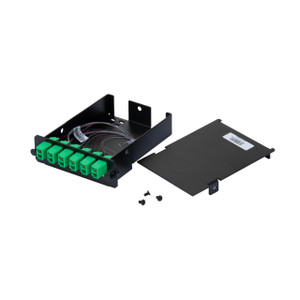
Panduit FNCS9N-12-10P Non-Shuttered Singlemode LC Duplex Pre-Terminated Fiber Assembly
Overview
The Panduit FNCS9N-12-10P is a pre-terminated OS2 singlemode fiber assembly built around non-shuttered LC duplex connectors — the correct choice when you need to deploy structured fiber infrastructure quickly without field-terminating every run. Designed to meet TIA-568.3-D, ISO/IEC 11801, and ITU-T G.652.D simultaneously, this assembly ships ready to install in fiber optic cable assemblies applications across data centers, telecommunications rooms, entrance facilities, and equipment distribution areas. If your project depends on a pre-certified, pull-and-plug deployment schedule rather than field splice verification, the FNCS9N-12-10P is purpose-built for that workflow. The red cable jacket provides instant visual identification in high-density trays and cable management environments — a practical benefit in any populated rack room where color discipline matters for future moves, adds, and changes.
Key Features
- OS2 Singlemode Fiber (9/125µm — ITU-T G.652.D): OS2 glass supports longer reach and lower attenuation than OM-series multimode — the right fiber type when you're connecting equipment across buildings, between floors separated by significant distance, or feeding into a WDM or DWDM transport layer. If your runs are under 100m between switches in a single room, multimode will do; beyond that, OS2 pays off in headroom and future-proofing.
- Non-Shuttered LC Duplex Connectors: LC is the dominant small-form-factor connector in modern SFP+ and QSFP transceivers and fiber optic assemblies. Non-shuttered versions are standard for most active equipment ports — shuttered variants are used where dust contamination in unmated ports is a critical concern (long-term storage panels, outdoor housings). If your transceivers require shuttered connectors specifically, verify before ordering.
- Pre-Terminated Assembly: Field termination of singlemode fiber requires trained technicians, a fusion splicer, and OTDR verification — a process that takes hours per run and introduces variability. A pre-terminated assembly eliminates all of that: pull it, route it, plug it in. Deployment time drops from hours to minutes per link, with factory-controlled insertion loss you can plan around instead of discover after the fact.
- Red Jacket Identification: The red cable color follows common industry color-coding conventions for singlemode fiber, making it visually distinct from OM3 (aqua), OM4 (magenta/violet), and OM5 (lime green) assemblies in mixed-fiber environments. In a busy structured cabling installation with multiple fiber types, jacket color is your first line of defense against mismatch errors during installation and maintenance.
- Triple-Standard Compliance (TIA-568.3-D / ISO/IEC 11801 / ITU-T G.652.D): Meeting all three standards simultaneously matters when your project documentation or RFP requires compliance sign-off. TIA-568.3-D covers North American commercial building cabling; ISO/IEC 11801 is the international equivalent for multinational or globally-specced projects; ITU-T G.652.D governs the glass itself. This assembly satisfies all three, reducing the compliance verification workload on your closeout documentation.
- Rapid Infrastructure Deployment: Data centers, telecom rooms, entrance facilities, and equipment distribution areas all share a common constraint: downtime costs money. Pre-terminated assemblies like the FNCS9N-12-10P (often searched as FNCS9N 12 10P) let you stage and test the full fiber plant before cutover, rather than discovering a bad splice at 2 a.m. during a maintenance window.
Integration & Compatibility
This assembly is designed for environments requiring pre-terminated OS2 singlemode fiber infrastructure — data centers, telecommunications rooms, entrance facilities, and equipment distribution areas. The LC duplex connector format is compatible with the overwhelming majority of modern SFP+ (10G), SFP28 (25G), QSFP28 (100G), and higher-density transceivers that accept duplex LC. Pair it with fiber patch panels and appropriate LC-compatible adapter plates for structured cabling termination. Verify transceiver polarity requirements before deployment — duplex LC assemblies follow standard TIA-568 polarity method A, B, or C depending on how the assembly is configured; consult Panduit documentation to confirm the polarity scheme for this specific part before wiring the plant. For patch panel integration in high-density installations, plan cable routing with adequate bend radius management — OS2 singlemode glass is more sensitive to tight bends than multimode, and exceeding the minimum bend radius degrades insertion loss performance.
Frequently Asked Questions
Q: What fiber type does the FNCS9N-12-10P use?
A: The FNCS9N-12-10P uses OS2 singlemode fiber with a 9/125µm core/cladding diameter, compliant with ITU-T G.652.D. This is a long-reach, low-attenuation fiber type suited for inter-building links, campus backbones, and data center interconnects where multimode would be insufficient.
Q: What connector type does this assembly use?
A: It uses LC Duplex connectors in a non-shuttered configuration. LC is the standard small-form-factor connector for SFP+, SFP28, and QSFP28 transceivers used in 10G, 25G, and 100G networking equipment.
Q: Which industry standards does the FNCS9N-12-10P comply with?
A: This assembly meets TIA-568.3-D (North American commercial building cabling), ISO/IEC 11801 (international generic cabling standard), and ITU-T G.652.D (standard singlemode optical fiber). All three are commonly required in enterprise and data center RFP specifications.
Q: What is the cable jacket color and why does it matter?
A: The jacket is red. In mixed-fiber environments, jacket color is the primary visual indicator of fiber type. Red is commonly used to identify singlemode assemblies, distinguishing them from OM3 aqua, OM4 magenta/violet, or OM5 lime green multimode cables — reducing mismatch errors during installation and maintenance.
Q: Where is this assembly typically deployed?
A: Panduit specifies this assembly for data centers, telecommunications rooms, entrance facilities, and equipment distribution areas that require pre-terminated fiber infrastructure for rapid deployment — environments where field termination time and variability are unacceptable tradeoffs.
Q: Can I use the FNCS9N-12-10P with multimode transceivers?
A: No. OS2 singlemode fiber is not compatible with multimode transceivers (which use 850nm VCSEL sources optimized for OM-series glass). You must pair this assembly with singlemode-compatible transceivers, typically those using 1310nm or 1550nm laser sources.
The FNCS9N-12-10P is Panduit's pre-terminated OS2 singlemode LC duplex assembly — and the spec that matters most when I'm reviewing it for a project is the triple-standards compliance: TIA-568.3-D, ISO/IEC 11801, and ITU-T G.652.D simultaneously. That combination means you're covered whether your closeout documentation requires North American, international, or fiber-glass-level certification, which matters on any project with a structured cabling spec sheet attached to the contract.
Technical Highlights:
- OS2 9/125µm Glass (ITU-T G.652.D): Standard singlemode with the attenuation headroom to support 10G, 25G, and 100G runs well beyond what multimode can reach — this is the glass type you want whenever inter-building or long in-building distances are in scope.
- Non-Shuttered LC Duplex: Matches the port standard on virtually every modern SFP+ and SFP28 transceiver in production today — no adapter required, no connector conversion risk.
- Red Jacket: Color-coded singlemode identification prevents transceiver mismatch in mixed-fiber cable trays. In a dense installation with both OM4 and OS2 runs, this is a maintenance-phase benefit, not just an aesthetic one.
Deployment Considerations:
- OS2 singlemode requires singlemode transceivers (1310nm or 1550nm sources) — do not mix with VCSEL-based multimode optics; the fiber types are physically intermateable but optically incompatible, and the link will appear to work at low distances while degrading under load.
- Confirm polarity method (TIA-568 A, B, or C) against your patch panel and transceiver configuration before pulling cable — a polarity mismatch on a pre-terminated assembly requires connector swapping or a crossover patch, not a field re-splice.
The FNCS9N-12-10P is the right call for data center interconnect and structured cabling backbone projects where field termination time, splice variability, or OTDR verification windows are not available — specifically in enterprise equipment distribution areas and telecom rooms running OS2-based 10G to 100G transport links.