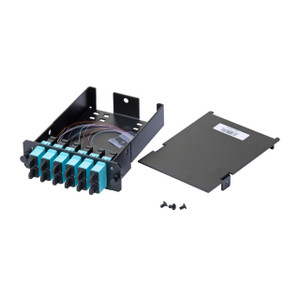
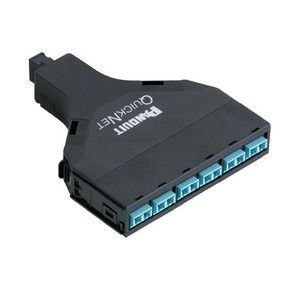
Panduit FCSZO-12-10R OptiCom™ 12-Fiber OM4 LC Duplex Splice Cassette
The Panduit FCSZO-12-10R is a factory pre-loaded OptiCom™ splice cassette engineered for high-density multimode fiber deployments in datacenter, enterprise campus, and building backbone environments. This cassette arrives with twelve 50/125µm OM4 fibers factory-terminated on LC duplex connectors at the front interface and ribbon pigtails at the splice end, eliminating field termination labor and delivering repeatable insertion loss performance. Steel housing provides mechanical protection for fusion splice points while maintaining organized fiber routing in OptiCom enclosures, panels, and rack-mount chassis. For integrators building or expanding 40GBASE-SR4, 100GBASE-SR4, or future 400G short-reach links, this cassette bridges backbone ribbon cable to structured LC distribution with factory-grade quality and significantly faster deployment than field-terminate alternatives.
Key Features
- OM4 50/125µm multimode fiber: Optimized for 40G/100G Ethernet applications up to 150 meters, backward-compatible with OM3 and legacy OM2/OM1 systems at reduced reach
- Factory pre-loaded LC duplex connectors: Front-facing industry-standard LC interface tested to ≤0.35 dB insertion loss, eliminates field polishing and testing time
- 12-fiber ribbon pigtail design: Unterminated ribbon end enables mass fusion splicing to backbone trunk cable with specialized ribbon splicer, reducing per-fiber splice time from ~3 minutes to ~30 seconds for entire 12-fiber array
- Steel protective housing: Rigid cassette body shields fusion splice points from mechanical stress during handling, insertion, and cable management operations
- OptiCom™ platform integration: Drop-in compatibility with Panduit FHD, FAP, FMP high-density fiber enclosures and patch panels supporting cassette-based architecture
- Black color coding: Standard multimode identification (black = multimode, blue = singlemode per TIA-598-D convention) for at-a-glance media type verification in mixed-fiber environments
- Factory quality assurance: Each fiber pre-tested for insertion loss, return loss, and polarity before shipment, with serialized documentation for as-built records
- Optimized Polish (PI Opt): Physical contact polish geometry on LC ferrules ensures low back-reflection and consistent optical performance across mated connections
Splice cassettes like the FCSZO-12-10R solve a fundamental fiber distribution problem: how to transition from high-count backbone trunk cables (typically 12, 24, 72, or 144 fibers in a single armored or plenum-rated jacket) to individual duplex patch cords feeding active equipment. Traditional field-termination workflows require technicians to strip, cleave, epoxy, polish, and test each fiber individually at the distribution point — a time-consuming, skill-intensive process prone to contamination and insertion-loss variation. Pre-loaded cassettes move that precision work into the factory where automated polishing equipment, controlled environments, and inline testing deliver repeatable performance. The ribbon pigtail configuration is specifically designed for backbone integration: a fusion splicer with ribbon fixtures can permanently join all twelve fibers in a single splice cycle (typically under two minutes including cleave prep and splice verification), compared to twelve individual splices at roughly three minutes each when working with individual buffered fibers. For a 144-fiber backbone, cassette-based distribution with ribbon splicing can reduce on-site labor from 7+ hours to under 90 minutes.
The OM4 fiber specification is critical for modern datacenter and campus deployments. While OM3 (also 50/125µm multimode) supports 10GBASE-SR to 300 meters and 40/100GBASE-SR4 to 100 meters, OM4's improved modal bandwidth (4700 MHz·km at 850nm versus OM3's 2000 MHz·km) extends 40G reach to 150 meters and 100G reach to 150 meters — sufficient for typical datacenter row-to-core distances and inter-building campus runs without stepping up to costly singlemode infrastructure. This cassette's OM4 rating also future-proofs installations for emerging 200G and 400G SR8/SR4.2 standards, which rely on the same 850nm VCSEL laser technology but demand the cleaner modal dispersion characteristics that OM4 delivers. The LC duplex connector format remains the industry standard for multimode datacenter connectivity: smaller footprint than SC duplex (enabling higher port density on switch faceplates), lower cost than MPO/MTP multi-fiber connectors for duplex applications, and universal compatibility with virtually all enterprise switches, storage arrays, and server NICs. Each cassette provides six duplex LC ports (12 fibers = 6 duplex pairs), mapping efficiently to common switch configurations like 4-port, 8-port, or 12-port line cards.
Installation into OptiCom enclosures is tool-free: the cassette slides into the chassis guide rails and latches with a snap-fit retention clip, allowing field technicians to populate or reconfigure panels without screwdrivers or special fixtures. Ribbon pigtails exit the rear of the cassette through a strain-relief boot and route to the enclosure's splice tray area, where backbone cable enters through a separate gland. Fusion splicing ribbon fiber requires a specialized ribbon fusion splicer (such as Panduit's FSM-R or equivalent Fujikura/Sumitomo models) and ribbon cleavers, but these tools are standard equipment for integrators handling high-fiber-count deployments. The alternative — individual fiber cassettes with 900µm tight-buffered pigtails — works with standard single-fiber splicers but sacrifices the speed advantage of mass splicing. Steel housing construction is a durability trade-off: heavier and slightly more expensive than polymer cassettes, but significantly more resistant to crushing or deformation during rough handling in crowded rack environments or when cables are over-tightened against the cassette body. For permanent backbone installations where the cassette will remain in place for 10-15 year infrastructure lifecycles, steel construction reduces the risk of long-term fiber stress from housing flex.
This cassette ships in cartons of ten units (120 total fibers / 60 duplex ports per carton), making it practical to stock for phased datacenter builds or campus backbone projects where fiber counts scale in 12-fiber increments. Each cassette includes protective dust caps on all LC ports and the ribbon pigtail is secured in a coil with cable ties to prevent damage during shipping. Panduit's OptiCom cassette system is widely deployed in hyperscale datacenter environments, Fortune 500 enterprise campuses, healthcare networks, and government facilities where structured fiber distribution, rapid deployment, and long-term reliability justify the premium over loose-tube field-terminate approaches. The FCSZO-12-10R's combination of OM4 future-proofing, ribbon splice efficiency, and factory-tested LC terminations makes it a core building block for integrators designing multimode fiber backbones that must support 40G/100G today with a credible path to 200G/400G migration without infrastructure replacement.