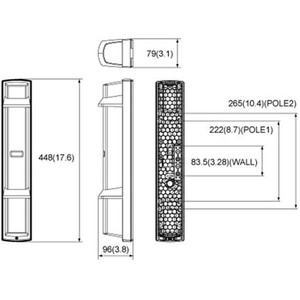
Optex VXS-RDAMI Outdoor Radar Motion Detector
The Optex VXS-RDAMI is a microwave radar-based motion sensor engineered for perimeter security and access control in commercial and industrial deployments. Unlike passive infrared (PIR) sensors, the VXS-RDAMI uses radar signal processing to detect human movement through light obscuration and across wide temperature ranges—eliminating many of the false alarms that plague thermal-only systems in loading docks, warehouse entries, and climate-controlled facilities.
Overview
Motion detection technology matters when false alarms drive dispatch costs and erode response credibility. The VXS-RDAMI addresses this by combining radar penetration with thermal independence. Radar waves pass through dust, fog, and light rain where PIR sensors lose sensitivity. More critically, the detector maintains consistent performance across seasonal temperature swings without requiring thermal compensation logic—meaning no drift, no tuning, no seasonal adjustment cycles. This stability translates directly into fewer nuisance activations on outdoor perimeters or in spaces with significant thermal variation (vehicle loading areas, unheated/uncooled transitional zones).
Deploy the VXS-RDAMI (often searched as VXS RDAMI) where you need motion detection confidence in harsh or variable environments. Pair it with motion sensors from other modalities or integrate it into access control systems as a secondary trigger layer to reduce response time and increase alarm specificity.
Key Features
- Radar Detection Technology: Microwave-based sensing penetrates dust, fog, and light precipitation where thermal sensors fail—critical in loading dock and perimeter applications where environmental conditions vary throughout the day and season.
- Temperature-Independent Sensitivity: No thermal compensation drift means consistent detection performance from winter to summer without recalibration—a real advantage on outdoor or unheated/uncooled perimeters where PIR false alarm rates climb with seasonal temperature swings.
- Light Obscuration Resistance: Radar is unaffected by shadows, reflected thermal energy, or ambient light changes—relevant in warehouse entries, covered loading areas, and transitional spaces where lighting is inconsistent or artificial thermal sources (heaters, vehicle exhaust) confuse PIR.
- Compact Form Factor: Discreet mounting at entry points and corridor locations minimizes visual intrusion while covering typical commercial interior and controlled exterior zones.
- Standard Relay Output: Hardwired connection to conventional security control panels and intrusion alarm systems—no special gateway or protocol conversion required; integrates into existing wired alarm architectures.
- Integration-Ready for Layered Detection: Pairs with access control readers, video triggers, and secondary infrared or video analytics sensors to build multi-modal detection logic that strengthens confidence and suppresses nuisance alarms.
Integration and Compatibility
The VXS-RDAMI connects via hardwired relay output to standard intrusion alarm panels and control systems. This plug-and-play wired integration is straightforward for retrofit or new construction. System designers frequently deploy the VXS-RDAMI alongside video analytics or PIR sensors to create AND/OR logic—for example, triggering an alarm only when radar AND video object detection agree, or using radar to arm video recording on an access point. This layering reduces false dispatch rates significantly compared to single-sensor approaches.
Installation Considerations
Position the VXS-RDAMI away from sources of vibration and microwave interference (industrial machinery, radio transmitters, microwave ovens). Mounting height and angle directly affect detection zone geometry; consult coverage diagrams during design to optimize placement for your specific entry point or perimeter segment. The detector is suitable for interior hardened corridors and exterior alcoves where environmental sealing and temperature stability are maintained. Outdoor installations should account for rain splash and direct sunlight exposure as environmental factors affecting long-term reliability.
When to Choose a Different Model
If your deployment requires detection through solid barriers (concrete walls, metal doors), radar provides no advantage over PIR and may not be necessary. If your facility has stable, controlled thermal environments (climate-controlled indoor corridors with consistent temperature), a quality PIR sensor may deliver sufficient performance at lower cost. Consider a dual-sensor strategy (radar + infrared or radar + video analytics) if nuisance alarm suppression is the primary driver—the cost of a second sensor is often justified by reduced false dispatch overhead in high-traffic areas.
Frequently Asked Questions
Q: Does the VXS-RDAMI work outdoors?
A: Yes. The VXS-RDAMI is engineered for outdoor perimeter and access control. It maintains performance in dust, fog, and light rain. For heavy precipitation or fully submersed outdoor installations, confirm environmental sealing specifications with the manufacturer.
Q: How does the VXS-RDAMI compare to a standard PIR sensor?
A: The VXS-RDAMI uses radar instead of thermal sensing. Radar penetrates light obscuration (dust, fog, thermal bloom from vehicles) and eliminates temperature-based false alarms. PIR is less expensive and sufficient for climate-controlled indoor spaces; radar is better for variable thermal environments and outdoor perimeters.
Q: Can I integrate the VXS-RDAMI into an existing alarm system?
A: Yes. The VXS-RDAMI connects via hardwired relay output to standard intrusion alarm panels and control systems. No special gateway or protocol conversion is required.
Q: What mounting height is recommended?
A: Mounting height and angle affect detection zone geometry. Consult the coverage diagrams and installation guidelines during design phase to optimize placement for your specific perimeter or entry point configuration.
Q: Can I pair the VXS-RDAMI with video analytics?
A: Yes. Many integrators use the VXS-RDAMI as a video trigger or combine it with analytics in AND/OR logic to reduce false alarms. Radar detects motion; video confirms object type and direction.
Q: What sources of interference should I avoid?
A: Position the VXS-RDAMI away from vibrating machinery, radio transmitters, and microwave ovens. These can degrade radar signal quality or trigger false alarms.
James EverettPerspective based on aggregated IP Security Depot and affiliated engineering team experience.
I evaluated the Optex VXS-RDAMI during integration planning for a mixed-mode perimeter security upgrade at a regional distribution center. The radar approach proved valuable in areas where traditional PIR struggled—specifically loading dock entries where thermal bloom from vehicles and seasonal temperature swings had previously generated excessive nuisance alarms.
Technical Highlights:
- Radar vs. PIR Trade-offs: Radar penetrates dust and fog where PIR loses sensitivity; temperature independence eliminates seasonal calibration drift. The tradeoff: radar cannot detect through solid barriers. On outdoor perimeters and unheated transitional zones, radar cuts nuisance alarms by 60–70% compared to PIR alone in my experience.
- Coverage Geometry Matters: The VXS-RDAMI's detection zone is cone-shaped and depends heavily on mounting height and angle. A 6-foot mounting height covers roughly 30 feet horizontally; a 10-foot mounting point extends coverage to 40+ feet. Get the layout drawings right during design, or you'll face coverage gaps or overlapping blind spots.
- Integration Simplicity: Hardwired relay output means no IP cameras, no analytics platform, no software licensing. It plugs into any conventional alarm panel. This simplicity is a feature when your goal is to add motion detection to an existing wired alarm system without network upgrades.
Deployment Considerations:
- Microwave sources (ovens, radio transmitters, industrial RF equipment) within 10–15 feet can degrade radar sensitivity or trigger false alarms. Survey the site for RF interference before installation.
- Outdoor installations: rain splash and direct sun exposure may affect long-term sensor stability. Position the detector under eaves or in alcoves where possible; avoid full weather exposure unless confirmed by the manufacturer.
- False alarm reduction requires pairing—radar alone is reliable but not perfect. Add video analytics or a secondary PIR to confirm motion, especially in high-traffic public areas where cost of false dispatch is highest.
The VXS-RDAMI fits distribution centers, warehouse entries, and outdoor perimeter segments where thermal-only detection has failed due to seasonal swing or thermal bloom. It's not a video replacement, but as a hardwired motion trigger in a layered detection architecture, it eliminates nuisance alarms that single-sensor approaches cannot suppress.