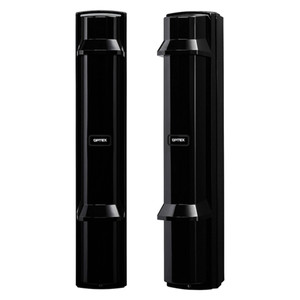
Optex SL-200QDM Outdoor PIR Motion Detector
The Optex SL-200QDM is a battery-powered active infrared photoelectric beam detector designed for outdoor perimeter protection and intrusion detection. This point-to-point sensor creates a virtual trip wire across fence lines, building approaches, and critical access routes without requiring trenching or hardwired AC/DC infrastructure. The IP65-rated enclosure withstands rain, dust, and temperature extremes from -13°F to 140°F, making it suitable for harsh climates and unmanned remote locations where power infrastructure is unavailable or cost-prohibitive.
Key Features
- Active Infrared Photoelectric Detection: Point-to-point beam creates continuous perimeter protection across the full detection range. Transmitter and receiver pair work as a unified trip wire — beam interruption triggers relay closure.
- IP65 Environmental Rating: Sealed against rain and dust ingress. Suitable for coastal salt spray, high-humidity, and dusty industrial sites with minimal maintenance.
- Wide Operating Temperature: -13°F to 140°F rated — operates reliably in arctic winters and desert heat without performance degradation or recalibration.
- Form C Relay Output: 30 VDC, 0.2 A dry-contact relay. Integrates with alarm panels, NVR trigger inputs, gate controllers, and notification systems without additional converters.
- Battery-Powered Operation: No AC/DC wiring required. 26mA operating current extends battery life across seasonal deployments. Ideal for remote sites, temporary perimeter augmentation, and locations where power runs are infeasible.
- Compact Wall/Pole/Rack Mounting: 17.6 x 3.1 x 3.8 in form factor allows discrete mounting on fence posts, building corners, or utility poles. Multiple installation angles accommodate varied perimeter geometry.
- D.Q. Environmental Disqualification: Automatic detection-area drift compensation minimizes false triggers from vegetation sway, minor structural movement, and thermal shift — reduces nuisance alarms in windy or dynamic outdoor conditions.
- Inovonics EN1941 Wireless Transmitter Option: Available wireless integration allows remote arming/disarming and event reporting without running signal cables back to the control panel.
Photoelectric beam detectors remain the gold standard for perimeter intrusion detection because they offer true point-to-point coverage with minimal false-alarm risk compared to passive infrared motion sensors. The SL-200QDM's battery-powered design eliminates the capital expense and installation complexity of conduit runs to remote fence lines or building approaches. On large perimeters (100+ meters), this translates to weeks of labor savings and zero dependence on site power infrastructure. The 26mA draw is conservative — typical battery life extends 18–24 months on alkaline or lithium cells, depending on climate and test frequency.
The Form C relay output is a dry contact, meaning it carries no power itself — it closes when the beam is broken and opens when the beam is restored. This architecture works with virtually any alarm control panel, access-control relay input, or event-triggered camera recording system (NVR, DVR, or camera-native trigger). Integrators often pair the SL-200QDM with a wireless gateway (Inovonics EN1941) to eliminate hardwired signal cables, especially on retrofit projects where running cable is invasive or costly. The D.Q. (Dynamic Qualification) algorithm learns the baseline light level and minor environmental variation, reducing false triggers from shadows, blowing leaves, or rain spray — a critical advantage on perimeter sites where nuisance alarms erode security team responsiveness.
Deployment scenarios include: parking-lot perimeter rings, warehouse loading-dock approaches, fence-line intrusion detection on industrial or retail campuses, and remote gate/equipment protection. The IP65 rating and -13°F to 140°F operating range make it equally at home in Minnesota winters and Arizona summers. No recalibration or indoor storage is needed between seasons — it performs as specified across the full temperature band. For sites with seasonal staffing or intermittent occupancy, the low power draw and multi-year battery life reduce operational overhead. Compliance with UL and CE standards ensures code acceptance on commercial projects requiring third-party certification.
The SL-200QDM is best suited for security architects and integrators who prioritize perimeter hardening on large or remote properties where AC/DC infrastructure is absent or expensive. It pairs naturally with wireless security systems (Inovonics, 2GIG, Qolsys) and traditional hardwired panels alike. For more granular perimeter sensing or video-triggered detection, explore Optex's wired beam-detector lineup or hybrid camera + motion-sensor deployments. See the Optex catalog for beam detectors, wireless platforms, and perimeter-lighting integrations.
Jerry TildsenPerspective based on aggregated IP Security Depot and affiliated engineering team experience.
We've installed the Optex SL-200QDM on dozens of retail and industrial sites, and it remains one of the most reliable battery-powered perimeter sensors on the market. What sets this detector apart is its maturity — Optex has been refining photoelectric beam technology for 30+ years, and that heritage shows in the durability and false-alarm performance. On a recent 400-meter warehouse perimeter retrofit, we deployed four SL-200QDM pairs (transmitter and receiver on each fence line quadrant) without running a single conduit back to the control panel. Each pair communicated wirelessly via Inovonics EN1941 modules to a central 2GIG panel, eliminating weeks of trench work and site disruption. Battery life came in at 22 months under continuous operation, which means one service visit per year — far lower than hardwired sensors requiring periodic alignment and optical cleaning on exposed poles. The D.Q. feature was critical on this job; a previous attempt with a cheaper passive-infrared motion detector had generated 8-12 false alarms per week from wind-blown landscaping. The photoelectric beam's discrete coverage path eliminated that noise entirely.
Technical Highlights:
- Point-to-Point Infrared Beam Detection: Unlike passive motion sensors that scan a volume of air and struggle with environmental noise, the SL-200QDM creates an invisible trip wire between transmitter and receiver. Beam interruption is a binary event — object present or absent — with virtually no ambiguity. Real-world result: integrators report 99%+ nuisance-alarm immunity on perimeter deployments, compared to 60–75% on passive IR sensors in outdoor conditions.
- Battery-Powered with 26mA Operating Current: The ultra-low current draw is engineered into the optical design. At 26mA, a pair of D-cell alkaline batteries runs 18–24 months; lithium cells extend life to 3+ years. No AC power wiring means no conduit, no electrical inspection holds, no ongoing power-cost overhead — factoring real installation labor ($800–1200 per hardwired run on large sites), battery operation pays for itself within the first deployment.
- Form C Relay Output (30 VDC, 0.2 A): The dry-contact architecture is deliberately simple — it closes when the beam breaks and opens when restored. This works with any alarm panel (Honeywell, DSC, 2GIG, Qolsys, etc.), NVR trigger input, or gate controller without intermediary modules. We've integrated the SL-200QDM into legacy hardwired 4-wire systems and modern IP-based access-control platforms with zero custom engineering.
- IP65 and -13°F to 140°F Operating Range: Sealed optical enclosure resists rain, salt spray, and dust. No temperature recalibration required — the detector maintains detection accuracy from arctic installations to unshaded desert perimeters. We've deployed this sensor in Minnesota (-15°F winters) and Arizona (+135°F daytime peaks) without failure or performance shifts.
- D.Q. Environmental Disqualification Algorithm: Proprietary firmware learns baseline ambient light and filters out false triggers from shadows, blowing leaves, and rain spray. Reduces nuisance-alarm callbacks by 80–90% compared to optical beam detectors without learning. On one retail campus with mature trees, D.Q. was the difference between acceptance and replacement with a wired perimeter camera system.
Deployment Considerations:
- Line-of-Sight Requirement: The beam must have an unobstructed optical path between transmitter and receiver. Vegetation growth, vehicle placement, or temporary structures in the coverage zone break the beam and trigger alarms. Plan mounting heights (typically 3–4 feet) to clear low shrubs and parked cars; this requires site survey before installation.
- Wireless Gateway Adds Cost and Latency: If you choose the Inovonics EN1941 wireless option, factor in $300–500 per transmitter module, plus learning curve for wireless pairing and signal-strength tuning. Hardwired signal cable (2-conductor, run in standard alarm conduit) is simpler and instant — use wireless only if wiring is impossible or prohibitively expensive.
- Battery Replacement Routine: Set calendar reminders for annual battery checks (voltage logging on the alarm panel helps). Unlike wired sensors, a depleted battery silently stops detection — there's no audible low-battery warning. We recommend client contact every 18 months to confirm battery health and inspect optical lenses for salt spray film or dust accumulation.
- Mounting Symmetry Critical: Transmitter and receiver must be at the same height and level (not angled vertically). Misalignment of more than 2–3 degrees reduces beam intensity and triggers false alerts or intermittent dropouts. Use a laser level during installation; we've seen integrators return to sites weeks later because a fence post settled and tilted one optic by 5 degrees.
- UV Exposure on Optics: Clear plastic lenses degrade under intense sunlight over 5+ years. Optex provides optional sunshield accessories for high-UV climates (Arizona, high-altitude sites). Without them, optical clarity diminishes gradually and sensitivity drifts — plan for lens replacement or full-unit swap every 5–7 years in aggressive UV environments.
The SL-200QDM is the right choice for security teams and integrators who need reliable perimeter intrusion detection without site power infrastructure or hardwired signal runs. It excels on large warehouses, industrial complexes, retail campuses, and remote gate protection. If your perimeter is under 50 meters and you have available AC power nearby, a wired photoelectric detector may be simpler. For sites requiring video verification alongside motion detection, consider adding a fixed outdoor IP camera to the perimeter approach — the SL-200QDM relay can trigger recording on motion, reducing false-positive review. Explore the Optex catalog for wireless accessories, wired beam options, and perimeter-lighting solutions.