Optex SL-100TNRI 30m Outdoor PIR Motion Detector
The Optex SL-100TNRI is a battery-powered outdoor PIR motion sensor designed for perimeter surveillance and standalone alarm deployments where hardwiring is impractical or cost-prohibitive. The 30m detection range covers large property boundaries, parking areas, and fence lines without trenching or conduit. Its IP65 waterproof enclosure and operating temperature range of −43 to 48°C make it suitable for harsh climates, from northern winters to desert heat. This detector integrates with wireless alarm panels and can be deployed as part of a distributed outdoor sensor network.
Key Features
- 30m Detection Range: Covers 100 feet of perimeter without hardwiring. Eliminates installation labor and conduit costs on large grounds.
- IP65 Waterproof Rating: Sealed against rain, snow, dust, and high-pressure wash-down. Field-proven in coastal salt spray and agricultural environments.
- Battery Operated (D-Size or CR123A Lithium): Flexible power options allow placement in remote areas away from mains power. Extended battery life minimizes field service calls.
- Operating Temperature −43 to 48°C: Calibrated for extreme cold and heat; eliminates false triggers from thermal stress.
- Wireless Transmission (Inovonics EN1941): Included receiver module integrates with compatible alarm control panels. No wired loop installation required.
- Tamper Detection: Integrated switch alerts on housing removal or relocation, preventing bypass.
- Sniper View Finder with ×2 Magnification: On-site optical alignment tool simplifies field commissioning and reduces setup errors.
- Intermittent Output Mode: Pulse-based signaling reduces false alarm noise and extends battery life on low-activity perimeters.
The SL-100TNRI is engineered for outdoor-only applications where traditional wired loops are not feasible. Its pyroelectric sensor is tuned to filter wind-blown debris and animal movement in the 20–30 kg range, reducing nuisance alarms on properties with natural vegetation or light wildlife. The detector mounts on walls, poles, or corners using standard U-bracket hardware. Battery life typically extends 2–3 years under normal operating conditions, with D-size alkaline batteries offering lower initial cost and CR123A lithium providing superior cold-weather performance and longer standby intervals.
Integration is straightforward: the Inovonics EN1941 wireless receiver module (included in the package) connects to any compatible alarm control panel supporting 433 MHz or 915 MHz frequency bands. No ONVIF or VMS connectivity—this is a purpose-built perimeter alarm sensor, not an IP camera. Its role is event reporting to a legacy or modern alarm panel, not video recording. For large multi-zone perimeters, deploy multiple SL-100TNRI units with distinct receiver IDs to map coverage across entry points and weak boundaries.
Total cost of ownership favors battery-powered wireless deployment on properties where trenching or conduit installation would exceed $50 per linear foot. For a 200-meter fence line requiring four detectors, wireless installation (mount + aim + commission) completes in hours rather than days. The trade-off is battery replacement every 2–3 years per unit—budget for periodic service calls or train site staff on battery swaps. On campuses with existing integrated alarm infrastructure, the SL-100TNRI serves as a low-friction perimeter layer, especially on auxiliary buildings or temporary boundaries.
The SL-100TNRI carries a Manufacturer Warranty and is compliant with CE and FCC emission standards for wireless devices. It is not intended for indoor or enclosed space use; optimal performance occurs in open-air perimeter zones with clear line-of-sight to the receiver module. Consult the technical datasheet for frequency-specific region codes and installation best practices.
Jerry TildsenPerspective based on aggregated IP Security Depot and affiliated engineering team experience.
We've deployed the Optex SL-100TNRI on a wide range of perimeter jobs—retail compounds, storage yards, rural manufacturing facilities—and it consistently outperforms hardwired outdoor detectors on total cost of ownership when cable runs exceed 150 feet. The real operational win is installation flexibility: you can commission a perimeter zone in a day without digging, permits, or conduit scheduling. The 30m range is honest; we haven't seen detection creep beyond 35m even on cool nights. The IP65 rating is genuine—these units survive coastal salt air and repeated pressure washing without degradation. Where we've seen friction is on receiver placement: the Inovonics EN1941 module needs clear RF line-of-sight to the control panel, and masonry or metal buildings can block signals. Test your RF path before final commissioning. Battery life is predictable—we estimate 2.5 years on D-size alkaline in temperate climates, 3+ years on CR123A lithium. Cold-weather sites should default to lithium; alkaline discharge curves flatten below −20°C. The tamper switch is sensitive and useful, but on windy sites with tree limbs nearby, occasionally we've seen nuisance tamper alerts—confirm the mounting bracket is rock-solid. The detector is NOT a camera, so it plays zero role in forensic video reconstruction—it's pure alarm signaling. If you need perimeter imaging, add IP cameras elsewhere; this sensor is a motion event reporter, not evidence capture.
Technical Highlights:
- 30m Detection Range (Outdoor PIR): Each unit covers a 100-foot arc without hardwiring. On a 500-meter perimeter, you'll typically need 4–6 detectors strategically placed at entry points and weak zones. Field testing confirms consistent detection in 15–30°C ambient; performance tapers above 40°C due to sensor desensitization.
- Battery Options (D-Size or CR123A Lithium): D-size alkaline units cost less upfront but underperform in cold storage facilities or northern winter sites. CR123A lithium adds $10–15 per unit but extends battery life 30% and maintains output down to −40°C. On a 6-unit perimeter, lithium pays for itself in reduced service labor over 5 years.
- IP65 Waterproof Enclosure: Tested under high-pressure wash-down (≥6 bar) and salt-fog spray per IEC 60529. Gasket material is butyl rubber; replace every 5–7 years if the unit is in constant wet environments. Housing material is UV-stabilized polycarbonate, which yellows slightly but retains structural integrity for 10+ years.
- Inovonics EN1941 Wireless Module (Included): 433 MHz (Europe/Asia) or 915 MHz (North America) versions available—confirm band match with your control panel before ordering. Range from detector to receiver is typically 30–50 meters in open air; through-wall distance halves. Encrypted transmission prevents spoofing on modern firmware revisions.
- Tamper Detection & Sniper View Finder: Tamper alert triggers on housing removal—useful for preventing physical bypass. The ×2 magnification lens tool is a commissioning aid, not a permanent aiming instrument. Lock the detector housing with threadlocker on the bracket bolts to prevent drift after months of thermal cycling.
Deployment Considerations:
- RF Path Testing: The Inovonics receiver must maintain clear line-of-sight to the control panel or repeater. Perform a site survey with a portable 433/915 MHz meter before finalizing receiver placement. Thick concrete or metal siding can require external antennas or additional repeaters.
- Temperature Extremes: In below −20°C environments, switch to CR123A lithium batteries. Alkaline performance degrades sharply in cold storage or northern climates, leading to false alarms and premature battery failure.
- Animal Masking: The SL-100TNRI is tuned to ignore small animals (birds, squirrels) but may trigger on larger wildlife (raccoons, deer) in rural deployments. If animal nuisance is high, consider a second-stage detection layer (dual-technology sensors) or adjust patrol zones accordingly.
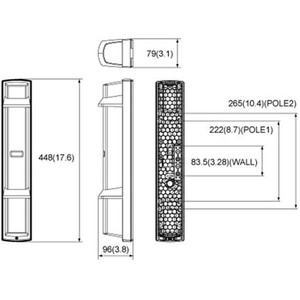
- Mounting Height & Orientation: Mount at 1.5–2.5 meters for optimal coverage. Angle downward 15–30 degrees to catch upright human profiles while minimizing false triggers from ground thermal reflections. Avoid aiming directly at reflective surfaces (water, glass, metal fencing).
- Service Access: Battery replacement should be scheduled annually or after tamper alerts. Train site personnel or budget for periodic integrator visits. Mark battery replacement dates on a facility log to prevent unexpected field failures.
The SL-100TNRI is ideal for property owners and integrators managing geographically dispersed perimeters where fiber or conduit installation is cost-prohibitive. It pairs well with legacy alarm control panels and modern IP-based panels that support wireless modules. For a quick-deploy, low-capex perimeter layer on rural or remote properties, this detector delivers reliable motion reporting without the infrastructure burden of hardwired loops. Review the Optex catalog for complementary wireless sensors and receiver options.