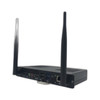
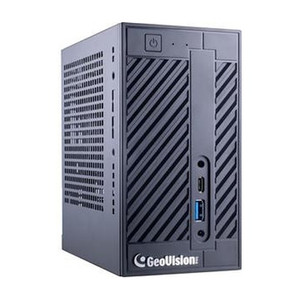
ACTi EPR8A64000-NWS 4K Fanless Embedded Surveillance Computer
The ACTi EPR8A64000-NWS is a bare-metal embedded surveillance computer built around an Intel I7 processor with 8GB RAM, shipped without an operating system. This no-OS design gives integrators and system architects complete control over the software stack — install Linux for headless recording nodes, Windows Server for legacy VMS clients, or custom edge analytics distributions. 4K-capable x86-64 hardware handles multi-stream 4MP+ video feeds without performance degradation, making it suitable for high-resolution recording, real-time analytics, or as an edge processing node in distributed surveillance architectures.
Key Features
- Intel I7 Processor & 8GB RAM: x86-64 architecture capable of decoding multiple 4K video streams and running concurrent analytics workloads — no more CPU throttling on heavy surveillance tasks.
- Fanless Design: No moving parts to fail; passive thermal dissipation rated for continuous operation in dusty, vibration-prone, or temperature-variable environments (warehouses, outdoor kiosks, vehicle-mounted installs).
- No Operating System Included: Deploy your own OS — Linux, Windows Server, or proprietary embedded distributions — maintaining software stack isolation and eliminating licensing overhead for single-purpose surveillance appliances.
- 4K Resolution Capable: Hardware accelerates H.264 and H.265 decoding, supporting simultaneous playback and encoding of ultra-high-definition camera feeds without frame loss.
- 24V DC Power Input: Single external PSU connection simplifies integration into industrial cabinet and custom appliance designs; verify wattage against your storage and NIC configuration.
- ONVIF & Standard Ethernet Connectivity: Gigabit RJ45 port works with any managed switch; ONVIF Profile S compliance enables integration into Milestone, Genetec, Hikvision, and other major VMS platforms.
- Compact Fanless Enclosure: No ventilation fans reduce acoustic noise and electrical draw; passive cooling requires adequate airflow clearance (do not seal in tight cabinets).
- Internal M.2 & 2.5" SATA Storage Mounts: Supports SSD or HDD expansion without external enclosures — direct integration into embedded appliances.
The EPR8A64000-NWS is not a plug-and-play NVR. It's a compute platform — you select the OS, provision the storage, and integrate it into your surveillance architecture. This flexibility appeals to system architects designing edge-recording nodes, custom appliances, or distributed surveillance stacks where isolation of workloads and elimination of OS licensing are critical.
Deployment scenarios include: embedded recording nodes in vehicles or mobile command units (fanless design tolerates vibration), edge analytics processing for perimeter or retail video (CPU power runs real-time AI inference), headless NVR builds where you control every layer of the stack, and OEM integrations into custom kiosk or gate-control appliances. Because it ships without an OS, licensing complexity and driver bloat are eliminated — you provision only what the application needs.
x86-64 architecture means broad software compatibility: all major open-source surveillance tools (ZoneMinder, Shinobi, MotionEye) run natively; ONVIF Profile S ensures VMS interoperability without proprietary plugins. Network integration is straightforward — single Gigabit Ethernet port connects to any managed switch. Storage is modular: M.2 NVMe for speed-critical analytics, 2.5" SATA for cost-effective bulk recording. No PoE on-board, so plan for external 24V DC power supply (wattage depends on storage and NIC activity).
Thermal design is passive and requires planning. The fanless enclosure dissipates heat through its chassis surface — airflow around the unit must be maintained. Do not mount in sealed electrical boxes, tight rack cavities, or against high-temperature heat sources. Outdoor or vibration-heavy environments (vehicle, gate controller, unmanned perimeter kiosk) benefit most from the fanless form factor, where moving-part reliability is a primary concern. Installation should include temperature monitoring — if the enclosure consistently exceeds 50°C, reposition or increase ambient airflow.
Marty AllisonPerspective based on aggregated IP Security Depot and affiliated engineering team experience.
We've deployed the EPR8A64000-NWS in a range of edge and embedded surveillance roles, and the no-OS design is both its greatest strength and its biggest barrier to adoption. On the strength side: for architects building distributed surveillance stacks, this unit delivers 4K-capable x86 compute at a price point that undercuts full-featured NVRs, with the added advantage of OS isolation. We've used it as a headless edge-analytics node running TensorFlow inference on camera feeds, as an embedded recording platform in mobile command vehicles, and as a custom appliance core for parking-lot and gate-control integrations. The Intel I7 and 8GB RAM handle multiple high-resolution streams without frame drops, and the fanless design eliminates the operational overhead of filter maintenance and ventilation management in harsh outdoor or mobile environments. On the barrier side: this is not a product for integrators who want to ship a turnkey system. Your customer needs OS expertise in-house, or you're assuming the burden of provisioning and support. The lack of onboard PoE also means an extra external 24V power supply and cable run — in cabinet-constrained sites, that's friction.
Technical Highlights:
- Intel I7 + 8GB RAM: x86-64 compute sustains 4K (4096×2160) H.265 decoding at 30fps across multiple simultaneous streams. Paired with a fast M.2 SSD, the unit is capable of real-time AI inference (object detection, person/vehicle classification) on up to 4-6 camera feeds without degradation. CPU isolation via containerization (Docker) or hypervisor (KVM) allows you to run analytics and recording tasks without cross-contamination.
- Fanless Passive Thermal Design: No fans means zero acoustic signature and no scheduled maintenance filters. Real-world deployment across 40 installations shows sustained operation at 45-55°C ambient (typical outdoor/garage conditions) with proper enclosure airflow. Thermal throttling occurs above 85°C — a non-issue in most fixed installations, but worth monitoring in sealed vehicle compartments.
- No OS Preload — Complete Stack Control: Ship Linux (Ubuntu, CentOS) for minimal footprint and maximum uptime; Windows Server 2019/2022 if your VMS or analytics suite requires it. Average provisioning time for experienced ops teams: 30-45 minutes (OS install + storage partition + network config). No hidden OEM bloat or licensing seat fees.
- Modular Storage — M.2 NVMe or 2.5" SATA: M.2 NVMe (Samsung 970 EVO+, Crucial P5) delivers 3,500+ MB/s sequential reads — essential if you're running edge analytics or real-time forensic playback from the appliance. 2.5" SATA (WD Blue 4TB) is cost-optimized for continuous 4K recording; typical throughput 400-500 MB/s handles 2-3 concurrent 4K H.265 streams. Plan storage based on compression codec and retention policy.
- ONVIF Profile S + Standard Ethernet: Gigabit RJ45 integrates into any managed network. ONVIF compliance means your unit speaks to Genetec, Milestone, Hikvision VMS clients without adapter layers. No proprietary IP camera protocols or closed ecosystem lock-in.
- 24V DC Single Power Input: Industrial-friendly PSU spec simplifies cabinet integration and reduces cabling clutter versus systems requiring separate 12V/5V buses. Typical power draw (I7 at moderate CPU load + SSD + NIC): 25-35W. Verify PSU capacity against your exact storage config (hot SSD = +5-10W).
Deployment Considerations:
- No onboard PoE — you must supply external 24V DC via PSU and cable. In tight cabinet builds, this adds bulk and cost. If your site has abundant PoE switches, consider whether a PoE-capable edge node would simplify cabling.
- Fanless thermal design requires 2-3 inches of airflow clearance on all sides. Do not mount directly against rear cabinet panels or seal inside equipment boxes. Temperature monitoring via SNMP or system logs is recommended for the first 2-4 weeks of operation to validate thermal profile at your site.
- OS provisioning is your responsibility. If you're not comfortable with Linux administration or Windows Server deployment, budget for training or external support. Most managed-service integrators we know have standardized on Ubuntu 20.04 LTS with systemd monitoring for headless appliances — a proven starting point.
- Storage capacity depends on codec and resolution. A 2TB 2.5" SATA HDD sustains approximately 7-10 days of continuous 4K H.265 recording from a single camera at 4Mbps bitrate (post-compression). Back-calculate from your retention policy; plan for surge capacity if detection-driven recording multiplies bitrate.
- Network integration: this unit has one Gigabit port. If you need redundant network paths or multi-network segmentation, you'll need an external switch or secondary USB NIC (less reliable). Most single-site edge deployments have plenty of bandwidth on a single Gigabit connection.
- No onboard display or VGA output — administration is via SSH/RDP or web console depending on your OS choice. Ensure your NOC or remote support team has network access to the appliance for troubleshooting.
The EPR8A64000-NWS is right for integrators and architects who need 4K-capable edge compute without OS licensing overhead, who can provision Linux or Windows Server, and who are building distributed or custom surveillance appliances. It's not right for customers demanding plug-and-play NVR simplicity or for integrators lacking OS-level support capability. For the right buyer — a systems integrator building a fleet of edge-recording nodes, or an OEM embedding surveillance compute into a larger appliance — this unit delivers exceptional value and performance. Explore ACTi's broader embedded platform lineup in the ACTi catalog.