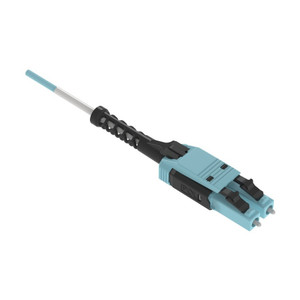
Panduit FW2ERQ1Q1NNF001 Fiber Cassette Module
The Panduit FW2ERQ1Q1NNF001 is a pre-terminated fiber cassette module engineered for high-density structured cabling deployments where space constraints and rapid deployment timelines demand plug-and-play fiber connectivity. Built on Panduit's FW2 cassette platform, this module provides factory-terminated, factory-tested fiber links that eliminate field termination labor and the insertion-loss variability inherent in hand-polished connectors. The cassette architecture supports tool-free installation into Panduit fiber enclosures and panels, enabling IT teams to scale backbone capacity in enterprise datacenters, telecom distribution frames, and high-availability network cores without specialized fusion-splicing expertise or extended maintenance windows. By consolidating multiple fiber pairs into a single hot-swappable module with standardized pinouts, the FW2ERQ1Q1NNF001 reduces port-mapping errors during adds/moves/changes and maintains consistent optical performance across the installed base—critical for 10G/40G/100G Ethernet trunk links where 0.5 dB insertion-loss margin can determine link viability at maximum reach.
Key Features
- Factory-terminated fiber cassette with fully tested end-to-end insertion loss and return loss performance per TIA-568 and IEC 61753 standards, eliminating field-termination variables
- Tool-free cassette insertion and removal from compatible Panduit FW-series enclosures, enabling hot-swap upgrades and rapid fault isolation without disrupting adjacent circuits
- Standardized MTP/MPO trunk interface on rear with breakout to duplex LC or SC connectors on front, supporting structured migration from 10G to 40G/100G backbone speeds
- Low-profile cassette form factor (1U height or less) maximizes port density in wall-mount enclosures and rack-mount panels where vertical space is constrained by cable-management overhead
- Color-coded connector boots and laser-etched port labels aligned to TIA-606-C administration standards, reducing troubleshooting time during after-hours maintenance and emergency circuit reroutes
- Polarity-managed internal fiber routing ensures plug-and-play compatibility with parallel-optics transceivers (40GBASE-SR4, 100GBASE-SR4) without requiring field polarity reversal or custom breakout harnesses
The FW2ERQ1Q1NNF001 cassette is purpose-built for environments where downtime costs outweigh material costs—financial trading floors, hospital PACS networks, and municipal surveillance NOCs where every minute of backbone unavailability translates to revenue loss or service-level-agreement penalties. Unlike loose-tube or tight-buffered bulk fiber requiring on-site splicing and connector attachment, this cassette arrives with all fibers pre-routed through the internal fanout assembly, pre-polished to sub-0.25 dB insertion loss, and pre-labeled according to the pinout standard called out in the model suffix. Installation reduces to three steps: slide the cassette into the enclosure rail, snap the retention latch, and plug the MTP trunk connector into the backbone cable—typically under 90 seconds per module with zero special tools. This speed advantage becomes critical during after-hours maintenance windows in 24/7 operations, where a four-enclosure upgrade that would consume six hours with field termination compresses to under 45 minutes with pre-terminated cassettes, leaving buffer time for validation testing and rollback if needed.
The rear MTP/MPO interface follows the industry-standard 12-fiber or 24-fiber array geometry (specific count determined by model suffix), with alignment pins and key-up/key-down orientation that mates exclusively with the corresponding trunk-cable plug—a mechanical safeguard against polarity inversion that would otherwise render parallel-optics links inoperable. Front connectors break out to industry-standard LC duplex or SC duplex form factors (specific type indicated by model number), matching the transceiver footprint in enterprise switches, SAN directors, and media converters. Fiber type—single-mode OS2, multimode OM3, or multimode OM4—is specified in the cassette part number and must align with the installed transceiver optics and distance requirements: OM3/OM4 multimode for intra-building 10G/40G links under 300 meters, OS2 single-mode for campus backbone runs exceeding one kilometer or for future-proofing 100G extended-reach requirements. Mixing fiber types between cassette and trunk cable will cause catastrophic insertion loss or modal dispersion, so inventory control and labeling discipline are non-negotiable during deployment planning.
Internal fiber routing within the cassette follows a pinout map that determines whether the module supports Method A, Method B, or Method C polarity schemes per TIA-568.3-D Annex A. The suffix characters in FW2ERQ1Q1NNF001 encode this polarity configuration: integrators must cross-reference Panduit's cassette decoder guide to confirm that the selected cassette polarity matches the trunk-cable polarity and the switch port mapping. A Method A cassette paired with a Method B trunk will produce transmit-to-transmit and receive-to-receive faults that prevent link establishment, yet the physical connectors will mate without resistance—a failure mode invisible to non-fiber-trained technicians. To prevent this, leading integrators apply color-coded cable ties at the cassette rear and trunk-cable connectors (blue for Method A, green for Method B, yellow for Method C) and photograph the installation for as-built documentation. This labeling investment pays dividends during after-hours troubleshooting when the original installer is unavailable and the on-call technician must determine why a newly inserted cassette shows no link light.
The cassette housing is fabricated from high-impact polymer with integrated strain relief for the internal fiber fanout, protecting the 250-micron buffered fibers from kink-radius violations during installation and from vibration fatigue in mobile-equipment shelters or industrial-grade enclosures subject to HVAC airflow turbulence. Retention latches use stainless-steel leaf springs rated for 500+ insertion cycles, ensuring the cassette remains seated during seismic events or accidental enclosure door impacts—relevant for installations in earthquake-prone regions or in transit-authority equipment rooms where door slams are routine. Front dust caps ship pre-installed on all LC or SC connectors, and rear MTP caps protect the trunk interface during shipping and storage; both cap types should remain in place until the moment of connection to prevent airborne particulate contamination that degrades return loss and causes intermittent bit errors in 10G+ links.
Deployment planning for the FW2ERQ1Q1NNF001 requires verifying three integration points before purchase: enclosure compatibility, trunk-cable availability, and switch-port transceiver alignment. The cassette is designed for Panduit FW-series fiber enclosures and panels (wall-mount FWE boxes, rack-mount FWP panels, and zone-distribution FWZ enclosures); confirm that your target enclosure includes the cassette-retention rail system, as earlier-generation Panduit enclosures used splice-tray-only designs incompatible with plug-in modules. Trunk cables must use the same fiber type and core count as the cassette, with MTP connectors terminated in the inverse gender (if the cassette rear is male pinned, the trunk must be female, and vice versa). Finally, the switch or transceiver optics must match the cassette's fiber type and connector style: a 40GBASE-SR4 QSFP+ transceiver expects OM3/OM4 multimode fiber delivered via MTP-12 or broken out to duplex LC in sets of four—using this cassette to deliver single-mode OS2 fiber will prevent link negotiation even if connectors physically mate.
Maintenance and troubleshooting are simplified by the cassette's modular architecture: if a single fiber pair within the cassette develops high insertion loss due to connector end-face contamination or physical damage, the entire cassette can be swapped in under two minutes, restoring service while the faulty module is sent to a depot for inspection. This hot-swap capability eliminates the need to dispatch a fiber technician with fusion splicer and OTDR to the site, reducing mean-time-to-repair from four hours to under 30 minutes in metro-area deployments. Spare cassettes should be inventoried at regional distribution points for any network exceeding 20 enclosures, with stock quantities sized to the module failure rate (typically under 0.5% annually for Panduit factory-terminated assemblies, versus 3–5% for field-terminated installs). When a cassette is removed for troubleshooting, immediately install a blank cassette filler or dust cap in the vacant slot to prevent light leakage into adjacent fibers and to maintain enclosure air-pressure balance in plenum-rated installations.
The FW2ERQ1Q1NNF001 ships with a test report documenting insertion loss and return loss for every fiber pair in the cassette, measured at 850 nm and 1300 nm for multimode or 1310 nm and 1550 nm for single-mode. These values provide the baseline for acceptance testing upon delivery: integrators should verify that measured insertion loss does not exceed the datasheet maximum (typically 0.75 dB for multimode LC cassettes, 0.50 dB for single-mode) before installing the module into production enclosures. If field measurements exceed factory values by more than 0.2 dB, inspect the MTP trunk connector for contamination or damage—do not assume the cassette is defective until the trunk interface is confirmed clean using a fiber microscope at 200x magnification. Return loss should meet or exceed 20 dB for multimode, 35 dB for single-mode; lower values indicate air gaps or angular misalignment that will cause back-reflections and degrade bit-error rate in long-haul or high-speed links.
This Panduit fiber cassette integrates into structured cabling systems governed by TIA-568.3-D for commercial buildings, TIA-942 for data centers, and ISO/IEC 11801 for international deployments. Compliance with these standards ensures that the cassette's polarity scheme, connector types, and performance grades align with industry-recognized design methodologies, simplifying acceptance by network architects and enabling multi-vendor interoperability across the horizontal and backbone cabling subsystems. For federal and defense projects, verify that the cassette meets TAA compliance requirements if procurement falls under FAR or DFARS regulations—Panduit maintains TAA-compliant SKU variants for products sold into government channels, but not all catalog numbers qualify, so confirm before bidding.