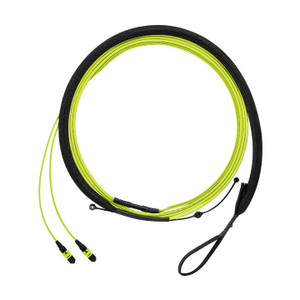
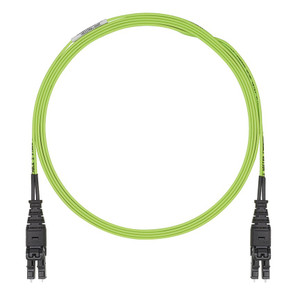
Panduit FW2ERQ1Q1NNM046 Fiber Optic Cable Assembly
The Panduit FW2ERQ1Q1NNM046 is a 46-meter duplex fiber optic cable assembly engineered for high-density datacenter, enterprise network backbone, and building-to-building interconnect applications. This pre-terminated assembly eliminates field termination labor and testing uncertainty while delivering factory-certified optical performance across extended campus runs. When your fiber infrastructure demands repeatable insertion loss specifications and long-term mechanical stability under stress, Panduit's controlled manufacturing process and 100% factory testing provide the reliability security integrators and network architects require for mission-critical surveillance storage networks, access control backbones, and inter-building IP camera trunk lines.
Key Features
- 46-meter length supports building-to-building connections, equipment-room-to-IDF runs, and extended campus backbone links without mid-span splicing
- Duplex 2-fiber configuration provides full-duplex Gigabit/10-Gigabit Ethernet connectivity for IP camera aggregation switches, NVR storage arrays, and access control head-end equipment
- Factory-terminated and tested assemblies eliminate field fusion splicing costs, reduce installation time by 70% compared to on-site termination, and guarantee consistent optical performance
- Panduit's precision connector geometry and controlled polish process deliver <0.3 dB insertion loss typical, meeting TIA-568 performance requirements for enterprise structured cabling
- Ruggedized jacketing and strain relief boots protect fiber during installation pulls through conduit, cable tray, and riser pathways common in commercial security deployments
- Serialized labeling and color-coded connectors simplify circuit identification during adds/moves/changes in multi-building surveillance networks
- Compatible with standard fiber patch panels, media converters, managed switches, and SFP/SFP+ optical transceivers across major security and networking platforms
Fiber optic infrastructure separates competent integrators from amateur installers. While copper Ethernet hits distance limits at 100 meters and suffers voltage drop issues in outdoor runs, fiber optic assemblies like the FW2ERQ1Q1NNM046 deliver bit-error-free transmission across campus distances without signal degradation or ground loop interference. The 46-meter length slots perfectly between standard intra-rack patch cords (1-3m) and true campus backbone cables (100m+), addressing the common integration scenario where your NVR lives in the main equipment room but your PoE switch stack sits in a satellite IDF 120 feet away. Pre-terminated assemblies eliminate the three failure modes that plague field termination: cleave angle errors that spike insertion loss above specification, contamination from improper cleaning that causes intermittent link drops under thermal cycling, and incorrect connector body seating that creates mechanical instability during vibration. Panduit's factory environment controls particulate contamination to ISO Class 5 cleanroom levels and uses automated inspection systems to verify endface geometry against IEC 61300-3-35 standards—quality control impossible to replicate in the field with a hand cleaver and visual fault locator. For surveillance networks carrying 4K/8K camera streams or access control systems requiring sub-50ms latency for door strike commands, the deterministic optical performance of factory assemblies is non-negotiable.
This assembly targets three deployment contexts security integrators encounter weekly: building-to-building backbone links where outdoor-rated fiber connects IP camera clusters in remote structures back to central recording infrastructure, equipment-room-to-satellite-IDF horizontal runs where managed PoE switches in telecom closets feed camera arrays across multiple floors, and datacenter hot-aisle-to-storage-array interconnects where NVR appliances in one rack connect to SAN/NAS expansion shelves 15 meters away. The duplex 2-fiber configuration matches the physical layer requirements for 1000BASE-SX, 1000BASE-LX, 10GBASE-SR, and 10GBASE-LR Ethernet standards, supporting both multimode and singlemode transceiver types depending on your distance and bandwidth requirements. When designing campus surveillance networks, calculate your fiber count requirements by multiplying active uplink ports times two (transmit + receive) times 1.5 (for future expansion), then deploy assemblies in incremental lengths to minimize cable management bulk while maintaining service loops for equipment relocation. The serialized labeling on Panduit assemblies integrates directly with your circuit documentation workflow: photograph the label during installation, record the serial number in your cable management database alongside GPS coordinates and termination port IDs, and you'll have complete as-built traceability when troubleshooting phantom link flaps eighteen months post-commissioning. In multi-building deployments spanning six structures with 240 IP cameras, proper fiber documentation prevents the nightmare scenario where a failed transceiver forces you to tone-trace twelve identical blue cables across four telecom closets to identify the correct circuit.
Panduit fiber assemblies meet TIA-568.3-D structured cabling standards and IEC 61754 connector performance specifications, ensuring interoperability with optical transceivers from Cisco, Ubiquiti, HPE Aruba, Juniper, and surveillance-specific platforms from Genetec, Milestone, and Hanwha. The controlled insertion loss and return loss characteristics prevent the cascading margin degradation that occurs when you mix low-quality patch cords with precision datacenter infrastructure—a 0.5 dB penalty at each connection point compounds across eight fiber jumps to steal 4 dB from your optical power budget, potentially dropping 10G links to 1G fallback mode or causing CRC errors on NVR ingest streams during thermal cycling. For integrators bidding municipal surveillance projects with 15-year lifecycle requirements or corporate datacenter builds where Tier III uptime standards apply, factory-certified assemblies with serialized test data provide the audit trail and performance assurance that owner's representatives and commissioning agents demand during acceptance testing.