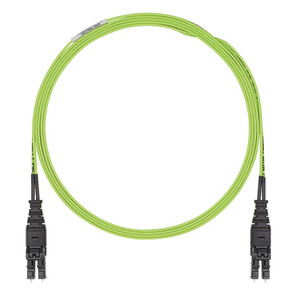
Panduit FW2ELQ1Q1NNM037 LC Duplex Fiber Optic Assembly
The Panduit FW2ELQ1Q1NNM037 is a factory-terminated duplex fiber optic assembly engineered for enterprise security networks, datacenter interconnects, and AV backbone installations where reliable high-bandwidth connectivity is non-negotiable. This precision-manufactured cable features LC duplex connectors on both ends, factory-polished and tested to meet strict insertion loss and return loss specifications. Built to Panduit's commercial-grade standards, this assembly eliminates field termination variables—delivering consistent optical performance out of the box for 10GbE, 40GbE, and fiber-based video transport applications.
Key Features
- Factory-terminated LC duplex connectors—pre-polished and performance-tested to TIA-568 standards, eliminating field termination risk and installation time
- Precision fiber geometry—controlled core alignment and end-face finish ensure low insertion loss (<0.3 dB typical) and high return loss (>20 dB) across the link
- Ruggedized jacket construction—abrasion-resistant outer jacket rated for in-building riser or plenum environments, depending on cable variant
- Color-coded boots and connectors—visual identification for polarity management in dense patch panel and switch environments
- Strain-relief boots—protect fiber at connector interface, maintaining minimum bend radius under cable dress and routing stress
- 100% factory tested—each assembly verified for optical continuity, insertion loss, and return loss; test results traceable to production lot
- Length-specific part numbering—Panduit's structured MPN encoding identifies connector type, fiber mode, and cable length, simplifying inventory and re-ordering
- Wide application compatibility—supports 1G/10G/40G Ethernet, Fibre Channel, and uncompressed 4K/8K video transport over multimode or singlemode fiber
Panduit's FW2 series fiber assemblies address the core challenge in modern network and security installations: eliminating the performance variability and labor cost of field-terminated fiber. Every LC connector on this assembly is terminated in a controlled factory environment using automated polishing equipment, then individually tested for insertion loss, return loss, and end-face geometry. This process removes the three most common failure modes in field-terminated fiber—improper polish angle, contaminated end-faces, and inconsistent ferrule seating. For integrators deploying IP camera networks with fiber backhaul, storage area networks in datacenter environments, or AV matrix systems requiring guaranteed 10G throughput, factory assemblies like the FW2ELQ1Q1NNM037 convert unpredictable field labor into predictable plug-and-play infrastructure.
The LC duplex form factor is the de facto standard for enterprise fiber connectivity, offering twice the port density of SC connectors in the same panel space. Panduit's LC connector design uses a ceramic ferrule with 1.25mm diameter—the same physical interface as SFP, SFP+, and QSFP transceiver modules found in managed PoE switches, media converters, and NVR uplink ports. The duplex configuration pairs transmit and receive fibers in a single connector body with a latch mechanism, preventing accidental disconnects during adjacent cable management. Boots are color-coded to indicate fiber type (aqua for OM3/OM4 multimode, yellow for OS2 singlemode), allowing technicians to visually verify polarity and prevent mode mismatch errors that cause link loss or transceiver damage. In high-density installations—think 48-port fiber distribution panels or top-of-rack switches with 24+ SFP+ uplinks—this visual coding cuts troubleshooting time and reduces human error during maintenance windows.
Insertion loss and return loss are the two critical optical parameters that determine link margin and bit error rate. Panduit specifies insertion loss at <0.3 dB typical for LC assemblies, meaning minimal signal attenuation across the connector pair. For a 10GBASE-SR link over OM3 fiber, the IEEE 802.3ae standard allows 2.6 dB total channel loss over 300 meters; a pair of high-quality LC connectors consumes only ~0.6 dB of that budget, leaving 2.0 dB for fiber attenuation and splice losses. Return loss—the ratio of reflected to transmitted power—exceeds 20 dB on Panduit assemblies, ensuring that back-reflections don't degrade laser transceiver performance or introduce jitter in high-speed serial links. These specs matter in security and AV applications: a 4K IP camera streaming 50 Mbps over a 1G fiber link has margin to spare, but a 12-camera 4K NVR with eight simultaneous playback streams over a single 10G fiber trunk operates near the edge of the loss budget. Guaranteed connector performance eliminates one variable in that equation.
Cable jacket construction varies by application environment and local code requirements. Panduit offers FW2 assemblies in riser-rated (OFNR) and plenum-rated (OFNP) jacket types; the specific rating for this MPN is encoded in the part number suffix. Riser jackets use PVC compounds suitable for vertical building risers and general indoor horizontal runs, meeting NEC Article 770 flammability and smoke generation limits. Plenum jackets use low-smoke, zero-halogen (LSZH) or fluorinated polymers for air-handling spaces, where fire codes mandate reduced smoke and toxic gas emission during combustion. For datacenter row-to-row links or camera-to-IDF backbone runs through drop ceilings, plenum rating is typically required; for in-rack switch-to-patch-panel jumpers or equipment room interconnects, riser-rated cable is sufficient and more cost-effective. Check local AHJ requirements and consult the project's fire protection engineer when specifying cable for air-return plenums or vertical shafts.
Fiber type—multimode versus singlemode—determines transmission distance and transceiver compatibility. OM3 and OM4 multimode fibers use 50-micron core diameter with laser-optimized grading, supporting 10GBASE-SR up to 300 meters (OM3) or 400 meters (OM4) and 40GBASE-SR4 up to 100 meters. OS2 singlemode fiber uses a 9-micron core with near-zero modal dispersion, enabling 10GBASE-LR links beyond 10 kilometers and 40GBASE-LR4 beyond 10 km. For campus security installations—camera clusters in parking structures, perimeter gates, or outlying buildings—singlemode assemblies paired with LR transceivers cover distances that defeat copper and short-reach multimode links. For in-building datacenter or head-end environments, multimode assemblies with SR transceivers offer lower transceiver cost and sufficient reach for typical rack-to-rack or row-to-row spans. The FW2ELQ1Q1NNM037 part number encodes fiber type in its suffix; verify mode compatibility with installed transceivers and link distance requirements before deployment.
Physical installation considerations include minimum bend radius, pull tension, and connector strain relief. Panduit specifies a minimum dynamic bend radius of 10× cable outer diameter during installation (typically 30-50mm for duplex assemblies) and 5× diameter for static installed bends. Violating these limits induces microbending losses—physical deformation of the fiber core that increases attenuation and can crack the glass under repeated stress. The strain-relief boot at each LC connector distributes bend stress over a longer arc, preventing sharp kinks at the connector-cable junction. During cable pulls through conduit or ladder rack, limit pulling tension to 100-120 pounds for duplex fiber assemblies; exceeding this spec can stretch the aramid strength members or separate the fiber from the connector ferrule, causing latent failures that appear days or weeks post-installation. Use pull boxes at 90-degree bends and avoid pulling fiber alongside copper power feeders in shared conduit—electromagnetic interference doesn't affect fiber, but physical abrasion from adjacent cable movement during thermal expansion cycles can damage the jacket.
Polarity management in duplex fiber links requires attention to transmit-receive pairing. Standard duplex LC assemblies use an A-to-B straight-through pinout: position A on one end connects to position A on the far end, position B to position B. This works for cross-connected links (switch TX port A to remote switch RX port A) but fails for straight-through patch panel applications. Panduit and TIA-568 define three polarity methods—Method A (straight-through), Method B (flipped at one end), and Method C (array cables with crossover modules). For security integrator deployments, Method B is most common: fiber distribution panel uses keystone adapters or cassettes that swap A-B positions, allowing straight-through patch cords on both equipment and field sides. If a link fails to establish despite known-good transceivers and proper fiber mode, swap the duplex connector 180 degrees—polarity reversal is the second most common fiber troubleshooting fix after dirty connectors.
Connector cleanliness is the leading cause of intermittent fiber link errors. Even factory-terminated assemblies accumulate airborne dust, skin oils, and residue from handling during installation. Before mating any LC connector—new or existing—inspect the ferrule end-face with a fiber microscope or inspection probe. Contamination appears as dark spots, scratches, or film on the core region; a single 5-micron dust particle on a 9-micron singlemode core can cause 1+ dB insertion loss or complete link failure. Clean connectors using lint-free wipes with isopropyl alcohol (for light dust) or dedicated fiber cleaning pens and cassettes (for oils and residue). Never blow on connectors—human breath deposits moisture and salts. Never use compressed air—propellant residue leaves a film. Establish a clean-first protocol for every fiber connection, and re-clean after any disconnect-reconnect cycle. This single habit prevents 80% of fiber trouble tickets.
Temperature and humidity ratings for Panduit fiber assemblies typically span -20°C to +70°C operating range and -40°C to +85°C storage, with 0-95% relative humidity (non-condensing). These specs cover indoor datacenter environments (18-27°C, 40-60% RH per ASHRAE) and most building IDF/MDF spaces, but fall short of outdoor or industrial extremes. For fiber runs exiting the building envelope—campus links to gate kiosks, parking lot camera poles, or perimeter substations—use outdoor-rated assemblies with UV-resistant jackets and water-blocking aramid yarn, or terminate field fiber inside weatherproof NEMA enclosures using indoor-rated jumpers for the last-meter connection to equipment. Standard indoor assemblies exposed to freeze-thaw cycles or direct UV will experience jacket cracking and strength-member degradation within 12-24 months, leading to catastrophic fiber breaks during routine handling.
Panduit's warranty and support model covers factory assemblies under a standard manufacturer warranty for defects in materials and workmanship. This includes connector retention (ferrule pull-out force), jacket integrity, and optical performance to published specs. It does not cover damage from exceeding bend radius, pull tension, or operating environment limits, nor damage from improper handling or connector contamination. For mission-critical links—datacenter SAN uplinks, building backbone trunks, or AV matrix core switches—keep spare assemblies on-site in sealed bags to enable rapid swaps during troubleshooting. A known-good spare cable eliminates 50% of variables when diagnosing a link-down event and avoids the 24-72 hour lead time for emergency shipments.
This Panduit LC duplex assembly integrates into standards-compliant structured cabling systems per TIA-568.3 (optical fiber) and ISO/IEC 11801 (generic cabling). It serves as a horizontal fiber link, backbone interconnect, or equipment patch cord in three-tier datacenter topologies (access-aggregation-core) and two-tier enterprise networks (access-distribution). For IP surveillance deployments, typical use cases include media converter-to-switch uplinks (converting remote PoE copper to fiber for backbone transport), NVR-to-SAN storage links (iSCSI or NFS over 10G fiber), and video wall controller-to-display links (uncompressed 4K over 10G SR). In each scenario, the factory assembly's guaranteed optical performance and plug-and-play installation reduce deployment time and eliminate the test equipment and skillset required for field termination, converting fiber installation from a specialized trade into a standard structured cabling task.
The FW2ELQ1Q1NNM037 provides field-proven fiber connectivity for integrators who need guaranteed optical performance, rapid deployment, and traceable quality documentation—eliminating the labor cost and performance uncertainty of field terminations while meeting TIA-568 and building code requirements for commercial fiber infrastructure.