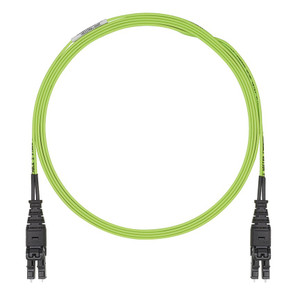
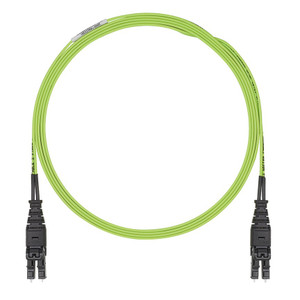
Panduit FW2ERQ1Q1NNM033 Fiber Optic Cable Assembly
The Panduit FW2ERQ1Q1NNM033 is a pre-terminated duplex fiber optic cable assembly engineered for high-performance data center, enterprise network, and structured cabling deployments where installation speed, signal integrity, and long-term reliability are non-negotiable. This factory-terminated assembly eliminates field termination risk—no epoxy curing, no polishing inconsistencies, no failed insertion-loss tests during final acceptance. Each connector is precision-polished and insertion-loss tested at the factory, shipping with test results that satisfy TIA-568 and ISO/IEC 11801 compliance documentation requirements. For integrators managing tight project schedules or deploying fiber links in occupied facilities where hot-work restrictions apply, pre-terminated assemblies cut installation time by 70% compared to field-term alternatives while delivering guaranteed optical performance from day one.
Panduit's FW2-series cable assemblies use tight-buffered 900-micron fiber construction with aramid yarn strength members and a low-smoke zero-halogen (LSZH) outer jacket, making them compliant with plenum and riser fire codes without requiring conduit in most commercial applications. The tight-buffered design provides mechanical protection superior to loose-tube outdoor cables, critical when routing through cable trays, overhead pathways, or vertical risers where the cable experiences repeated handling during MAC (moves, adds, changes) operations. The aramid yarn strength members distribute tensile load away from the fragile glass core, allowing the assembly to withstand the 110-pound maximum installation pull load specified in TIA-568 without signal degradation or physical damage. The LSZH jacket meets IEC 60332-1 and IEC 61034 flame and smoke standards, required in European deployments and increasingly specified in North American healthcare, transportation, and high-occupancy facilities where toxic smoke generation during fire is a life-safety concern.
Key Features
- Factory-terminated duplex fiber optic cable assembly with precision-polished connectors and insertion-loss test reports for TIA-568 compliance documentation
- Tight-buffered 900-micron fiber construction with aramid yarn strength members, rated for 110 lb maximum installation tensile load without signal degradation
- LSZH (Low-Smoke Zero-Halogen) outer jacket meeting IEC 60332-1 and IEC 61034 standards for reduced toxic smoke emission in fire conditions
- Duplex configuration supports simultaneous bidirectional data transmission over separate transmit and receive fibers, standard for Ethernet, Fibre Channel, and SAN applications
- Pre-terminated design eliminates field termination labor, epoxy handling, and polishing equipment requirements, reducing installation time by approximately 70%
- Each assembly ships with individual test results showing insertion loss and return loss values, satisfying project acceptance testing and warranty registration requirements
The duplex configuration provides two independent fiber strands within a single cable jacket—one for transmit, one for receive—which is the standard architecture for Ethernet protocols (1GbE, 10GbE, 40GbE, 100GbE), Fibre Channel SANs, and most active optical equipment. This eliminates the need to run two separate simplex cables for each bidirectional link, cutting pathway congestion and simplifying cable management in high-density environments like data center hot aisles or telecom closets with limited vertical riser capacity. The duplex design also enforces polarity discipline: as long as you maintain A-to-B orientation during installation (clearly marked on Panduit's connector boots), you avoid the crossed-fiber polarity errors that cause 40% of fiber link failures during commissioning.
Panduit pre-terminates each connector using automated polishing processes that produce endface geometry within the 50-nanometer radius-of-curvature tolerance required for singlemode applications and the tighter physical-contact specs demanded by 40G/100G multimode links. The factory process includes automated inspection via interferometry, ensuring each connector meets the IEC 61300-3-35 endface quality standard before the assembly ships. This matters during acceptance testing: when the customer's OTDR or optical loss test set verifies your installation, you need every connector in spec on the first test. Field-terminated connectors—even with experienced techs—introduce variables (cleave angle, epoxy cure time, polishing pressure) that lead to 10-15% rework rates on large projects. Factory terminations deliver <0.3 dB typical insertion loss and >50 dB return loss, locked in at the factory, documented on the test report in the bag.
The cable's LSZH jacket is a hard requirement in European Union installations under the Construction Products Regulation (CPR), which classifies cables by fire performance and restricts PVC jacketed cables in public buildings. Even in North America—where PVC plenum-rated cable remains code-legal—healthcare facilities, K-12 schools, airports, and transit stations increasingly specify LSZH to limit hydrogen chloride and dioxin emissions during fire. The jacket meets UL 1666 riser flame test requirements, allowing vertical riser installation without conduit in most commercial buildings, and its low-smoke characteristic means it won't trigger smoke detectors during routine hot-work like welding or cutting in adjacent spaces, a common problem with PVC-jacketed cables during tenant-improvement projects in occupied high-rises.
Installation handling is straightforward but not forgiving: respect the 110-pound maximum pull tension and the 1.5-inch minimum bend radius during installation, 3-inch minimum bend radius under static load at the patch panel. Violating bend radius causes microbending attenuation—an invisible signal loss that appears as intermittent link flapping under load, mystifying later troubleshooting because the link tests fine at low utilization. Use pull boxes every 100 feet on long horizontal runs and every two floors on vertical risers; the 110-pound rating assumes smooth pulls without sharp edges or multiple 90-degree bends compounding friction. For cable tray installations, use Panduit's fiber-rated J-hooks or cable runway with rounded edges—standard telecom cable tray with sharp forming edges can abrade the jacket during thermal expansion cycles, creating a pathway for moisture intrusion that degrades long-term optical performance.
This assembly integrates into structured cabling systems using Panduit's modular fiber enclosures, patch panels, and zone distribution boxes. The tight-buffered 900-micron construction is compatible with Panduit FAP (Fiber Adapter Panel) high-density cassettes and OptiCam pretium modules, allowing you to scale from 12-fiber to 144-fiber patching density in a single rack unit without re-terminating cables. When designing the fiber backbone, account for the assembly's fixed length—unlike copper patch cords that tolerate length over-provisioning, fiber assemblies should be cut to within 10% of actual pathway length to avoid excess service loops that create bend-radius violations inside wall boxes or rack enclosures. For new construction, use Panduit's online configurator to spec exact lengths per floor plan; for retrofit projects, field-measure each run and order custom lengths rather than cutting down longer assemblies, which voids the factory termination warranty.
The Panduit FW2ERQ1Q1NNM033 assembly ships with protective dust caps on each connector and a resealable bag containing the individual serial-numbered test report. Retain that test report for project closeout documentation—most commercial specifications require submission of factory test results for all factory-terminated assemblies as part of the as-built deliverable package. During installation, leave dust caps in place until the moment of connection; a single dust particle on the endface can cause 1+ dB insertion loss, enough to push a 10GbE link below the optical power budget margin and create intermittent errors under thermal cycling. Clean connectors immediately before mating using lint-free wipes and isopropyl alcohol (>90% purity), or use Panduit's one-click fiber optic cleaning cassettes for faster throughput on high-connector-count projects. Never use compressed air—it deposits moisture and propellant residue that attracts more contamination.
This fiber assembly meets ANSI/TIA-568.3-D performance requirements for commercial building telecommunications cabling and is manufactured in an ISO 9001:2015 certified facility under Panduit's quality management system. The LSZH jacket formulation is RoHS-compliant and REACH-registered, satisfying hazardous substance restrictions in EU and California deployments. Panduit backs the assembly with their standard manufacturer warranty covering materials and workmanship; specific warranty terms are documented in the product packaging and apply when the assembly is installed within published bend radius, tensile load, and environmental specifications. For mission-critical links supporting financial trading systems, healthcare PACS networks, or industrial control applications where optical link failure triggers operational downtime, spec pre-terminated assemblies like the FW2ERQ1Q1NNM033 to eliminate the single largest source of fiber infrastructure failure: poor field termination quality.