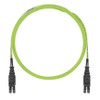
Panduit FW2ERQ1Q1NNF049 Duplex Fiber Optic Patch Cable
Panduit FW2ERQ1Q1NNF049 is a factory-terminated duplex fiber optic patch cable designed for high-density data center interconnects, enterprise backbone links, and structured cabling deployments requiring guaranteed optical performance. This assembly features precision-polished LC duplex connectors on both ends, terminated to 50/125 µm laser-optimized multimode fiber with aqua LSZH jacket construction. The cable ships with insertion loss and return loss test reports traceable to NIST standards, eliminating field termination risks and providing day-one certification compliance for TIA-568 and ISO/IEC 11801 installations. Pull-tab boot design enables single-handed extraction from crowded patch panels without damaging adjacent connections, while factory inspection ensures polarity integrity across the full cable length—critical for 40G/100G QSFP breakout applications and BiDi transceiver deployments where A-to-B polarity errors cause immediate link failure.
Key Features
- Factory-terminated LC duplex connectors with ceramic ferrules polished to <0.15 dB insertion loss typical, <0.25 dB max per mating interface—ensures margin for multi-span links and OM3/OM4 channel requirements
- 50/125 µm laser-optimized multimode fiber core supports 10GBASE-SR up to 300m (OM3) or 550m (OM4), 40GBASE-SR4 up to 150m, and 100GBASE-SR10 applications per IEEE 802.3 standards
- Aqua LSZH (Low Smoke Zero Halogen) jacket rated for plenum, riser, or general-purpose installations depending on variant—complies with IEC 60332-1 flame propagation and UL 910 plenum safety requirements where applicable
- Pull-tab boot design with 10 lb minimum pull force rating allows tool-free connector removal from high-port-count modules without finger access behind the panel—reduces installation time in 1U 96-port MPO cassette arrays
- Serialized test reports include insertion loss (dB), return loss (dB), and length measurements at 850 nm and 1300 nm wavelengths, traceable to NIST-certified reference standards—satisfies TIA-568.3-D Tier 1 component certification for permanent link budgets
- Type A polarity (A-fiber Tx to B-fiber Rx) factory-verified across the cable span—eliminates cross-wiring risks in duplex LC-to-LC links and ensures plug-and-play operation with standard transceiver pinouts
- Duplex clip secures both LC connectors as a single unit during handling and installation, preventing connector separation in cable trays and maintaining polarity alignment when routed through tight bend-radius pathways
- 50-micron bend radius minimum during installation, 25-micron static radius after termination—supports pathway routing through vertical cable managers and behind zero-U PDUs without exceeding OM3/OM4 macrobend loss thresholds
- RoHS 2.0 and REACH compliant construction with halogen-free materials—meets European Union chemical restrictions for IT equipment disposal and indoor air quality standards in occupied spaces
Panduit's factory termination process uses automated polishing and inspection systems that achieve sub-wavelength surface finish tolerances impossible to replicate with field termination kits. Each ferrule endface undergoes interferometric inspection to verify core-to-ferrule concentricity within 1.5 µm, apex offset below 50 nm, and surface geometry free of scratches, pits, or contamination per IEC 61300-3-35 standards. This level of quality control directly impacts optical link margin: a 0.10 dB improvement in connector loss translates to 25 meters of additional reach on OM3 fiber at 10 Gb/s, or the ability to add an extra mated connector pair within TIA channel loss budgets. For integrators deploying 40GBASE-SR4 or 100GBASE-SR10 parallel optics, where four or ten fiber pairs must simultaneously meet BER thresholds, factory-grade termination quality becomes mandatory—field-terminated MPO connectors routinely exhibit 1-2 dB loss variation across lanes, causing link negotiation failures that factory assemblies avoid.
The LC duplex form factor dominates enterprise and service provider networks due to its small footprint (2× the density of SC) and latch mechanism that prevents accidental disconnection during cable management. This assembly's pull-tab boot extends 8 mm beyond the standard connector body, providing a graspable surface when the cable is routed flush against adjacent connectors in 1U 48-port or 96-port panels. The boot material is low-friction thermoplastic engineered to slide past neighboring cables without snagging, and the tab itself withstands 500+ insertion cycles without tearing—a common failure mode in cheaper assemblies where techs resort to pliers or screwdrivers, damaging both the connector and the panel. For installations requiring future MACs (moves, adds, changes), this design reduces labor costs and eliminates the risk of broken ferrules or bent alignment sleeves that occur when extracting cables with insufficient grip points.
Aqua LSZH jacketing identifies the cable as laser-optimized 50/125 µm multimode fiber (OM3 or OM4 grade) per TIA-598-D color coding standards, enabling instant visual differentiation from OM1/OM2 (orange), single-mode OS2 (yellow), or OM5 wideband (lime green) fibers during troubleshooting and MAC operations. The LSZH compound emits <0.5% hydrogen chloride gas and <5% visible smoke obscuration during combustion per IEC 60754-1 and IEC 61034 tests, making it the required cable type for European installations under CPR (Construction Products Regulation) Class B2ca, Cca, or Dca ratings, and the preferred choice for enclosed spaces like risers, air-handling plenums, and under-raised-floor pathways in North American data centers where occupant egress depends on visibility and breathable air during fire events. LSZH jacketing also resists UV degradation and maintains flexibility across -20°C to +60°C operating temperatures, unlike PVC compounds that crack in cold outdoor environments or stiffen in climate-controlled server rooms, causing microbend attenuation spikes when cables are dressed into tight bundles.
This cable assembly integrates into structured cabling architectures as a Equipment Cord (horizontal) or Backbone Cord (vertical) per TIA-568.0-E definitions, connecting active equipment ports to consolidation points, zone distribution areas, or main/intermediate cross-connects. When deployed as part of a permanent link, the assembly's factory test data contributes to the overall channel insertion loss budget: TIA-568.3-D allows 2.0 dB maximum loss for OM3 channels up to 300m at 850 nm, of which connector losses typically consume 0.50-0.75 dB (2-3 mated pairs), leaving 1.25-1.50 dB for cable attenuation and splice losses. Integrators can reference the serialized test report to calculate exact worst-case loss before energizing transceivers, avoiding the trial-and-error troubleshooting that occurs when installers assume generic 0.75 dB/connector budgets and discover links fail to train at 10 Gb/s due to cumulative connector geometry variations. For 40G/100G deployments using MPO-to-LC breakout modules, this LC duplex cable serves as the final equipment cord between the breakout cassette and the switch QSFP port's duplex LC adapter, where polarity type (A, B, or C) must align with the cassette's internal fiber mapping—Panduit's factory-verified Type A polarity ensures compatibility with Method A (straight-through) cassettes and standard duplex transceivers without requiring crossover adapters or field re-termination.