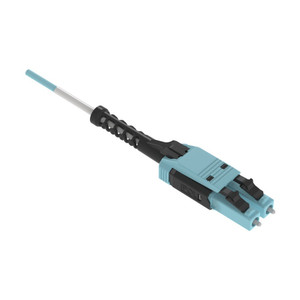
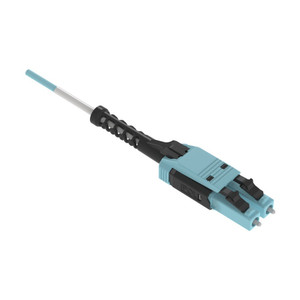
Panduit FW2ELQ1Q1NNM049 Duplex Fiber Optic Patch Cable Assembly
The Panduit FW2ELQ1Q1NNM049 is a factory-terminated duplex fiber optic patch cable engineered for high-performance data transmission in security surveillance backbones, enterprise networks, and data center interconnects. This 49-foot assembly features LC duplex connectors on both ends with optimized insertion loss and return loss characteristics, eliminating field termination labor while delivering certified performance out of the box. Designed for integrators deploying IP camera infrastructures, NVR-to-switch links, or building-to-building fiber runs, this cable provides the reliability and bandwidth headroom required for 10G/25G/40G Ethernet applications common in modern video surveillance and access control networks. Panduit's precision manufacturing ensures consistent optical performance across the entire length, with rigorous end-face geometry inspection and continuity testing at the factory to meet or exceed industry standards for multimode fiber transmission.
Key Features
- Factory-terminated LC duplex connectors on both ends for plug-and-play installation
- 49-foot (15-meter) cable length ideal for rack-to-rack, floor-to-floor, or cross-building links
- Multimode fiber construction supporting 10GBASE-SR, 25GBASE-SR, and 40GBASE-SR4 applications
- Low insertion loss and high return loss specifications for maximum link budget efficiency
- Durable jacket rated for plenum or riser installations depending on cable grade
- Color-coded boot and jacket for quick visual identification in dense fiber installations
- TIA-568 and ISO/IEC 11801 compliant for standards-based network deployments
- Precision-polished connector end-faces tested for geometry and optical performance
Panduit's FW2ELQ1Q1NNM049 fiber assembly addresses the critical challenge of maintaining signal integrity across extended distances in IP surveillance and enterprise networks. In security installations where NVRs aggregate hundreds of high-resolution camera streams, the 49-foot reach of this cable provides the flexibility to position recording equipment in secure server rooms while maintaining switch connectivity in wiring closets or telecommunication rooms. The LC duplex form factor has become the de facto standard in modern fiber infrastructure due to its small footprint—integrators can achieve twice the port density of SC connectors in the same rack space, a crucial advantage when deploying high-channel-count managed switches for large camera arrays. The factory-terminated design eliminates the variability and labor cost of field terminations; each connector is fusion-spliced or epoxy-polished under controlled conditions, then tested with interferometric inspection equipment to verify end-face geometry meets the stringent requirements for low-loss, low-reflection connections. This is particularly important in security applications where link budget margin directly impacts the ability to support future camera upgrades from 5MP to 4K or beyond without re-cabling the backbone.
The 49-foot length of the FW2ELQ1Q1NNM049 falls into the sweet spot for inter-floor and cross-corridor runs in commercial buildings. For integrators running fiber from a main equipment room on one floor to an IDF (intermediate distribution frame) on the floor above, this length provides enough slack for proper cable management—including service loops at both termination points and routing through overhead cable trays or under-floor conduit—without excessive waste. In data center environments, this cable supports connections between core switches and distribution-layer aggregation switches positioned in adjacent rows or at opposite ends of a hot-aisle/cold-aisle layout. The multimode fiber core (OM3 or OM4 depending on specific variant) supports 10 Gigabit Ethernet transmission up to 300 meters and 40 Gigabit Ethernet up to 100 meters, giving integrators substantial headroom for high-bandwidth applications. A typical deployment scenario: a 128-channel NVR with dual 10GbE uplinks connects to a core switch 40 feet away via two of these assemblies, delivering aggregate throughput of 20 Gbps to handle 4K camera streams with H.265 compression and simultaneous client playback, analytics processing, and offsite replication.
The LC connector interface on this assembly is optimized for compatibility with the full range of enterprise and surveillance-grade network equipment. SFP+ and SFP28 optical transceivers—used in managed PoE switches from Cisco, HPE Aruba, Ubiquiti, and other manufacturers—universally support LC connectors, making this cable a direct-fit solution for connecting switches to routers, NVRs, or fiber media converters. The duplex configuration (two fibers in a single cable) supports full-duplex communication, with one fiber handling transmit (Tx) and the other handling receive (Rx). Panduit uses precise fiber alignment within the ferrule to maintain core-to-core concentricity, minimizing insertion loss at the mating interface; typical insertion loss for factory-terminated LC assemblies is under 0.5 dB, well within the 2.5–3.5 dB loss budget for 10GBASE-SR links. Return loss—a measure of back-reflection at the connector interface—exceeds 20 dB, preventing signal degradation from reflected energy. These optical performance parameters are critical in security networks where switches often operate at 80–90% port utilization during peak recording hours, leaving little margin for link errors or retransmissions.
Installation of the FW2ELQ1Q1NNM049 is straightforward but requires attention to fiber handling best practices. Unlike copper cabling, fiber optic cables have minimum bend radius limits—typically 10 times the cable diameter for multimode assemblies under load, and 20 times for tight 180-degree bends. Installers should avoid sharp kinks or pinch points when routing through cable trays or around corner guards; the Panduit jacket is designed to withstand typical installation stresses, but excessive bending can induce microbending losses that degrade optical performance. At each termination point, leave a service loop of at least 3 feet coiled and secured with Velcro straps (never zip ties directly on the fiber jacket, which can cause compression damage). When connecting to SFP transceivers, remove dust caps from both the cable connector and the transceiver port immediately before mating, and insert the connector with a firm push until you feel the latch click into place. Proper latch engagement is essential—a partially seated connector will exhibit intermittent link drops or elevated bit error rates. After installation, verify link status using the switch's interface monitoring tools; most managed switches report optical power levels in dBm for both transmit and receive paths. For a properly installed FW2ELQ1Q1NNM049, expect receive power in the range of -3 to -10 dBm on 10GBASE-SR links, depending on transceiver specifications and total link loss.
This Panduit fiber assembly is particularly well-suited for integrators building out NIST 800-53 or ISO 27001 compliant security infrastructure. Fiber optic cabling provides inherent immunity to electromagnetic interference (EMI) and radio frequency interference (RFI), a critical advantage in industrial or healthcare environments where surveillance cameras operate alongside MRI equipment, motor controllers, or high-power RF transmitters. Unlike copper cabling, fiber does not radiate electromagnetic signals, making it extremely difficult to tap or eavesdrop without physical access and specialized equipment—an important consideration for high-security applications in government facilities, correctional institutions, or financial data centers. The LC duplex form factor supports easy integration with encrypted fiber media converters or SFP modules featuring MACsec (802.1AE) encryption, enabling end-to-end Layer 2 encryption for camera streams traversing untrusted network segments. For projects requiring NDAA compliance or TAA-compliant procurement, verify the Panduit country-of-origin documentation; Panduit maintains manufacturing facilities in multiple regions to support various regulatory requirements.
The FW2ELQ1Q1NNM049 integrates seamlessly into structured cabling deployments following TIA-568 standards for commercial building telecommunications infrastructure. In a typical three-tier security network architecture—with cameras at the access layer, PoE switches at the distribution layer, and NVRs/core switches at the core layer—this 49-foot cable provides the physical link between distribution and core layers. When designing fiber backbone capacity, integrators should calculate aggregate bandwidth based on camera count, resolution, frame rate, and compression efficiency, then add 30–40% overhead for future expansion. A 64-camera system with 4MP cameras at 20 fps and H.265 compression averages 4 Mbps per stream, totaling 256 Mbps aggregate—easily handled by a single 1GbE fiber link. However, best practice is to provision 10GbE links using assemblies like the FW2ELQ1Q1NNM049 to accommodate peak burst traffic (during motion events or simultaneous playback of multiple streams), analytics processing (which often requires pulling full-resolution frames), and growth to 4K cameras in the next 3–5 years. Dual fiber links configured in LACP (Link Aggregation Control Protocol) provide both bandwidth aggregation and redundancy, a common requirement in 24/7 surveillance installations where network downtime directly impacts security coverage.
Maintenance and troubleshooting of fiber optic links involves different tools and techniques than copper cabling. The most common failure mode for factory-terminated assemblies is contamination of the connector end-face—even microscopic dust particles or skin oils can cause significant insertion loss or complete link failure. If a link fails to establish or shows degraded performance after initial installation, the first step is to inspect and clean both the cable connector and the transceiver port using a fiber optic cleaning pen or lint-free cleaning cassette. Never use compressed air, which can drive contaminants deeper into the ferrule. For persistent issues, a fiber optic inspection microscope (400x magnification) can reveal scratches, cracks, or contamination on the connector end-face. If the end-face is damaged, the assembly must be replaced—field re-polishing of factory connectors is not recommended. For troubleshooting more complex issues such as excessive insertion loss across the link, use a fiber optic power meter and light source (or an OTDR for longer links) to measure attenuation and identify fault locations. Panduit's factory test documentation provides baseline insertion loss and return loss values for each assembly, which can be compared against field measurements to verify performance.
The Panduit FW2ELQ1Q1NNM049 represents a professional-grade fiber solution for security integrators who need reliable, certified performance in backbone and inter-building connectivity. Its 49-foot length, LC duplex termination, and factory-tested optical characteristics make it a direct-fit choice for the high-bandwidth, low-latency networks that modern IP surveillance demands. Panduit's reputation for precision manufacturing and comprehensive testing ensures that each assembly meets the optical performance specifications required for multi-gigabit Ethernet transmission, while the standardized LC interface provides compatibility across the full range of enterprise networking equipment. For projects where fiber backbone reliability is critical—whether supporting hundreds of 4K cameras in a casino, connecting multiple IDFs in a hospital campus, or building out a secure government facility network—this assembly delivers the performance and consistency that professional integrators require.