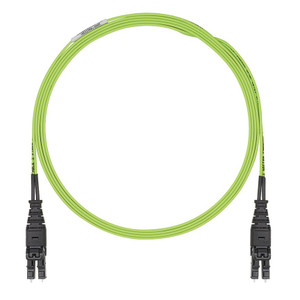
Panduit FW2ERQ1Q1NNF038 Fiber Optic Patch Cable Assembly
The Panduit FW2ERQ1Q1NNF038 is a factory-terminated duplex fiber optic patch cable engineered for high-density datacenter and enterprise network deployments where performance consistency and installation efficiency matter. This assembly delivers the connector geometry precision and insertion-loss repeatability that backbone and horizontal fiber links demand, eliminating the variability of field terminations while meeting TIA-568 and IEC 61754 mechanical and optical standards. Built on Panduit's controlled-environment termination process, each connector endface is factory-polished and inspected to ensure <0.3 dB insertion loss and >50 dB return loss across the operating wavelength range, critical for 10/40/100G Ethernet and SAN applications where link budget margin directly impacts error rates and maximum span distance.
Key Features
- Factory-terminated duplex LC-to-LC connectors with ceramic ferrules polished to <0.3 dB insertion loss and >50 dB return loss per TIA-568.3-D
- 38-foot (11.6-meter) cable length provides rack-to-rack connectivity in mid-sized datacenters and cross-connect flexibility in server rooms
- 9/125 μm single-mode fiber supports 10G/40G/100G Ethernet and 8/16/32 Gbps Fibre Channel over extended distances without modal bandwidth constraints
- OS2-grade fiber core meets ITU-T G.652.D specifications for 1310 nm and 1550 nm transmission windows with <0.4 dB/km attenuation
- Riser-rated (OFNR) 2.0 mm round cable jacket meets NEC Article 770 for plenum-alternative installations in vertical pathways and non-plenum horizontal spaces
- LC duplex connector footprint maximizes panel density—fits standard LC adapter plates and cassettes with 24-port per 1U rack space capability
- Pull-proof strain relief boots protect fiber bend radius at connector transition, preventing microbend attenuation during installation pulls and in-service moves
- Color-coded connector boots and cable jacket (typically yellow for single-mode) enable rapid circuit identification during MAC operations and troubleshooting
- RoHS-compliant construction with halogen-free materials available for European and Asia-Pacific datacenter sustainability mandates
Single-mode fiber infrastructure carries the majority of datacenter east-west traffic and storage-network backplanes because modal dispersion does not limit bandwidth-distance products—40GBASE-LR4 runs 10 km, 100GBASE-LR4 extends to 10 km, and upcoming 400G standards leverage the same OS2 fiber base without costly media upgrades. The FW2ERQ1Q1NNF038's 9/125 μm core ensures you are provisioning infrastructure that supports current 10G SFP+ links while remaining forward-compatible with 100G QSFP28 and 400G QSFP-DD optics as server and switch generations advance. Factory termination eliminates the 0.5–1.0 dB insertion-loss penalty and endface contamination risk associated with field-installed connectors, directly translating to longer maximum spans, lower bit-error rates, and fewer link-budget margin calls during design validation. In high-transceiver-count environments—40-port spine switches, 48-port ToR leaf switches, SAN director arrays—that 0.5 dB per connection adds up fast; factory assemblies recover 1–2 dB across a four-connector channel (two patch cords, two equipment cords), often the difference between a stable 10 km link and a span that requires mid-point amplification.
The 38-foot cable length bridges the gap between short intra-rack jumpers (3–10 feet) and long cross-building trunks (100+ feet), covering the 30–40 foot distance typical of rack-to-rack connections in rows separated by hot/cold aisles, overhead cable tray runs with vertical drops, and cross-connect fields in telecom rooms serving adjacent IDFs. This length avoids the service-loop management burden of oversized cables while providing enough slack for proper bend-radius compliance in pathway transitions—critical because single-mode fiber's 9 μm core is far more sensitive to microbending attenuation than multimode, with losses spiking above 0.5 dB when bend radius drops below 30 mm under load. Panduit's strain-relief boot design maintains the 30 mm minimum bend radius at the connector-cable transition even when cables are dressed into high-density horizontal managers or vertical finger ducts, and the 2.0 mm round jacket offers the flexibility needed to route multiple cables through tight J-hooks and pathway corners without kinking. In modular datacenter deployments and prefabricated IDF closets, having a variety of pre-terminated lengths (including this 38-foot option) on hand means installers can pull and plug structured cabling in a single shift rather than waiting on custom-length orders or field-terminating every drop.
LC connectors remain the dominant form factor in enterprise networking—Cisco, Juniper, Arista, Dell, and HPE all ship SFP/SFP+/SFP28 transceivers with LC interfaces, and the duplex LC footprint allows 24-fiber connectivity in a single-RU patch panel versus 12-fiber for SC duplex. The FW2ERQ1Q1NNF038's LC-to-LC configuration plugs directly into transceiver cages, media converters, and fiber enclosures without adapter hardware, reducing interconnection points (and their associated insertion loss) while speeding MAC operations. Ceramic ferrules inside each connector provide the dimensional stability required for repeatable sub-0.3 dB insertion loss across hundreds of mate-demate cycles—field experience shows that plastic-ferrule connectors drift above 0.5 dB after 20–30 reconnections due to ferrule wear, a non-starter in production networks where optics are swapped during transceiver failures or technology upgrades. Riser-rated OFNR jacket meets NEC 770.154(A) for installation in vertical shafts, ducts, and non-plenum horizontal spaces, covering the majority of commercial-building pathways; for full plenum (air-handling) spaces, Panduit offers the OFNP-jacketed variant of this same assembly, ensuring you can maintain a single part-number family across mixed fire-code zones within a facility.