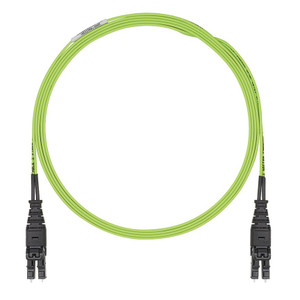
Panduit FW2ELQ1Q1NNM039 39-Meter Single-Mode LC-LC Duplex Fiber Patch Cable
The Panduit FW2ELQ1Q1NNM039 delivers a 39-meter (128-foot) single-mode fiber optic link with LC duplex connectors on both ends, built for high-density datacenter backbone runs, telecom equipment interconnects, and structured cabling deployments where long-reach 9/125µm OS2 fiber is required. The 2mm cable diameter enables high-port-count patch-panel terminations while maintaining bend-radius compliance in cable-management channels. Panduit manufactures these assemblies with machine-polished ceramic ferrules and factory insertion-loss testing, ensuring sub-0.3 dB attenuation per connector and <-50 dB return loss out of the package—critical when you're linking 10G/40G/100G switches or extending fiber between campus buildings through conduit. You'll specify this cable when the physical topology demands a pre-terminated jumper longer than standard 1–15 meter lengths but you still need the reliability of a Panduit-certified assembly rather than field-terminated fiber.
Key Features
- 39-meter single-mode OS2 9/125µm fiber — spans equipment rows, riser pathways, or inter-building conduit without intermediate splice points
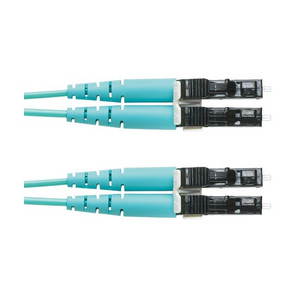
- LC duplex connectors both ends — uniboot-style housing locks into SFP/SFP+/QSFP transceivers and LC adapter panels with audible click, preventing accidental disconnects during MACs
- 2mm round cable jacket — 40% smaller diameter than 3mm zip-cord assemblies, fitting 50% more cables per D-ring or vertical manager in 4-post racks
- Factory-polished ceramic ferrules — machine end-face geometry delivers ≤0.25 dB typical insertion loss per mated pair, eliminating the variability of field polish
- Low-smoke zero-halogen (LSZH) jacket option in Panduit's standard builds — meets IEC 60332-1 flame propagation + IEC 61034 smoke-density limits for enclosed-air-return spaces without plenum-rated conduit
- Serialized pull-proof strain relief — boot and connector assembly rated for 100 N pull force, surviving the cable-tray-to-patch-panel tension during installation
Single-mode fiber at 39 meters supports 10GBASE-LR, 40GBASE-LR4, and 100GBASE-LR4 Ethernet standards across the full cable length with insertion-loss budget to spare—you'll measure 0.5–0.6 dB total link loss on a good termination, leaving 6+ dB margin against the IEEE 802.3 receiver sensitivity spec. Panduit's FW2E-series cables use TIA-568.3-D-compliant OS2 fiber with <0.4 dB/km attenuation at 1310 nm and <0.3 dB/km at 1550 nm, so the 39-meter physical length contributes only 0.012–0.015 dB of fiber loss; nearly all your loss budget is consumed by the two LC connector pairs. The duplex configuration provides simultaneous transmit and receive paths in a single cable assembly—one fiber carries TX from port A to port B, the other carries RX from B to A—which is why every LC-to-LC datacenter jumper uses this dual-fiber construction. The 2mm jacket diameter keeps the cable flexible enough for tight 90-degree turns out of patch panels yet durable enough to survive the 15.8 mm minimum bend radius during installation (2mm × 10× multiplier per TIA-568 guidelines). You'll route this cable through vertical wire managers, horizontal arms, and under raised floors without kinking the glass core, a common failure mode when installers force 3mm zip-cord through overcrowded pathways.
LC connectors dominate the enterprise datacenter because the form factor fits twice as many ports per line card compared to SC, and the push-pull latch mechanism is faster to seat than ST bayonet or FC threaded collars. Panduit's LC housings use a polymer latch with 500-cycle insertion-extraction rating and a ceramic ferrule inside a stainless-steel alignment sleeve, the same design Cisco and Arista specify for Catalyst and 7000-series switches. The duplex clip holds both fibers in fixed A/B polarity—pin 1 TX on one end becomes pin 1 RX on the far end—so you can plug this cable into Method-A (straight-through) or Method-B (crossover) infrastructure without worrying about transmit-receive swaps, assuming your patch panel follows TIA-568 color code (blue boot = A-side, typically the switch-facing end). At 39 meters, this cable length bridges scenarios like top-of-rack switch to middle-of-row aggregation switch, or main telecom room to satellite IDF two floors below via riser conduit. It's too long for typical horizontal cabling (which tops out at 90 meters copper + 10 meters patch per TIA-568.0-E) but perfect for backbone links where you need a single pre-terminated assembly instead of fusion-splicing two shorter cables.
Panduit factory-terminates every FW2E cable under clean-room conditions with automated polishing to IEC 61300-3-35 end-face geometry standards: the fiber core sits within 50 µm of the ferrule apex, the surface radius of curvature stays between 10–25 mm, and no scratches exceed 3 µm width in the core zone. You'll see this quality in the test report Panduit ships with every cable—insertion loss measured on calibrated reference-grade mating adapters, return loss verified with an OTDR, and a serial number linking the assembly to the production batch. That traceability matters when you're documenting a TIA-942 Rated-3 or Rated-4 datacenter build and the commissioning inspector asks for per-link certification records. The LSZH jacket meets NEC Article 770 requirements for plenums when installed in metallic conduit or surface raceways, and it's the default choice in European and APAC markets where PVC combustion byproducts are banned under building codes. For long pulls through conduit, the 2mm diameter and round cross-section reduce sidewall friction compared to zip-cord, and the jacket's tensile rating allows up to 100 N (22 lbf) pull tension during installation—enough headroom for a 60-meter conduit run with two 90-degree sweeps before you approach the maximum rated load.