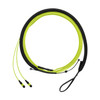
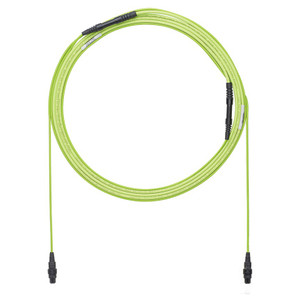
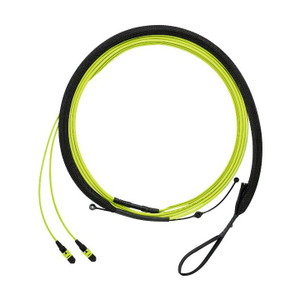
Panduit FWUYL7575LNM042 QuickNet 24-Fiber OM5 Trunk Cable Assembly
The Panduit FWUYL7575LNM042 is a 24-fiber OM5 wideband multimode trunk cable assembly engineered for high-density data center deployments where space optimization and rapid infrastructure buildout intersect. This 42-meter QuickNet™ trunk delivers up to 40% space savings over traditional cable bundles while maintaining full TIA-568-C.3 compliance, making it the practical choice for installations facing cabinet congestion, limited pathway capacity, or aggressive project timelines. The lime LSZH jacket provides both fire-safe operation in enclosed plenums and instant visual identification during multi-trunk routing.
Key Features
- 24-fiber OM5 wideband multimode trunk supporting 40/100 Gb/s applications and short-wave wavelength division multiplexing (SWDM) for future 200/400 Gb/s migration paths
- 42-meter (137.8 ft) factory-terminated assembly eliminates field termination labor, fusion splice delays, and OTDR testing loops on extended intra-facility runs
- Small-diameter trunk design uses 30–40% less pathway space than equivalent individual duplex cables, freeing congested overhead trays and underfloor conduits
- Lime LSZH (Low Smoke Zero Halogen) jacket rated for enclosed-space fire safety with reduced toxic gas emission during thermal events
- QuickNet™ pre-terminated format cuts installation time by 60–70% versus on-site fusion splicing, shipping with factory OTDR insertion-loss certification
- 50 µm graded-index fiber core optimized for 850 nm and 950 nm VCSEL transmission, supporting 100 m reach at 40 Gb/s and OM5-spec SWDM distances
- TIA/EIA-568-C.3, ISO/IEC 11801, TIA-492-AAAD, and IEC 60793-2-10 A1a.3 compliant for standards-driven campus and data center backbone installations
- Factory-installed MPO connectors aligned for polarity method A, B, or C trunk-to-trunk or trunk-to-cassette breakout deployments
- RoHS compliant construction meets green-building material requirements for LEED and ISO 14001 certified facilities
OM5 wideband multimode fiber represents the current endpoint in laser-optimized 50 µm multimode evolution, originally standardized in TIA-492-AAAD to support short-wave wavelength division multiplexing (SWDM) across four wavelength channels (850, 880, 910, 940 nm). While OM4 fiber delivers excellent performance at 850 nm VCSEL wavelengths, OM5's tightened differential mode delay (DMD) and reduced effective modal bandwidth variation across the 850–950 nm window allow parallel optics transceivers to aggregate multiple wavelengths over a single fiber pair, quadrupling effective bandwidth without increasing fiber count. For data center operators, this means the FWUYL7575LNM042 trunk will support current 40GBASE-SR4 and 100GBASE-SR4 deployments at their full 100-meter OM4-equivalent reach, while providing a hardware-ready migration path to future 200 Gb/s and 400 Gb/s SWDM optics that leverage OM5's wideband characteristics. The 24-fiber count in this trunk translates to twelve duplex channels or six quad-lane 40/100 Gb/s links, aligning with common top-of-rack to spine switch architectures and blade-server backplane uplink densities. The 42-meter length sits in the extended range for intra-building backbone runs—long enough to span multi-floor riser closets, cross-building pathways, or deep data hall equipment rows, yet short enough to remain within OM5's 100-meter channel limit for 40 Gb/s applications, avoiding the cost jump to single-mode infrastructure.
Field deployment of this QuickNet trunk directly addresses three chronic pain points in high-velocity data center builds: installation time, pathway congestion, and quality assurance overhead. Traditional fiber deployment involves pulling individual duplex or simplex cables, mounting enclosures, fusion-splicing pigtails, polishing connectors, labeling each circuit, and performing per-link OTDR insertion loss and return loss verification—a process that can consume 45–60 minutes per duplex link for a skilled technician. A 24-fiber trunk delivering twelve duplex circuits compresses that workflow into a single pull, two MPO connector insertions, and a factory-provided test report, cutting site labor by an estimated 8–10 hours per trunk. The small-diameter construction becomes critical in retrofit scenarios and high-density greenfield builds where overhead ladder rack, cable tray, or raised-floor conduit fill ratios approach NEC Article 770 limits. By occupying 30–40% less cross-sectional area than an equivalent bundle of twelve LC duplex cables, the FWUYL7575LNM042 trunk preserves airflow in underfloor plenums, reduces cable-tray sag loads, and leaves headroom for future circuit additions without triggering expensive pathway expansion or fire-stopping re-certification. The lime LSZH jacket color serves a dual function: the low-smoke zero-halogen compound meets international fire-safety requirements for enclosed spaces (critical in European installations and jurisdictions adopting IEC 61034/60754 standards), while the high-visibility lime hue allows installers to visually trace backbone routes in mixed-infrastructure environments where orange OM2, aqua OM3/OM4, and lime OM5 trunks converge at distribution frames. This color-coding reduces mis-patching risk during maintenance windows and simplifies audit documentation for DCIM platforms tracking physical layer topology.
Pre-terminated trunk assemblies eliminate the three largest sources of field installation variability: connector endface geometry inconsistencies from hand polishing, fusion splice loss accumulation from technician skill variations, and documentation gaps when per-link test reports don't make it into as-built drawings. Panduit's factory termination process uses automated MPO connector ferrule polishing to achieve consistent endface geometry across all twelve fiber positions, followed by interferometric inspection to verify surface finish quality and core-to-ferrule concentricity. Each trunk ships with an OTDR insertion loss test report documenting performance against TIA-568.3-D Tier 2 random-mated limits (≤0.35 dB per connection for multimode), providing day-one documentation for structured cabling warranty activation and future troubleshooting baselines. The MPO connector format supports field polarity management through three industry-standard methods: Method A (straight-through key-up to key-up for use with cross-over adapter modules), Method B (one end rotated 180° for direct trunk-to-trunk mating), and Method C (pair-flipped array for specific cassette types). Installers working with Panduit's FHD cassette system, Corning's Pretium Edge modules, or any TIA-604-5 (FOCIS-5) compliant MPO cassette can specify polarity method at order time or use field-swappable gender-changing adapters to match existing infrastructure without re-terminating the trunk.
The LSZH jacket formulation addresses a specific regulatory and risk-management gap in traditional PVC-jacketed cables. When PVC burns, it releases hydrochloric acid gas and dense black smoke—both immediate life-safety hazards in enclosed evacuation routes and long-term contamination risks for sensitive electronic equipment. LSZH compounds substitute halogen-free polymers that produce minimal visible smoke (typically <10% light obscuration per IEC 61034-2) and negligible acid gas (<0.5% hydrogen chloride per IEC 60754-1) during combustion. For data centers operating in jurisdictions with adopted IEC standards (EU, UK, Middle East, Asia-Pacific), LSZH is often code-required for plenum and riser spaces. In North America, where NEC Article 770 allows plenum-rated (OFNP) PVC cables, specifying LSZH represents a voluntary upgrade—trading a 10–15% cost premium for reduced equipment damage and business-continuity risk in the event of a cable-tray fire. The lime jacket color provides instant differentiation from aqua OM3/OM4 trunks and orange OM1/OM2 legacy infrastructure, allowing maintenance teams to visually verify upgrade completion during phased OM5 rollouts and preventing accidental patching of dissimilar fiber grades that would limit channel performance to the lowest common specification.
The FWUYL7575LNM042 ships with full TIA/EIA-568-C.3, ISO/IEC 11801 Ed. 2.2, and TIA-492-AAAD compliance certification, ensuring compatibility with structured cabling warranty programs and interoperability with standards-compliant MPO cassettes, breakout modules, and fiber enclosures across manufacturers. The QuickNet trunk format integrates into Panduit's broader FHD (Flex HD) and FAP (Fiber Adapter Panel) ecosystems while maintaining cross-vendor compatibility with Corning Edge, CommScope SYSTIMAX, and Leviton Opt-X systems through adherence to TIA-604-5 MPO connector interface standards. For installations subject to LEED, WELL Building, or ISO 14001 environmental compliance, the RoHS-compliant construction satisfies green-building material restrictions without requiring exemption documentation. This trunk is the appropriate choice for network architects designing 40/100 Gb/s leaf-spine fabrics with OM5 future-proofing, facility managers retrofitting legacy pathways under space constraints, contractors facing accelerated delivery schedules where field termination time impacts critical-path milestones, and operators planning for 200/400 Gb/s SWDM optics migration within existing OM5-capable physical infrastructure.