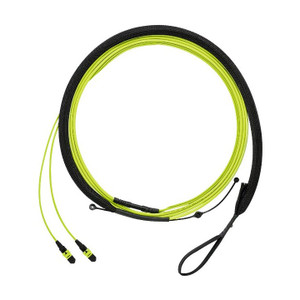
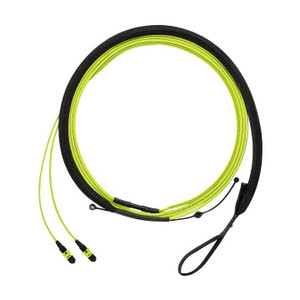
Panduit FWUYL7575KNM018 QuickNet 24-Fiber OM5 Trunk Cable Assembly
High-density 100G and 400G datacenter fabrics demand fiber infrastructure that delivers extended reach, tight bend radius, and pathway efficiency. The Panduit FWUYL7575KNM018 QuickNet trunk cable assembly addresses all three: 24 fibers of OM5 wideband multimode in an 18-meter (59 ft) preterminated trunk with LSZH jacketing. Small-diameter construction saves 30 to 40 percent of pathway space compared to traditional breakout cables, while OM5's short-wavelength division multiplexing (SWDM) capability extends 100GBASE-SR4 reach to 100 meters and positions the link for future 400G-SWDM8 optics without rip-and-replace.
Key Features
- 24-fiber OM5 (50/125 μm) wideband multimode optimized for SWDM and parallel optics
- 18-meter (59 ft) length for MDA-to-HDA, row-to-row, or leaf-spine distribution
- QuickNet preterminated MPO connectors eliminate field termination and reduce installation time by 80%
- Small-diameter trunk design consumes 30–40% less conduit and cable tray space than breakout assemblies
- LSZH (Low Smoke Zero Halogen) jacket meets international fire safety requirements for enclosed spaces
- Lime jacket color per TIA-568 OM5 identification standard
- Meets TIA-568-C.3, ISO/IEC 11801, IEC 60793-2-10 type A1a.3, and TIA-492-AAAD standards
- Factory-tested insertion loss and end-face geometry for reliable Day 1 performance
- RoHS compliant for global deployment
OM5 fiber represents the current apex of multimode technology. While OM3 and OM4 fibers are optimized for 850 nm laser transmission, OM5 extends bandwidth across the 850–950 nm window, enabling short-wavelength division multiplexing. In practical terms, this means a single OM5 fiber pair can carry four 25G lanes (100GBASE-SR4) at 100 meters—matching OM4's reach—while also supporting SWDM variants that double effective bandwidth without requiring additional fibers. The FWUYL7575KNM018's 24-fiber count translates to twelve duplex pairs or two 12-fiber MPO channels, enough to support a full leaf switch uplink (4× 100G QSFP28 ports using 8 fibers each) or a single 400G-SR8 link with room for future expansion. OM5 maintains backward compatibility with OM3 and OM4 optics, so existing 10G, 40G, and 100G transceivers operate without modification. Panduit's QuickNet manufacturing process pre-polishes connector end faces to sub-0.15 dB insertion loss and better than -40 dB return loss, eliminating the variability and installation time associated with field terminations. Each connector undergoes automated interferometric inspection to verify end-face geometry meets IEC 61300-3-35 grade-B limits for fiber height, radius of curvature, and apex offset—critical parameters that determine whether a 100-meter OM5 link will achieve its full bandwidth at 100G and beyond.
Trunk cable assemblies like the FWUYL7575KNM018 are the backbone of structured cabling in modern datacenters. Unlike breakout cables—where a central trunk splits into individual duplex LC or SC connectors—a trunk assembly maintains all 24 fibers in a single protective jacket from end to end, terminating in MPO connectors that mate with patch panels, cassette modules, or direct-attach equipment ports. The result is a 70–80% reduction in cable bulk at cross-connect points and a dramatic improvement in airflow management. An 18-meter length fits the typical main distribution area (MDA) to horizontal distribution area (HDA) run in a raised-floor datacenter, or the row-to-row link in a leaf-spine Clos fabric where spine switches sit in a central hot aisle and leaf switches distribute across the room. The small-diameter design becomes critical in these scenarios: a bundle of twelve 24-fiber trunks occupies the same pathway space as roughly seven traditional breakout cables, freeing up conduit capacity for power or future fiber adds. Installation speed is another advantage. Field termination of 24 fibers would require roughly four hours of labor plus fusion splicing or mechanical termination hardware; a preterminated trunk goes in-place in under ten minutes, with zero risk of contamination or misalignment. The jacketed trunk construction also provides superior mechanical protection during installation—individual breakout legs are vulnerable to snag and kink damage when pulled through crowded cable trays, while the FWUYL7575KNM018's continuous jacket maintains a uniform bend radius and distributes tensile load across the entire assembly.
MPO (Multi-Fiber Push-On) connectors have become the de facto standard for high-density datacenter fiber because they pack 12 or 24 fibers into a single connector body roughly the size of an RJ45 jack. The FWUYL7575KNM018 uses factory-installed MPO connectors with alignment pins on one or both ends (polarity method A, B, or C depending on link architecture). The connector ferrule is a precision-molded rectangular block with a 12-fiber or 24-fiber array at 250 μm pitch, held in alignment by guide pins that mate with corresponding holes in the opposing connector. This mechanical alignment tolerance is ±0.5 μm—tighter than anything achievable with field termination—and it's why MPO links routinely achieve <0.35 dB insertion loss per mated pair even with 12 connections in parallel. Panduit's QuickNet line uses stainless steel guide pins with a 0.699 mm nominal diameter, compliant with IEC 61754-7 and TIA-604-5 (FOCIS-5). The connector boots are molded in lime to match the cable jacket, and they include integrated pull tabs for one-handed mating and extraction in tight spaces. A critical but often overlooked detail: MPO connectors are gender-specific (male with pins, female without), and polarity method determines whether you need a straight-through or key-up-to-key-down orientation at the far end. Panduit ships QuickNet trunks with a polarity label on each connector boot and a detailed polarity map in the product documentation, eliminating the guesswork that can lead to Tx-Rx misalignment and a dead link.
The LSZH jacket addresses fire safety and regulatory requirements that are mandatory in many international markets and increasingly common in North American hyperscale builds. LSZH compounds produce 30–50% less smoke and virtually no halogenated acid gases (hydrochloric acid, hydrobromic acid) during combustion compared to PVC, reducing toxicity risk for personnel and corrosion risk for sensitive electronics. While LSZH cables historically carried a bend-radius penalty, Panduit's small-diameter construction maintains a minimum bend radius of 10× cable OD during installation and 5× OD when dressed, comparable to plenum-rated PVC assemblies. The lime jacket color follows the TIA-568 standard for OM5 identification, preventing accidental cross-patching with OM3 (aqua) or OM4 (magenta) links that could limit performance to legacy 10G or 40G speeds. The cable's outer diameter is typically 5.5–6.5 mm for a 24-fiber trunk, compared to 8–10 mm for a traditional round breakout cable carrying the same fiber count, and that 30–40% space reduction compounds quickly: a 4-inch conduit that maxes out at 18 breakout cables can accommodate 28 small-diameter trunks, an extra 55% capacity for the same pathway investment. The jacket material also exhibits superior abrasion resistance and UV stability compared to PVC, critical for cables that may be exposed to cleaning solvents, occasional sunlight in loading dock areas, or mechanical wear from repeated moves-adds-changes.
Compliance with TIA-568-C.3, ISO/IEC 11801 Edition 2.2, IEC 60793-2-10 type A1a.3, and TIA-492-AAAD ensures interoperability with any standards-compliant optics or infrastructure, and RoHS certification clears the regulatory path for EU, UK, and Asia-Pacific deployments. TIA-568-C.3 specifies the optical performance requirements for OM5 cabling (effective modal bandwidth ≥4700 MHz·km at 850 nm and ≥2470 MHz·km at 953 nm), while IEC 60793-2-10 type A1a.3 defines the fiber's physical and transmission characteristics. TIA-492-AAAD is the detailed fiber specification that covers attenuation, bandwidth, and chromatic dispersion limits. Meeting all four standards means the FWUYL7575KNM018 will support any IEEE 802.3, Fibre Channel, or InfiniBand application designed for OM5 fiber, from 10GBASE-SR at 300 meters down to 400GBASE-SR8 at 100 meters. Panduit backs the assembly with a comprehensive manufacturer warranty covering cable, connectors, and performance when installed per TIA-568-C.0 guidelines—no pro-rated coverage or fine-print exclusions for "improper installation," just a straightforward guarantee that the trunk will meet its specified insertion loss and return loss limits over its operational lifetime. For integrators deploying 100G spine-leaf fabrics, 400G AI cluster networks, NVMe-oF storage fabrics, or hyperconverged infrastructure with 25G server NICs, the FWUYL7575KNM018 delivers the fiber density, reach, and future-proofing to scale from Day 1 through multiple technology generations without re-cabling the backbone.