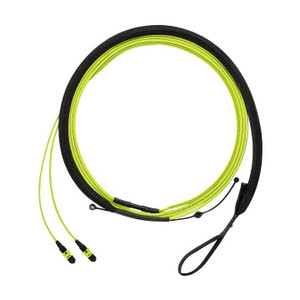
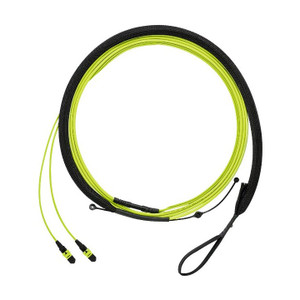
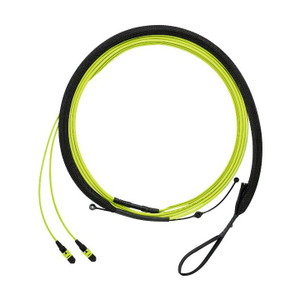
Panduit FWUYL7575LNM018 QuickNet 24-Fiber OM5 Trunk Cable Assembly
The Panduit FWUYL7575LNM018 delivers factory-terminated 24-fiber OM5 connectivity in an 18-meter assembly engineered for high-density data center deployments. This QuickNet trunk cable eliminates field termination labor and polarity errors while providing wideband multimode fiber performance for 40GBASE-SR4 and 100GBASE-SR10 applications. The LSZH-rated lime jacket ensures instant visual identification of OM5 infrastructure and meets plenum and riser flame requirements. With 30 to 40 percent space savings over conventional trunk assemblies, this cable addresses the critical challenge of airflow obstruction and pathway congestion in modern rack environments where every cubic inch of vertical manager and overhead tray space directly impacts cooling efficiency and expansion capacity.
Key Features
- 24-fiber OM5 wideband multimode construction supports 40G and 100G short-reach applications up to 150 meters at 850nm
- 18-meter (59-foot) length suited for cross-aisle zone distribution, spine-to-leaf uplinks, and storage fabric interconnects
- LSZH jacket meets IEC 60332-3-24 flame propagation and low-smoke emission requirements for enclosed pathways and underfloor plenums
- Lime cable jacket provides instant OM5 infrastructure identification per TIA-598-D color coding standard
- Factory-terminated connectors with polarity management eliminate field termination errors, fusion splice labor, and testing rework cycles
- Small-diameter trunk design uses 30 to 40 percent less conduit fill and pathway space than standard 24-fiber assemblies
- 50-micron core diameter with extended effective modal bandwidth across 850nm to 950nm SWDM wavelength range
- QuickNet series design optimized for rapid deployment in greenfield builds, phased expansions, and infrastructure refresh projects
- Full backwards compatibility with OM3 and OM4 transceivers enables mixed-generation network operation
- Factory insertion loss and polarity testing with serialized test reports documents performance before installation
OM5 fiber extends the capabilities of legacy 50-micron multimode infrastructure by supporting shortwave wavelength division multiplexing (SWDM) in addition to traditional 850nm VCSEL transmission. This assembly's OM5-grade fiber delivers a minimum effective modal bandwidth of 4700 MHz·km at 850nm, 2470 MHz·km at 953nm for SWDM channel 1, and maintains full backwards compatibility with OM3 (2000 MHz·km at 850nm) and OM4 (4700 MHz·km at 850nm) transceiver modules. This wavelength flexibility allows network operators to deploy a single fiber type across mixed-generation 10G, 40G, and 100G environments without requalifying link budgets or managing multiple fiber inventories. The 24-fiber count in Panduit's reduced-diameter jacket construction directly addresses the space constraint crisis in hyperscale and enterprise data centers, where traditional trunk cables consume excessive conduit fill ratios and block airflow in vertical cable managers. Standard 24-fiber trunk assemblies often exceed 0.6 inches in overall diameter; this small-diameter design reduces that cross-section by 30 to 40 percent while maintaining the 50-micron core geometry and 125-micron cladding specifications required for sub-0.35 dB insertion loss per mated connector pair. Each fiber position is factory-mapped to a specific polarity scheme—typically Method A, Method B, or Method C per TIA-568-C.0 Annex A—and connectors are inspected for end-face geometry per IEC 61300-3-35 interferometric standards to ensure dome radius, apex offset, fiber height, and surface defects meet the insertion loss and return loss budgets required for 40GBASE-SR4 parallel optics (1.9 dB maximum channel loss) and 100GBASE-SR10 applications (1.9 dB maximum loss).
The 18-meter length bridges the most common data center zone distribution scenarios: middle-of-row equipment enclosures to end-of-row aggregation switches (typically 12 to 15 meters of vertical riser plus 3 to 6 meters of overhead tray run), storage arrays to SAN fabric core directors across hot aisles in opposed-row layouts, and top-of-rack leaf switches to spine switches in two-tier Clos architectures where cabinet height consumes 10 to 12 meters and horizontal pathways add another 4 to 8 meters of dressed length. The factory-terminated design compresses installation schedules by eliminating the termination, inspection, testing, and rework cycle inherent in field-terminated fiber infrastructure. A single technician can deploy and dress this 24-fiber trunk in 8 to 12 minutes—pulling the assembly through the pathway, securing it to cable management hardware, routing breakout legs to patch panels, and performing a visual connector inspection. The equivalent task using field termination methods (fusion splicing 24 fibers to fanout kits or mechanical termination with epoxy-polish procedures) requires 90 to 120 minutes of labor, plus test equipment setup, loss verification with an OLTS, and potential rework if any fiber fails insertion loss limits. Over a 500-drop data center build, this time differential translates to 650 labor hours saved—roughly 16 weeks of technician time at 40 hours per week. The LSZH jacket composition addresses fire-safety mandates in enclosed HVAC plenums and underfloor pathways where PVC combustion byproducts create corrosive hydrochloric acid vapor and optically dense smoke that obscures egress routes. The lime color coding provides instant visual differentiation from OM3 (aqua per TIA-598-D) and OM4 (erika violet) infrastructure during MAC (moves, adds, changes) operations, preventing accidental cross-patching between fiber grades that would degrade link margin and cause intermittent bit errors on 40G and 100G links.
This assembly meets ISO/IEC 11801 Category OM5 channel specifications, TIA-568-C.3 optical fiber performance requirements for 50-micron laser-optimized multimode fiber, TIA-604-5 (FOCIS-5) intermateability standards for duplex connectors, TIA-568-C.1 commercial building telecommunications cabling standards, and European RoHS Directive 2011/65/EU material restrictions for lead-free and heavy-metal-free manufacturing. The fiber itself complies with TIA-492-AAAD geometry specifications (50-micron core, 125-micron cladding, 242-micron coating) and IEC 60793-2-10 Type A1a.3 multimode fiber category for wideband performance. Panduit subjects each QuickNet trunk to factory insertion loss testing using calibrated reference-grade test jumpers, polarity continuity verification to confirm pin-to-pin mapping matches the declared method, and return loss measurement to validate connector end-face geometry. Serialized test reports accompany each assembly, documenting that maximum insertion loss is below 0.75 dB per connector pair (including connector, fiber, and splice contributions) and return loss exceeds 20 dB—margins that ensure compliance with IEEE 802.3ba 40GBASE-SR4 and 100GBASE-SR10 worst-case loss budgets even after accounting for additional mated pair connections at patch panels. For network architects and infrastructure managers deploying 40G and 100G server connectivity, storage fabrics, or spine-leaf underlay networks with deterministic performance requirements and aggressive construction timelines, the FWUYL7575LNM018 delivers the factory-certified quality, space efficiency, and labor savings that field-terminated solutions cannot provide.