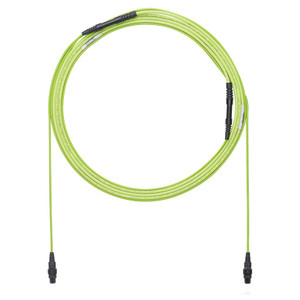
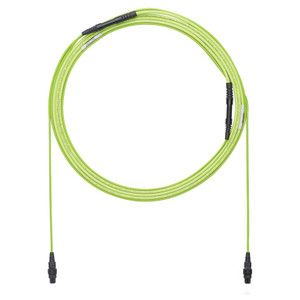
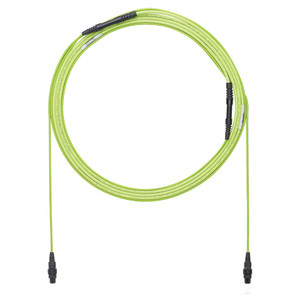
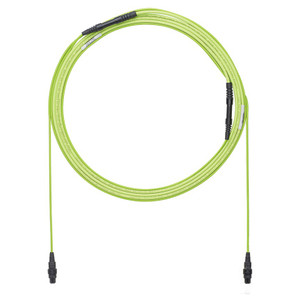
Panduit FWTYL7575KNM042 QuickNet OM5 12-Fiber Trunk Cable Assembly
The Panduit FWTYL7575KNM042 is a 42-meter, 12-fiber OM5 trunk cable assembly engineered for high-density data center deployments requiring extended reach and future-proof bandwidth scalability. Built on Panduit's QuickNet platform, this pre-terminated trunk features PanMPO female connectors on both ends with Method A polarity, LSZH jacket construction for safety-critical environments, and HD Flex transition design that reduces cable diameter by 30-40% compared to legacy trunk assemblies. OM5 wideband multimode fiber supports Short Wavelength Division Multiplexing (SWDM) technology, delivering four times the effective capacity of OM4 over the same fiber count—a critical advantage when retrofitting existing pathways or planning for 400G/800G migration without infrastructure replacement.
Key Features
- OM5 wideband multimode fiber (50/125 µm) certified to TIA-492-AAAD and IEC 60793-2-10 type A1a.3 for SWDM applications up to 400 meters at 40G/100G, enabling multi-wavelength transmission across 850-950 nm spectrum
- Pre-terminated 12-fiber trunk with factory-installed PanMPO female connectors (key-up to key-up Method A polarity) eliminates field termination labor and ensures ultra-low insertion loss performance out of the box
- 42-meter (137.8 ft) length factory-tested and certified, ideal for cross-row connections in modular data centers, storage area network fabrics, or spine-to-leaf architectures where reach exceeds typical 15-30m patch cord limits
- Low Smoke Zero Halogen (LSZH) jacket rated to IEC 60754 and IEC 61034, meeting European EN50173 and international building codes for enclosed spaces, risers, and air-handling plenums where PVC combustion byproducts pose life-safety risks
- HD Flex small-diameter construction (approximately 6.8 mm OD for 12-fiber trunk) uses 30-40% less pathway space than standard round-jacket designs, directly addressing conduit fill limits and cable tray congestion in mature facilities
- Lime green jacket color per TIA-598-D OM5 identification standard simplifies moves/adds/changes and prevents accidental cross-patching with OM3 (aqua) or OM4 (magenta/aqua) infrastructure during mixed-generation deployments
- Ultra insertion loss grade ensures ≤0.35 dB per mated connector pair, preserving link budget for 400GBASE-SR8 (100m OM5), 100GBASE-SR4 (150m OM5), and emerging 800G-SR8 applications where every 0.1 dB matters
- SigCore fiber technology with tighter manufacturing tolerances on core geometry and concentricity, reducing modal dispersion and enabling consistent performance across all twelve fibers in the trunk without per-fiber characterization
- RoHS compliant construction eliminates lead, cadmium, and restricted substances, satisfying procurement requirements for EU markets, federal GSA schedules, and corporate sustainability mandates
OM5 wideband multimode fiber represents the most significant capacity evolution in premises optical networking since the OM4 standard arrived in 2009. While OM3 and OM4 rely on single-wavelength transmission at 850 nm (with OM4 extending effective modal bandwidth to 4700 MHz·km), OM5 maintains backward compatibility with legacy 850 nm optics while adding support for Short Wavelength Division Multiplexing across four discrete wavelengths: 850 nm, 880 nm, 910 nm, and 940 nm. This SWDM capability allows a single 12-fiber OM5 trunk to carry the equivalent data load of a 48-fiber OM4 trunk when paired with SWDM transceivers—cutting fiber count by 75% and proportionally reducing the size, weight, and cost of backbone cabling infrastructure. For integrators managing hyperscale environments or colocation facilities where every rack unit and every square inch of overhead pathway carries premium value, OM5 trunks deliver immediate density relief without forklift upgrades to single-mode fiber and the associated optics cost penalties. The Panduit FWTYL7575KNM042's 42-meter length specifically targets mid-range data center topologies: cross-aisle connections between end-of-row aggregation switches and spine fabrics, SAN director interconnects in dual-controller storage arrays, or cross-building links within campus data center clusters where 30-meter patch cords fall short but 100+ meter runs warrant single-mode consideration. Factory termination with PanMPO connectors eliminates the three most common field failures in high-fiber-count deployments: contamination during connector assembly, inconsistent polish geometry from hand-lapping variability, and pinched fibers from improper strain relief crimping. Each trunk ships with dust caps installed, connector end-faces inspected via interferometry to IEC 61300-3-35 standards, and insertion loss verified across all twelve fibers—documentation included for projects requiring as-built test records or TIA-568 compliance certification.
The HD Flex small-diameter design directly addresses the cable management crisis facing retrofit and expansion projects in production data centers. Traditional round-jacket trunk cables, built around legacy loose-tube or tight-buffered constructions optimized for outdoor OSP durability, consume 40-60% more cross-sectional area than necessary for controlled indoor environments. As rack density climbs from 8 kW per cabinet (2015 baseline) to 15-25 kW (current AI/ML compute standard), the proportional growth in east-west traffic between GPU nodes and storage arrays forces 3-5x more fiber trunk cables through the same overhead ladder rack and under-floor conduit infrastructure installed a decade ago. Panduit's HD Flex construction uses a compact central strength member, reduced-diameter 900 µm tight-buffered fibers, and a thin-wall LSZH outer jacket to achieve approximately 6.8 mm overall diameter for a 12-fiber assembly—compared to 10-12 mm for equivalent legacy designs. That 30-40% diameter reduction translates to roughly 50-65% less cross-sectional area (area scales with radius squared), which directly improves conduit fill ratios under NEC Article 770 limits and reduces the weight load on cable tray systems where adding tonnage risks structural code violations. Method A polarity (key-up to key-up, straight-through fiber mapping) is the dominant standard for 40G/100G parallel optics deployments: it pairs naturally with duplex LC breakout harnesses on the equipment side, supports both transmit-receive diversity and SWDM wavelength assignments without adapter flipping, and simplifies troubleshooting since fiber position 1 on Connector A always maps to fiber position 1 on Connector B. For installations following TIA-568.3-D structured cabling guidelines or data center operators standardizing on Panduit's FHD (Fiber High Density) cassette system, Method A trunks eliminate the need for Type B crossover assemblies or Type C array-flip configurations that introduce training overhead and increase the risk of polarity mismatches during MAC work. The 42-meter factory length is non-standard (most catalogs stop at 30m or jump to 100m), making this assembly particularly valuable for facilities with specific architectural constraints: think cross-row runs in 60-foot-wide data halls with overhead distribution, or vertical riser runs spanning three floors in a multi-tenant colocation cage where tenant demarcation points don't align with convenient 20m or 50m increments.
Compliance with TIA/EIA-568-C.3, ISO/IEC 11801, and IEC 60793-2-10 type A1a.3 standards ensures this trunk integrates seamlessly into internationally deployed structured cabling systems, satisfying both North American TIA specifications and European CENELEC EN50173 requirements without region-specific SKU splits. The LSZH jacket's third-party certification to IEC 60754-1 (halogen acid gas content <0.5%) and IEC 61034 (light transmittance >60% during combustion) makes this trunk legally compliant for installation in transportation tunnels, high-rise risers, hospital data centers, and pharmaceutical cleanroom facilities across EU and APAC markets where PVC-jacketed cable is explicitly prohibited by local fire codes. For U.S.-based projects pursuing LEED certification or following ASHRAE 90.4 energy-efficiency guidelines, specifying LSZH cabling contributes to Indoor Environmental Quality credits (reduced toxic off-gassing) and Materials & Resources credits (RoHS compliance, recyclability). The ultra insertion loss grade—Panduit's premium performance tier—guarantees ≤0.35 dB per mated connector pair versus the ≤0.75 dB maximum allowed under TIA-568-C.3, preserving an additional 0.4 dB of link budget per connection. In a typical two-tier spine-leaf architecture where each 100GBASE-SR4 link traverses two patch panels (four mated pairs total), that 1.6 dB aggregate budget improvement can mean the difference between marginal bit-error rates at equipment end-of-life and rock-solid performance with headroom for 15 years of connector wear and environmental aging. This assembly ships individually packaged with serialized test reports, making it traceable for projects requiring change-order documentation, FAT/SAT acceptance testing, or post-installation OTDR verification against baseline manufacturer data.