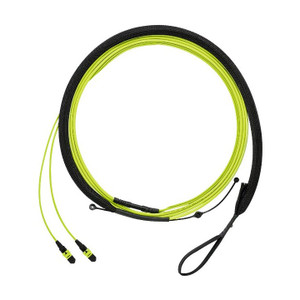
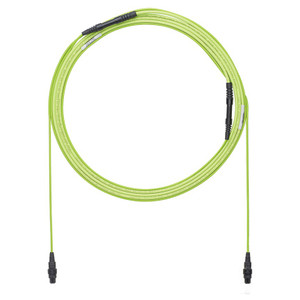
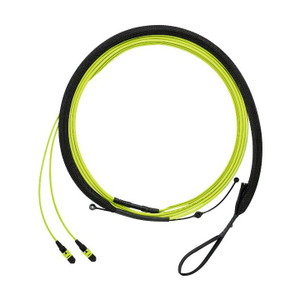
Panduit FWUYL7575LNM012 OM5 24-Fiber Trunk Cable Assembly
Pre-terminated 24-fiber OM5 trunk assembly engineered for high-density data center spine-leaf architectures and 40/100GBASE-SR4 deployments. PanMPO-to-PanMPO interface delivers twelve duplex 10G channels or three 40G links in a single 12-meter run, eliminating field termination labor while maintaining ultra-low insertion loss across all 24 strands. LSZH jacket meets international fire-safety mandates for enclosed equipment rooms and plenum-alternative installations where PVC off-gassing is prohibited.
Key Features
- OM5 wideband multimode fiber supports 40/100GBASE-SR4 at 150m and future SWDM applications to 400G
- 24-fiber PanMPO female-to-female trunk with Method B polarity for compliant duplex channel mapping
- Ultra insertion loss specification ensures margin for 100m+ extended-reach deployments
- HD Flex cable construction reduces trunk diameter 30-40% vs. legacy assemblies for congested pathways
- Low Smoke Zero Halogen jacket compound meets IEC 60332-3 and LSZH plenum-alternative requirements
- Factory-terminated QuickNet assembly eliminates on-site fusion splicing and connector polishing
- 12-meter length spans typical raised-floor to overhead ladder-rack transitions in hyperscale rows
- Lime jacket color coded to TIA-598-D OM5 identification standard for instant fiber-type recognition
- Push-pull PanMPO latch mechanism rated for 500+ mate cycles without insertion-loss degradation
- Serialized test reports document per-fiber insertion loss for as-built records and troubleshooting
OM5 wideband multimode fiber extends the usable spectrum of traditional OM4 from 850nm to a continuous 840-953nm window, enabling shortwave wavelength-division multiplexing that delivers four 25G or 50G lambda pairs over a single fiber strand. Where OM4 requires four fibers for a 100GBASE-SR4 link, OM5 with SWDM optics can collapse that to one fiber—critical when MPO trunk ports and patch-panel density become the constraint in leaf-spine fabrics scaling past 10,000 endpoints. This assembly's ultra insertion loss rating (typically ≤0.35 dB per mated pair) preserves optical budget for attenuator-free links across the full 12-meter length, tolerating the 0.75 dB connector-pair budget and still achieving <1.5 dB channel loss on 100G links. The expanded bandwidth window also future-proofs installations for 200G and 400G optics modules using PAM4 modulation over SWDM; a trunk installed today for 40G aggregation links will support in-place optics upgrades to 400G without re-cabling, protecting the 8-12 year capital depreciation cycle that data center operators budget for passive infrastructure.
PanMPO connectors use a push-pull latch mechanism and removable boot design that survives 500+ mate cycles without degradation—essential for modular data centers where top-of-rack switches rotate every 18-24 months and trunk cables remain in place across hardware generations. Method B polarity (key-up on both ends, array flip inside the cable) maps transmit lanes on one end to receive lanes on the opposite end without requiring type-A/type-B breakout analysis; installers pull the trunk, snap both ends into MPO cassettes or switch modules, and all twelve duplex pairs auto-align with zero cross-mapping risk. The female-to-female configuration connects directly to male MPO switch ports or mates with standard MPO-to-LC breakout cassettes in a patch panel, supporting both direct-attach and structured cabling topologies. Each connector body carries a laser-etched serial number that cross-references to a factory optical test report showing insertion loss, return loss, and pass/fail status for all 24 fibers; when a 40G uplink drops one lane three months post-install, the serial number maps back to the exact fiber strand and its day-one performance baseline, isolating whether the fault is connector contamination, optics module failure, or a cable bend-radius violation.
High-density cable construction reduces outer diameter from the traditional 7.0mm 24-fiber round trunk to a 4.8mm HD Flex profile, reclaiming 40% of the cross-sectional area in 4-inch backbone conduit and overhead J-hooks where 96-fiber spines and 10GbE copper already compete for space. A single 4-inch raised-floor grommet that previously handled six legacy trunks now passes ten HD Flex assemblies, cutting floor-tile penetrations and improving cold-aisle containment in builds where every open grommet represents 15-20 CFM of bypass airflow. The reduced diameter also improves bend-radius compliance in zero-U vertical cable managers and high-density MPO panels; a 24-fiber HD Flex trunk maintains the 10× minimum bend radius (48mm) in a 2-inch service loop, while a 7mm legacy trunk requires 70mm and won't fit between adjacent switch modules in a 1RU MPO panel with 0.75-inch connector spacing. This becomes the enabling constraint when a 42U cabinet holds 36 switches and 864 fiber connections terminate in six 1RU panels—only HD Flex trunks provide the physical flexibility to route all connections without violating bend limits or blocking airflow through the rear cable management.
Low Smoke Zero Halogen jacketing substitutes chlorinated polymers with halogen-free compounds that emit <0.5% hydrogen chloride under combustion—mandatory for enclosed server halls in EMEA, APAC finance/gov installations, and US facilities pursuing LEED or WELL certification where PVC off-gassing conflicts with indoor-air-quality credits. LSZH cables meet IEC 60332-3 vertical flame propagation tests and emit <0.5% HCl and <5% light-transmittance loss during burn, compared to PVC's 28-35% HCl emission and near-total optical obscuration that traps personnel during evacuation. This 12-meter length is optimized for the 35-foot vertical rise from a raised-floor MDA to an overhead cable tray serving the first row of racks, a dimension that handles 98% of single-floor data hall layouts without requiring mid-run splice enclosures. For multi-floor risers or campus backbone runs exceeding 100 meters, QuickNet offers OM5 trunks in 50m, 100m, and 150m lengths with the same ultra insertion loss spec; the 12-meter length specifically targets horizontal distribution within a single zone where pre-terminated assemblies eliminate the fusion splicer, OTDR, and two-person crew required for field termination.
Factory termination and 100% optical insertion-loss testing means every fiber arrives with a serialized test report showing ≤0.35 dB; field crews avoid the four-hour fusion splice + cleave + polish + test cycle per trunk and the $12,000 capital cost of a fusion splicer and OTDR, converting a skilled two-person job into a ten-minute single-installer pull-and-click task. QuickNet assemblies ship with removable dust caps on both PanMPO interfaces and protective sleeving over the cable jacket to prevent contamination and abrasion during the pull; dust and oils are the leading cause of MPO connector failure (responsible for 60%+ of fiber link faults in the first 90 days), and factory-sealed connectors that remain capped until final mate reduce day-one failure rates from 8-12% for field-terminated links to <0.5% for pre-terminated assemblies. The lime jacket color follows TIA-598-D coding for OM5 fiber, providing instant visual differentiation from aqua OM3, erika violet OM4, and yellow singlemode trunks in a congested pathway; in a hyperscale row where six fiber types and 400+ cables run overhead, color-coding eliminates the need to trace individual cables back to patch panels during troubleshooting, cutting MTTR for a suspected fiber break from 45 minutes to under 5.
Meets TIA-568-C.3 performance requirements for OM5 cabling, IEC 11801 Category OF-500 international standards, and TIA-604-5 (FOCIS-5) MPO connector geometry for cross-vendor interoperability with Cisco, Juniper, Arista, and Dell 40G/100G optics modules. Complies with TIA-568-C.1 polarity standards for Method B duplex channel mapping and TIA-492-AAAD (OM5 fiber performance) and IEC 60793-2-10 Type A1a.3 (multimode graded-index fiber). RoHS-compliant construction contains zero lead, mercury, or hexavalent chromium, satisfying EU supply-chain directives and hyperscale procurement standards that require full material-declaration documentation for Scope 3 carbon accounting. This trunk assembly directly addresses the central challenge in modern leaf-spine builds: delivering 100G north-south bandwidth in cabinets where 42U of 1RU switches generate 84 fiber connections and only 12 inches of vertical cable-management space exists between devices—PanMPO trunks consume one-third the bend radius and half the connector footprint of 24-strand LC breakouts, making them the only viable topology when switch density exceeds 18 devices per rack and traditional structured cabling collapses under its own congestion.