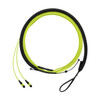
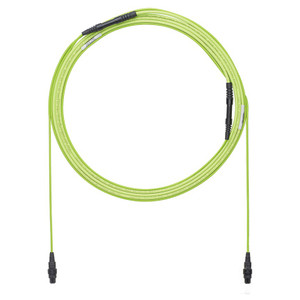
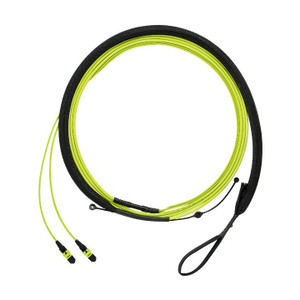
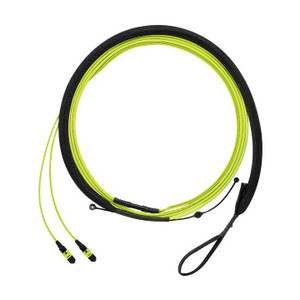
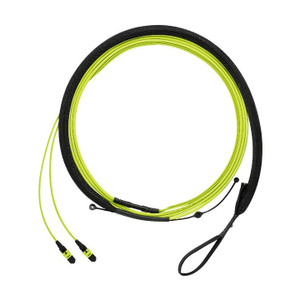
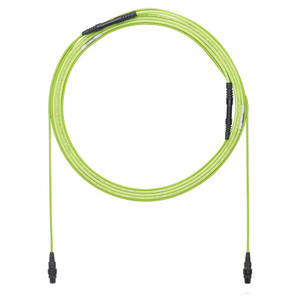
Panduit FWUYL7575LAM049 QuickNet 24-Fiber OM5 Trunk Cable Assembly
The Panduit FWUYL7575LAM049 is a 49-meter (160.76 ft) QuickNet trunk cable assembly engineered for high-density data center backbone installations where space, bandwidth, and deployment speed converge. Built on OM5 wideband multimode fiber with 24 strands of 50 μm core diameter, this trunk delivers 4× the effective bandwidth of OM4 via short-wave division multiplexing (SWDM), supporting 40G/100G over extended distances while consuming 30-40% less pathway space than legacy trunk designs. The lime LSZH jacket provides instant visual identification in mixed-infrastructure environments and meets international low-smoke-zero-halogen fire safety mandates for enclosed plenums and risers. Factory-terminated with TIA-604-5 (FOCIS-5) compliant connectors, this assembly eliminates field splicing labor and performance variability—critical when deploying multi-building campus networks, hyperscale compute clusters, or any backbone where downtime costs exceed the premium for pre-tested infrastructure.
Key Features
- OM5 Wideband Multimode Fiber: 50 μm core diameter optimized for SWDM—transmits four wavelengths per fiber pair (850/880/910/940 nm) to quadruple effective bandwidth without additional strands, supporting 40GBASE-SR4 to 150m and 100GBASE-SR4 to 150m versus OM4's 100m ceiling
- 24-Fiber High-Density Trunk: Small-diameter construction reduces conduit fill by 30-40% compared to 12-fiber OM3 bundles of equivalent capacity, freeing pathway space for future expansion or ventilation in packed cable trays
- Factory-Terminated QuickNet Assembly: Panduit pre-polished connectors and full insertion-loss testing eliminate field fusion-splicing—deploy backbone segments in minutes rather than hours, with guaranteed performance documented on included test reports
- LSZH Jacket for Enclosed Spaces: Low-smoke-zero-halogen compound meets IEC 60332-1 and IEC 61034 flammability standards, mandated for European installations and increasingly required for US data halls, telecom vaults, and any pathway sharing air-handling space
- Lime Color Coding: Bright lime jacket matches TIA-598-D OM5 identification standard, preventing cross-connects between OM3/OM4/OM5 trunks during moves-adds-changes and simplifying rapid visual audits in dark server rows
- Extended 49-Meter Length: Pre-configured for inter-row, cross-aisle, or floor-to-floor runs in large facilities, reducing the need for mid-span splice enclosures that introduce loss, labor, and failure points
- ISO/IEC 11801 and TIA-568-C.3 Compliant: Meets or exceeds all international structured cabling standards for OM5 multimode fiber, ensuring interoperability with Cisco, Juniper, Arista, and all major OEM optics modules
- RoHS Compliant: Lead-free, cadmium-free construction meets European Union RoHS directives and California Proposition 65 requirements for environmentally responsible procurement
OM5 Bandwidth Advantage and SWDM Economics: OM5 fiber represents the fourth generation of 50 μm multimode technology, purpose-built for short-wave division multiplexing. Traditional OM4 fiber optimizes a single 850 nm wavelength; OM5 extends that optimization across four distinct windows—850, 880, 910, and 940 nm—by tightly controlling differential mode delay (DMD) across the entire wideband spectrum. In practical terms, a single OM5 fiber pair can carry four independent 25G channels simultaneously, aggregating to 100G without requiring additional physical strands or complex parallel optics. This is transformative for 40G/100G spine-leaf architectures: where OM4 demands eight fibers (four transmit, four receive) for 40GBASE-SR4, OM5 can theoretically deliver the same aggregate bandwidth over two fibers via 4×10G SWDM, though current IEEE standards still specify parallel optics. The real-world advantage today is reach: OM5 extends 40G and 100G distances to 150 meters versus OM4's 100-meter limit, covering 95% of intra-building data center runs without mode-conditioning or single-mode conversion. For hyperscale operators, colocation providers, or enterprise campuses planning 400G migration, OM5 trunks future-proof the physical layer—200GBASE-SR4 and 400GBASE-SR8 optics are already sampling with 150m OM5 support, while OM4 will require costly re-cabling or fiber-count doubling. The incremental cost of OM5 over OM4 (typically 10-15% at the trunk level) is trivial compared to the labor cost of a second cabling cycle or the opportunity cost of bandwidth-limited infrastructure during a capacity crunch.
High-Density Deployment and Pathway Management: Data center white space is measured in watts per rack and dollars per square foot; every cubic inch of cable tray, overhead ladder rack, or under-floor conduit counts. Traditional 12-fiber OM3 trunks with 3mm buffer tubes and legacy jacket compounds can exceed 0.5 inches in outside diameter; this 24-fiber OM5 QuickNet trunk measures substantially smaller due to Panduit's tight-buffered construction and optimized bundle geometry. In a 4-inch wire basket tray, the difference between 0.5-inch and 0.35-inch trunk OD translates to fitting 18 trunks versus 12 trunks in a single layer—a 50% capacity gain without adding infrastructure. The compounding benefit: reduced congestion improves airflow around cables (critical when trays pass through hot aisles), simplifies adds-moves-changes by leaving working space for hands and tools, and delays the expensive trigger point where facilities must install a second parallel tray or re-route through a longer path. For new-build projects, the smaller trunk diameter reduces conduit size requirements—dropping from 4-inch to 3-inch EMT on a 200-foot run saves approximately $800 in materials and pulling labor per pathway. Installers also appreciate the reduced bend radius: OM5 fiber maintains performance with bends as tight as 10× the cable OD under load (15× unloaded), so this trunk can navigate tight turns around structural beams, through cabinet knockouts, or into crowded patch panels without kinking or exceeding the 0.3 dB loss budget per connector pair. Lime color coding is non-negotiable in mixed-generation environments—accidentally patching OM5 optics into an OM3 trunk (which is often aqua-colored per TIA-598-D) can cause link budget failures or intermittent errors that consume hours of troubleshooting. The instant visual differentiation prevents that failure mode entirely, especially in low-light server rows where a headlamp and color are your only orientation cues.
Factory Termination Quality and Field Time Savings: Field fusion splicing of 24-fiber trunks is a multi-hour process requiring a $15,000+ fusion splicer, consumables (splice trays, heat-shrink, cleaning supplies), and a technician with BICSI TECH or FOA CFOT credentials. Each fusion splice introduces 0.05-0.15 dB insertion loss and a mechanical failure point; multiply by 24 fibers and the cumulative loss and risk becomes non-trivial. Panduit QuickNet trunks ship factory-terminated with machine-polished connectors, full insertion-loss and return-loss testing per TIA-526-14A and TIA-526-7, and serialized test reports traceable to the individual assembly. Insertion loss is guaranteed ≤0.35 dB per mated connector pair (typical <0.25 dB), and return loss exceeds -20 dB across all fibers, ensuring compatibility with sensitive 25G/100G optics that rely on clean optical return paths to maintain bit error rates below 10⁻¹². The time savings alone justify the factory-termination premium: deploying a 49-meter trunk between two floors in a multi-tenant office building takes one technician approximately 20 minutes (pull, dress, mate, test continuity), versus 3-4 hours for field splicing the equivalent breakout. Labor cost at $125/hour means the factory trunk saves $400-$500 in labor per deployment, even before accounting for the elimination of splice enclosure hardware ($200-$400 per enclosure) and the risk of a bad splice that fails acceptance testing and requires a re-do. For integrators managing dozens of trunk runs on a campus build-out or data center refresh, this compounds into five-figure labor savings and a two-week schedule compression—often the difference between hitting or missing a customer's go-live deadline.
This assembly meets ISO/IEC 11801 Edition 3.0, TIA-568-C.3, TIA-492-AAAD (OM5 fiber performance specification), and IEC 60793-2-10 type A1a.3 multimode fiber standards. LSZH jacket compound is tested to IEC 60332-1 (flame propagation) and IEC 61034 (smoke density), required for installation in European Union countries, UK, Middle East, and increasingly mandated by US enterprise customers for data halls, telecom rooms, and any space where cable pathways share air return plenums with occupiable areas. RoHS compliance ensures this product meets lead-free and heavy-metal restrictions for government, healthcare, and California-based projects. Panduit's 25-year application assurance warranty backs this trunk when installed per manufacturer guidelines and tested within specification limits. Integrators deploying 40G/100G leaf-spine fabrics, SAN storage backbones, or AV-over-IP distribution networks above 25G will find this trunk eliminates the most common failure modes—inadequate reach, pathway congestion, and field termination variability—that delay cutovers and trigger expensive truck rolls during the critical first 90 days of a new installation.