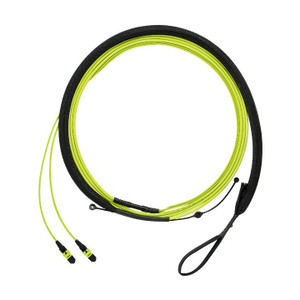
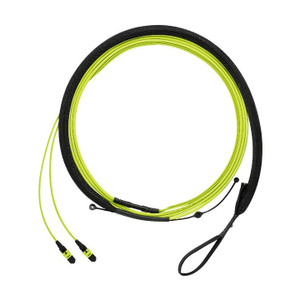
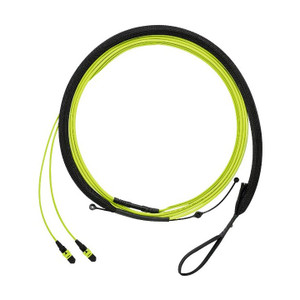
Panduit FWUYL7575LAM036 QuickNet 24-Fiber OM5 Trunk Cable Assembly
The Panduit FWUYL7575LAM036 is a factory-terminated 24-fiber OM5 trunk cable assembly engineered for high-density datacenter and enterprise network deployments. Measuring 36 meters (118 feet) in length with LSZH jacketing, this QuickNet trunk eliminates field termination labor while delivering 30-40% space savings compared to traditional bundled patch cords. OM5 50-micron multimode fiber supports 100GBASE-SR4 to 150 meters and enables future 400G short-wave wavelength division multiplexing (SWDM) applications, making this trunk a future-proof backbone solution for MDA-to-IDF runs, SAN infrastructure, and horizontal high-count deployments.
Key Features
- 24-fiber OM5 (50/125 µm) wideband multimode fiber rated for 100G/400G applications
- 36-meter (118-foot) length suits typical datacenter main/intermediate distribution runs
- LSZH (low smoke zero halogen) jacket for plenum-equivalent safety in occupied spaces
- Factory-terminated QuickNet assembly ships test-certified, eliminating field fusion/polish labor
- 30-40% smaller cross-section than equivalent loose-tube or bundled patch cord installations
- Lime jacket provides high-visibility cable management and instant visual identification
- Meets TIA-568-C.3, ISO/IEC 11801, TIA-492-AAAD (OM5 specification), and IEC 60793-2-10 A1a.3 standards
- RoHS compliant construction for environmentally responsible installations
Pre-terminated trunk cable assemblies like the FWUYL7575LAM036 solve three critical datacenter infrastructure problems: deployment speed, pathway congestion, and certification uncertainty. Field termination of 24 fibers requires fusion splicing or mechanical termination of 48 individual connector ends, typically consuming 6-8 labor hours plus the cost of consumables, specialized tooling, and OTDR testing. Factory QuickNet assemblies arrive pre-tested with insertion loss and return loss documentation, allowing installers to pull cable, dress breakout legs, and verify continuity in under an hour. For integrators billing project labor by the hour, this time compression directly impacts job profitability and allows faster moves to the next site.
The OM5 fiber specification (TIA-492-AAAD) extends the capabilities of traditional OM3/OM4 multimode fiber by optimizing performance across a wider wavelength range—specifically 850 nm, 880 nm, 910 nm, and 940 nm. This wideband optimization enables short-wave wavelength division multiplexing (SWDM), a technology that transmits four 25G or 50G channels simultaneously over a single duplex fiber pair. For 100GBASE-SR4 applications, OM5 delivers the same 100-meter reach as OM4, but future 400G-SR4.2 SWDM implementations will push usable distance to 150 meters over OM5 versus 100 meters over OM4. In practice, this means a trunk installed today at 36 meters will cleanly support both current 100G optics and future 400G SWDM transceivers without requiring a forklift upgrade when bandwidth demands increase. Specifying OM5 now avoids the costly scenario of discovering installed OM3 or OM4 trunks cannot support next-generation optics without replacement.
Trunk cable construction uses a tight-buffered central core with 24 individual 900-micron buffered fibers bundled under a single LSZH outer jacket. This consolidated design achieves a 30-40% reduction in cross-sectional area compared to installing twelve duplex LC patch cords in parallel—an important advantage when pathway fill ratios approach the 40% NEC limit or when overhead ladder rack is already congested with copper infrastructure. The reduced diameter also improves airflow in hot aisle containment environments, as dense patch cord bundles can create localized obstructions that force air around, rather than through, the intended cooling path. For brownfield datacenter expansions where adding conduit or runway is impractical, the ability to fit 24 fibers in a smaller envelope can be the difference between completing an upgrade in place or needing to reroute entire cable trays.
LSZH jacketing is specified for installations where building codes require low-toxicity materials in occupied spaces or where plenum-rated pathways do not exist. Unlike PVC-jacketed cable—which releases hydrochloric acid and dense black smoke during combustion—LSZH compounds produce minimal visible smoke and no halogenated gases. This matters in datacenters with raised-floor or drop-ceiling return air plenums that are not rated as traditional HVAC ducts: while plenum-rated (OFNP) cable is the gold standard for such spaces, LSZH-rated assemblies provide comparable fire safety performance in international markets (Europe, Middle East, Asia-Pacific) where LSZH is the dominant safety standard. Installers working on projects governed by IBC, NFPA 72, or European EN 50173 standards will find LSZH compliance simplifies AHJ approval and eliminates the need to justify PVC in occupied return-air spaces.
The 36-meter length is purpose-selected for typical datacenter topology distances. In a two-tier leaf-spine architecture, the run from an end-of-row (EOR) aggregation switch to a middle-of-row (MOR) spine switch typically ranges from 25 to 40 meters, depending on row length and rack depth. Similarly, in a three-tier core/distribution/access design, the horizontal distance from an intermediate distribution frame (IDF) to a main distribution area (MDA) in a 10,000-square-foot floor plate often falls in the 30- to 50-meter range after accounting for vertical rise, pathway routing around obstacles, and service loops at both ends. A 36-meter trunk provides adequate length for these scenarios without the excess slack that creates cable management problems or the shortfall that forces mid-run splices. For installations requiring different lengths, Panduit's QuickNet portfolio includes assemblies from 5 meters to 300 meters in 1-meter increments, but the 36-meter variant represents the sweet spot for single-floor horizontal and short vertical riser applications.
Lime-colored jacketing serves two purposes: high visibility for rapid identification during troubleshooting and color-coded segregation of network tiers or traffic types. In large installations with mixed OM3, OM4, and OM5 infrastructure, visual differentiation prevents accidental cross-connection of incompatible fiber grades. Some integrators adopt a color discipline where lime (or aqua) indicates OM5 spines, while orange marks OM3 access layer links; others use color to denote production versus management networks. The bright lime hue also improves visibility in dimly lit datacenters or when cables are routed behind rack PDUs and vertical wire managers, reducing the time spent tracing individual links during adds/moves/changes.
This trunk assembly is RoHS compliant and meets TIA-568-C.3 (commercial building telecommunications cabling standard), ISO/IEC 11801 (international generic cabling standard), TIA-604-5 (FOCIS-5, fiber optic connector intermateability standard), TIA-492-AAAD (OM5 fiber specification), and IEC 60793-2-10 type A1a.3 (multimode fiber detail specification). Compliance with these overlapping standards ensures the assembly will integrate with multi-vendor active equipment (Cisco, Arista, Juniper, Dell, HPE optics), meet insurance and building code requirements in North America and internationally, and provide a documented performance baseline for acceptance testing. Factory test reports ship with each assembly and include insertion loss at 850 nm for each fiber pair, return loss measurements, and length verification—the exact data required for BICSI certification submittal or vendor warranty registration when deploying 100G/400G spine fabrics.