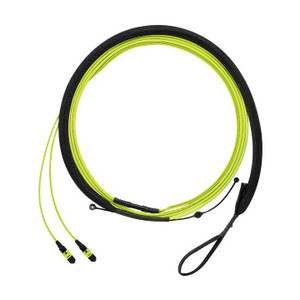
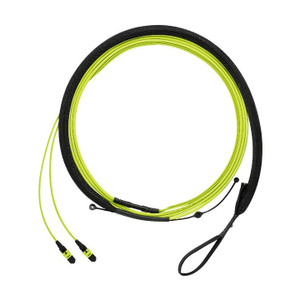
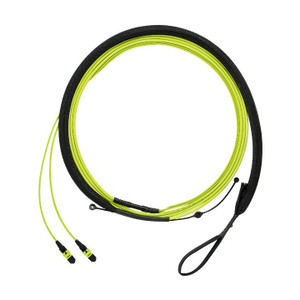
Panduit FWUYL7575LAM091 OM5 24-Fiber Trunk Cable Assembly
The Panduit FWUYL7575LAM091 is a 24-fiber OM5 trunk cable assembly engineered for high-density data center deployments requiring extended reach and future-proof bandwidth scalability. This 91-meter (298.56 ft) trunk terminates in PanMPO female connectors on both ends, configured for Method B polarity, and ships with Panduit's Ultra Insertion Loss performance tier—critical for maintaining loss budgets on 40GBASE-SR4, 100GBASE-SR4, and emerging 400GBASE-SR8 links. The Low Smoke Zero Halogen (LSZH) jacket meets international flammability mandates for enclosed building spaces, while the HD Flex design reduces trunk diameter by up to 40% compared to legacy constructions, directly addressing pathway congestion in modern spine-leaf architectures. Factory termination eliminates field splicing, and each assembly ships with serialized insertion-loss test data traceable to NIST-certified reference standards.
Key Features
- 24 fibers of 50µm OM5 wideband multimode fiber, supporting 850–953 nm SWDM transmission for 4× the effective capacity of OM4 on the same fiber count
- PanMPO female to PanMPO female connectors with Method B polarity (key-up A-end, key-down B-end) for deterministic lane mapping in parallel optics without crossover modules
- Ultra Insertion Loss tier: ≤0.35 dB typical per mated connector pair, vs. ≤0.75 dB industry standard—preserving 0.8 dB total margin on a two-connection channel
- LSZH jacket compliant with IEC 60332-1 flame propagation and IEC 61034 smoke density limits, required under EN 50575 CPR Euroclass for European installations
- HD Flex construction with reduced-diameter buffer tubes and flexible strength member: 30–40% smaller OD than conventional 24-fiber trunks for higher pathway fill ratios
- Integrated pulling eye on one end, rated to full trunk tensile load, allows conduit and overhead routing without stressing connectors or ferrules
- 91-meter continuous length eliminates mid-span fusion splices, removing 0.1–0.3 dB splice loss and associated failure points from the permanent link
- QuickNet SigCore factory termination: every fiber tested to ≤0.15 dB average insertion loss, with per-trunk serialized test reports documenting connector endface geometry and return loss
- Lime-green jacket for instant OM5 identification in mixed-fiber environments (OM3 aqua, OM4 erika violet, OM5 lime per TIA-598-D)
OM5 fiber extends the OM4 specification with wideband performance across four distinct wavelength windows: 850 nm, 880 nm, 910 nm, and 953 nm. This enables shortwave wavelength division multiplexing (SWDM), where a single fiber pair carries four independent 25 Gb/s or 50 Gb/s channels—one per wavelength—using low-cost VCSEL transceivers instead of expensive long-wavelength lasers. For a 100GBASE-SR4 link, traditional OM4 requires eight fibers (four TX, four RX) at 25 Gb/s per fiber. With OM5 and SWDM-capable optics, the same 100 Gb/s fits on two fibers (one TX, one RX) at four wavelengths each, quadrupling the effective density of this 24-fiber trunk from twelve duplex ports to forty-eight duplex-equivalent ports. Method B polarity is the TIA-568.3-D standard for duplex transmission over MPO trunks: the A-end connector has the key in the up position (Pin 1 maps to fiber position 1), and the B-end connector has the key in the down position (Pin 1 maps to fiber position 12). This crossing ensures that when you connect Switch A's transmit MPO (pins 1–12) to this trunk's A-end, and the trunk's B-end to Switch B's receive MPO (pins 1–12), the transmit fibers on Switch A automatically align with the receive fibers on Switch B—no polarity-flip modules, no crossover patch cords, no guesswork. Panduit's Ultra Insertion Loss spec tightens the maximum allowable loss per mated MPO pair from the industry-standard ≤0.75 dB down to ≤0.35 dB typical. On a two-connection channel (trunk mated to patch panel at each end), this saves 0.8 dB of total link loss compared to standard-grade MPO—critical margin when a 91 m run approaches the 100 m OM4 reach limit for 100GBASE-SR4, or when deploying 400GBASE-SR8 over OM5 at distances near the 100 m IEEE 802.3cm spec.
Data center pathway congestion is one of the most common physical-layer constraints in modern builds. A typical 4-inch ladder rack or cable tray has an allowable fill of 40% per NEC Article 770 and TIA-568 guidelines; exceed that limit and you risk cable jacket damage, excessive bend radius, or failed inspections. A legacy 24-fiber trunk with 12 mm outer diameter consumes substantial cross-sectional area, limiting how many trunks fit in a shared pathway. Panduit's HD Flex design replaces the traditional large-diameter central strength member with a flexible aramid-yarn core and uses smaller-OD tight-buffered fibers in a compact bundle. The result: this OM5 trunk has an outer diameter 30–40% smaller than equivalent legacy constructions, allowing integrators to route significantly more trunks—or route the same number of trunks with room left for power cabling and future additions—without hitting fill limits. The LSZH jacket is no longer optional in many jurisdictions. European data centers must comply with EN 50575 Construction Products Regulation (CPR), which mandates low-smoke, low-toxicity cables in enclosed building spaces. North American hyperscale operators, financial institutions, and colocation providers increasingly specify LSZH even where not legally required, because PVC cable jackets release hydrogen chloride gas when burning—corrosive to electronics and hazardous to occupants. IEC 60332-1 flame-propagation and IEC 61034 smoke-density testing verify that this trunk's jacket self-extinguishes and produces minimal visible smoke, keeping egress routes navigable and reducing equipment contamination during a fire event.
The factory-installed pulling eye simplifies installation in overhead cable tray, J-hook routes, and conduit runs. Traditional trunk installation often involves gripping the connector boot and pulling the assembly through the pathway—a practice that applies side-load to the MPO ferrule, misaligning the fiber array and spiking insertion loss, or worse, cracking the ceramic ferrule endface. Panduit rates the pulling eye to the trunk's maximum tensile load (typically 100–200 lbf depending on construction), so installers attach a pull rope to the eye, route the trunk through the entire horizontal or vertical path, and then remove the eye before mating into patch panels or switch MPO ports. This preserves connector endface geometry and maintains the Ultra Insertion Loss spec through installation. For vertical riser installations—common in multi-floor data centers—the pulling eye also allows the trunk to support its own weight during routing without stressing the connector backshell. Once installed, the 91-meter continuous length means no mid-span splice enclosures: every meter of fiber runs uninterrupted from panel to panel, eliminating the 0.1–0.3 dB loss and 0.05–0.15 dB variability that fusion splices introduce. In a two-tier leaf-spine architecture where each connection point adds loss, removing even a single splice can mean the difference between meeting and failing the 1.5 dB IEEE 802.3 100GBASE-SR4 channel insertion-loss limit.
This trunk assembly meets or exceeds ISO/IEC 11801 Edition 3 Class OM5 channel and permanent-link requirements, TIA-568.3-D Annex A for OM5 50µm laser-optimized multimode fiber, TIA-604-5 (FOCIS-5) for MPO connector mechanical interface and endface geometry, and IEC 60793-2-10 Type A1a.3 for graded-index 50/125 µm fiber optical performance. It is part of Panduit's QuickNet SigCore pre-terminated solution platform, which delivers factory-terminated and factory-tested assemblies with insertion-loss data sheets serialized to each trunk. Every connector endface is inspected under 400× magnification for scratches, contamination, and geometry defects; every fiber is tested for insertion loss and return loss against NIST-traceable reference-grade test jumpers; and the results are printed on a label affixed to the trunk or accessible via QR code for digital record-keeping. PanMPO connectors are mechanically compatible with standard MTP and MPO connectors (MTP is a registered trademark of US Conec), ensuring interoperability with third-party patch panels, cassettes, and switch optics. The QuickNet part-numbering system encodes fiber type (OM5), fiber count (24), connector type (PanMPO female), polarity method (Method B), insertion-loss tier (Ultra), jacket type (LSZH), and length (91 m) in a single SKU, simplifying procurement and eliminating the ambiguity that leads to polarity mismatches or wrong-fiber-type errors on large deployments.
Typical applications include main distribution area (MDA) to horizontal distribution area (HDA) backbones in multi-tier data center topologies, where the 91 m length bridges floor-to-floor vertical risers or spans across multiple rows of racks in large single-floor installations. Spine-to-leaf switch fabrics in Clos or fat-tree designs rely on high-fiber-count trunks to deliver the port density needed for non-blocking east-west traffic; this 24-fiber trunk supports twelve duplex 100GBASE-SR4 links (or six duplex 400GBASE-SR8 links with breakout) from a single spine switch to a leaf-layer patch panel. Storage-area-network (SAN) architects deploying 32 Gb/s Fibre Channel or NVMe-oF over Fibre Channel also depend on OM5's low-loss, long-reach characteristics to meet distance requirements in distributed storage arrays. High-performance computing (HPC) clusters running InfiniBand HDR (200 Gb/s) or NDR (400 Gb/s) over fiber use OM5 trunks to minimize latency and maximize link margin in fat-tree or dragonfly topologies. In every case, the combination of OM5 wideband fiber, Method B polarity, Ultra Insertion Loss performance, and LSZH compliance ensures that this trunk meets both today's 40G/100G requirements and tomorrow's 400G/800G migration paths without re-pulling cable—protecting the capital investment in physical infrastructure as optics evolve.