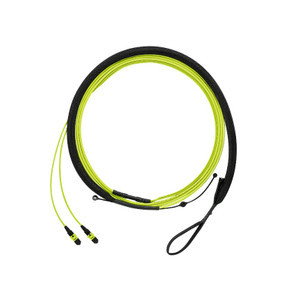
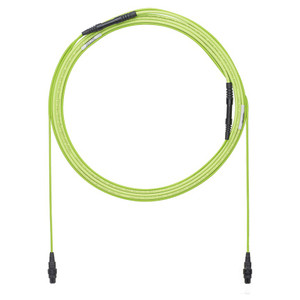
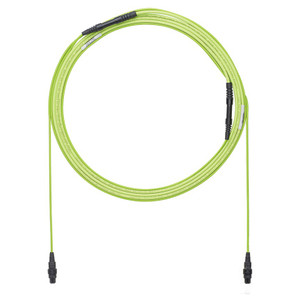
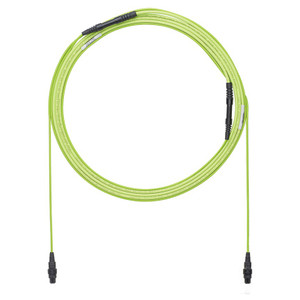
Panduit FWTYL7575KAM049 QuickNet OM5 12-Fiber Trunk Cable Assembly
The Panduit FWTYL7575KAM049 is a factory-terminated 49-meter OM5 wideband multimode trunk cable designed for high-density data center deployments requiring extended reach at 40/100/400 Gigabit Ethernet speeds. This 12-fiber assembly terminates in PanMPO female connectors on both ends, configured for Method A polarity to simplify integration with structured cabling architectures. The HD Flex cable design reduces outer diameter by 30-40% compared to legacy trunk assemblies, directly addressing pathway congestion in zero-U cable managers, overhead ladder rack, and high-density panel environments. Low Smoke Zero Halogen (LSZH) jacket construction meets plenum air-handling space requirements without the cost premium of traditional riser-rated fiber, while ultra-low insertion loss performance preserves optical budgets for extended-distance links in spine-leaf and storage-area network topologies.
Key Features
- OM5 wideband multimode fiber supporting 40GBASE-SR4, 100GBASE-SR4, and 400GBASE-SR8 applications with extended reach over OM3/OM4
- 12-fiber trunk configuration with PanMPO female connectors both ends - supports dual 40GbE or single 100GbE links per trunk
- 49-meter (160.76 ft) length ideal for cross-row aggregation, end-of-row distribution, and storage network interconnects
- Method A polarity (straight-through keying) pairs with standard Method B patch cords for duplex transceiver connectivity
- Ultra insertion loss performance - factory-tested to <0.35 dB typical, preserving optical budget for 100+ meter OM5 links at 400GbE data rates
- HD Flex cable construction delivers 30-40% smaller outer diameter vs. standard 12-fiber trunks - critical space savings in congested pathways and zero-U horizontal managers
- LSZH jacket meets IBC plenum requirements for air-handling spaces - lower cost than riser-rated alternatives with identical flame/smoke performance
- Lime cable color per TIA-568 OM5 identification standard - prevents accidental cross-connections with OM3 (aqua) or OM4 (erika violet) infrastructure during MAC work
- Pulling eye on one end simplifies installation through overhead cable tray, raised-floor conduit, or plenum spaces without connector damage
- 50-micron fiber diameter optimized for VCSEL transmitter coupling and Short-Wavelength Division Multiplexing (SWDM) at 850/880/910/940nm wavelengths
- Factory-terminated and tested to TIA-604-5 (FOCIS-5) endface geometry - serialized test reports included, eliminating field testing and contamination risk
- RoHS compliant construction for EU data center deployments and corporate sustainability reporting requirements
OM5 wideband multimode fiber represents a generational leap over OM3 and OM4 for data center operators planning 100 Gigabit Ethernet and 400 Gigabit Ethernet migration paths. While OM4 fiber supports 100GBASE-SR4 to 100 meters and 400GBASE-SR8 to 70 meters using parallel optics, OM5 extends those distances to 150 meters at 100GbE and 100 meters at 400GbE by leveraging Short-Wavelength Division Multiplexing (SWDM) technology. SWDM transmits four wavelengths (850/880/910/940nm) simultaneously over fewer fibers, reducing the fiber count required for 40/100/400GbE links and lowering transceiver costs compared to parallel single-mode optics. This trunk's 12-fiber configuration supports a single 100GBASE-SR4 link (8 fibers active, 4 spare for redundancy or future use) or two independent 40GBASE-SR4 links with full bidirectional transmission. The PanMPO connector system - fully interoperable with MPO/MTP standards per TIA-604-5 - provides a 12-fiber interface in a single connector body with push-pull latch mechanism, drastically reducing panel port density requirements compared to LC duplex connectivity. Method A polarity configuration means the fiber positions are mirrored pin-to-pin (position 1 to position 1, position 12 to position 12), requiring a polarity-reversing Method B patch cord at each equipment end to achieve the transmit-to-receive crossover that duplex transceivers expect. This polarity scheme is the industry-standard deployment model for backbone trunks connecting passive cassette modules or breakout panels in a three-jumper structured cabling architecture.
The HD Flex cable design addresses the single most common constraint in data center retrofit projects: pathway fill capacity. Traditional 12-fiber trunk cables use 900-micron buffered fibers in a 3.0mm outer diameter tight-buffered construction, consuming significant cross-sectional area in cable trays, zero-U vertical managers, and horizontal wire management fingers. This trunk reduces that outer diameter to approximately 1.6mm by using smaller-diameter buffering and tighter fiber bundling, achieving a 45-50% reduction in cross-sectional area. When you're installing 20+ trunks in a single vertical manager or routing six trunks through a 1-inch overhead J-hook, that space savings directly translates to avoiding a costly pathway infrastructure upgrade. The 49-meter length is strategically chosen for intra-datacenter distribution that exceeds the reach of standard 30-meter trunks but avoids the insertion-loss budget penalties that begin affecting 100+ meter links at 400GbE data rates. Common deployment scenarios include spine-to-leaf switch connections in a two-post row layout (up to 45 meters), end-of-row aggregation switches to mid-row compute racks, and storage-area network links between SAN directors and disk arrays in separate fire zones. The pulling eye on one end - a reinforced loop integrated into the cable jacket - allows installation crews to attach pull strings or fish tape and route the trunk through congested overhead pathways or under-floor conduit without applying tension directly to the PanMPO connector boots, which can damage the precisely aligned ferrule endfaces and cause insertion loss failures. LSZH jacket construction meets International Building Code plenum air-handling space requirements by producing low smoke particulate and zero halogen acid gases during combustion, making this trunk code-compliant for installation above drop ceilings and in return-air plenums without the need for dedicated conduit - a significant labor cost savings compared to riser-rated or general-purpose fiber that requires enclosed pathways in plenum spaces.
Factory termination and testing to TIA-604-5 (FOCIS-5) endface geometry standards ensures insertion loss performance that field terminations cannot reliably achieve. Each connector endface is polished to sub-micron flatness tolerances and inspected under interferometric microscopy for apex offset, radius of curvature, and fiber height - parameters that directly control the air gap between mated connectors and thus the insertion loss of the optical link. Panduit ships each trunk with serialized insertion-loss and return-loss test data measured at 850nm and 1300nm wavelengths per IEC 61300-3-34 test methods, providing documentable proof of <0.35 dB typical insertion loss for link budget calculations and eliminating the need for expensive field test equipment (OTDR or light source/power meter) during installation acceptance testing. This is critical for 400GBASE-SR8 deployments where the IEEE 802.3bs standard allocates only 1.5 dB total channel insertion loss budget over 100 meters - every 0.1 dB of connector loss directly subtracts from usable link distance. The lime cable jacket color follows TIA-568 color-coding standards that designate lime green for OM5 fiber, distinct from aqua (OM3) and erika violet (OM4), preventing accidental cross-patching during moves, adds, and changes. When a technician is working in a dense patch field under time pressure, color-coding provides instant visual confirmation of fiber type without needing to trace cable labels or consult documentation. RoHS compliance - restriction of hazardous substances including lead, mercury, cadmium, and hexavalent chromium - meets European Union data center procurement requirements and supports corporate ESG reporting for Fortune 500 clients with global sustainability mandates. QuickNet sub-branding indicates Panduit's lifetime warranty coverage, which protects against manufacturing defects in materials and workmanship for the operational life of the product when installed per manufacturer guidelines - a concrete risk transfer that matters when you're specifying $150,000 of trunk infrastructure for a spine-leaf fabric supporting business-critical SAP HANA or VMware vSAN workloads where a single failed trunk can black-hole 400 Gbps of east-west traffic.