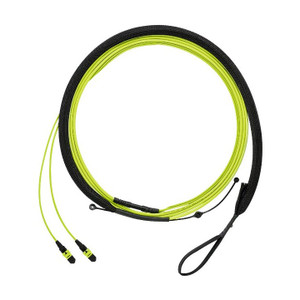
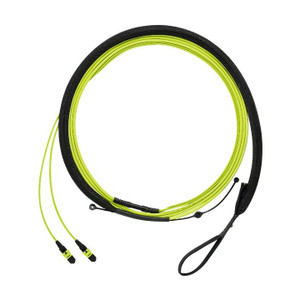
Panduit FWUYL7575KNM024 OM5 24-Fiber Trunk Cable Assembly
The Panduit FWUYL7575KNM024 is a 24-meter QuickNet OM5 trunk cable assembly engineered for next-generation data center infrastructure where short-wave wavelength-division multiplexing (SWDM) and extended reach requirements intersect with aggressive space constraints. This 24-fiber trunk ships with PanMPO female connectors at both ends in Method A polarity configuration, HD Flex transition strain relief, and Ultra insertion loss performance grading—designed to support 40/100/400 Gigabit Ethernet applications over multimode fiber in compact pathways. The LSZH jacket meets European and North American low-smoke zero-halogen mandates for enclosed spaces, while the lime cable color provides instant OM5 identification per TIA-568 convention. With a small-diameter trunk design that consumes 30 to 40% less pathway volume than legacy trunk solutions, this assembly addresses the dual challenge of scaling fiber density while maintaining headroom for future adds in congested overhead and underfloor cable routes.
Key Features
- OM5 wideband multimode fiber supports 4-wavelength SWDM transmission for 40/100/400GbE applications
- 24-fiber count in compact HD Flex trunk construction reduces pathway fill by 30-40% versus traditional cable designs
- PanMPO female connectors (both ends) with Method A polarity for duplex channel pairing in parallel optics architectures
- Ultra insertion loss performance tier ensures margin for extended reach and multi-connection channel configurations
- Low Smoke Zero Halogen (LSZH) jacket meets IEC 60332-1, IEC 60754-1, and IEC 61034 flammability and toxicity requirements
- Lime cable jacket provides instant visual identification of OM5 fiber per TIA-568-C.3 color coding standards
- 24-meter (78.74 ft) pre-terminated length eliminates field termination labor and variability in backbone installations
- 50-micron core diameter OM5 fiber rated for 550m at 10GbE, 150m at 40/100GbE (SR4/SR10), 150m at 400GbE (SR16)
- HD Flex transition strain relief at both connector interfaces prevents micro-bend losses during cable management
- Meets TIA-568-C.3, ISO/IEC 11801, TIA-492-AAAD, and IEC 60793-2-10 A1a.3 optical performance specifications
The OM5 fiber specification (TIA-492-AAAD, IEC 60793-2-10 A1a.3) extends the capabilities of 50-micron laser-optimized multimode fiber (LOMMF) by tightening effective modal bandwidth (EMBc) requirements across four discrete short-wave wavelengths—850nm, 880nm, 910nm, and 940nm. This wideband performance enables short-wave wavelength-division multiplexing (SWDM) transmission, where a single fiber pair carries four parallel data streams at different wavelengths, quadrupling effective bandwidth without additional fiber strands. For 40 and 100 Gigabit Ethernet SR4 applications, the 24-fiber PanMPO interface provides six duplex channels (12 fibers transmit, 12 fibers receive) when used in breakout configurations, or serves as a single 24-fiber parallel optics trunk for 400GbE SR16 applications (16 active fibers transmit, 16 active fibers receive, with 8 fibers reserved). The Ultra insertion loss grading—Panduit's tightest factory performance tier—guarantees maximum insertion loss below industry-standard limits, preserving link budget for extended reach installations, multiple mated connection points in cross-connect topologies, or margin against future degradation from contamination and handling. The PanMPO connector design incorporates a push-pull latch mechanism that eliminates the snagging hazards of traditional MPO bail-latch designs in dense patch panel arrays, while the female pin configuration at both ends requires a male-pinned adapter or patch cord for mating, ensuring proper polarization alignment in Method A trunk-to-trunk or trunk-to-breakout deployments. HD Flex transition boots provide bend radius protection at the connector-cable interface without the rigid bulk of traditional strain reliefs, allowing tighter routing in congested patch panel zones where vertical and horizontal pathway transitions occur within a few inches.
In contemporary data center spine-leaf architectures, the shift from 10GbE server connectivity to 25/50GbE hosts and 100/400GbE spine uplinks drives exponential growth in backbone fiber counts. A single top-of-rack switch deploying 400GbE uplinks may require 16 to 32 fiber strands per uplink port, creating scenarios where a 48-port spine switch consumes 768 to 1,536 fiber strands in its upstream connectivity. Traditional round OM3/OM4 trunk cables—typically 6-8mm in diameter for a 12-fiber assembly—would consume prohibitive volumes in overhead ladder rack or underfloor conduit when scaled to these fiber densities. The HD Flex trunk construction in the FWUYL7575KNM024 uses a flat ribbon fiber geometry with an ultra-compact outer jacket, reducing overall cable diameter by 30 to 40 percent compared to equivalent fiber-count round trunk designs. This space efficiency translates directly to pathway capacity: a 4-inch ladder rack that would accommodate 80 legacy 12-fiber trunks can support 120 to 135 HD Flex trunks of equivalent fiber count, or can maintain the original 80-trunk fill while reserving 30-40% of pathway volume for future expansion. The 24-meter length suits typical data center row-to-row or aisle-crossing backbone runs—sufficient for a 60-foot horizontal pathway run plus vertical rise to overhead racks and service loops at both ends, without the slack management burden of oversized pre-terminated lengths. The Low Smoke Zero Halogen jacket composition is mandatory for installations subject to European EN 50174-2 and EN 50173 standards, NFPA 75 data center guidelines, or municipal building codes requiring limited combustion products in occupied IT spaces, air-handling plenums, or vertical riser shafts. Unlike PVC or OFNR-rated jackets that emit hydrogen chloride gas and dense smoke under combustion, LSZH compounds produce minimal halogenated acids and reduced smoke density, improving egress visibility and reducing corrosive damage to active equipment during fire events.
The Method A polarity scheme defined in TIA-568-C.0 Annex A positions this trunk for universal deployment in duplex-based parallel optics systems. In a Method A configuration, fiber position 1 at connector A maps to fiber position 1 at connector B, fiber position 2 to fiber position 2, and so forth—maintaining straight-through physical connectivity across the trunk. To achieve the required transmit-to-receive crossover for duplex channels, the installation pairs a Method A trunk with either a Method B patch cord at one end (which flips fiber pairs within the connector) or deploys a crossover adapter at the patch panel interface. This architecture simplifies inventory management: all backbone trunks use Method A polarity, all equipment patch cords use Method B polarity, and the system integrator stocks a single trunk SKU for the entire backbone infrastructure. The PanMPO female-to-female configuration ensures that the trunk interfaces with male-pinned breakout modules, adapter panels, or patch cords, preventing accidental mating of two female-pinned or two male-pinned connectors (which would reverse polarity and cause link failure). Panduit's factory termination process includes end-face geometry inspection per IEC 61300-3-35 interferometry standards, ensuring that fiber protrusion, apex offset, and radius of curvature fall within the narrow tolerances required for Ultra insertion loss performance. Every trunk ships with individual test data documenting insertion loss at 850nm and 1300nm wavelengths for all 24 fibers, providing as-built performance records for link budget validation and troubleshooting. The QuickNet product family designation indicates compatibility with Panduit's broader pre-terminated fiber system portfolio, including breakout modules, cassette adapters, and field-installable trunk-to-duplex conversion hardware—ensuring that a single vendor ecosystem supports the full structured cabling architecture from backbone trunk to equipment patch cord. Compliance with TIA-568-C.3, ISO/IEC 11801 Edition 2.2, and TIA-604-5 (FOCIS-5) connector intermateability standards guarantees interoperability with third-party OM5-rated transceivers, switch modules, and fiber infrastructure from any standards-compliant vendor, eliminating single-source lock-in risks in multi-vendor data center environments.