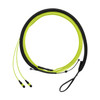
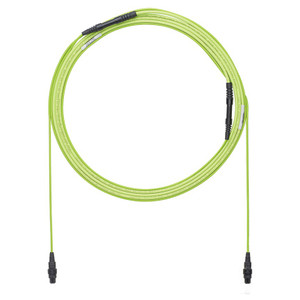
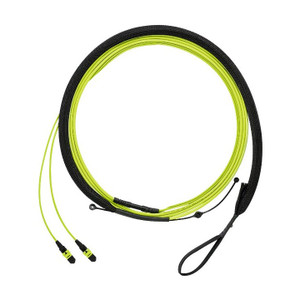
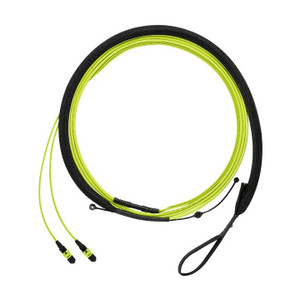
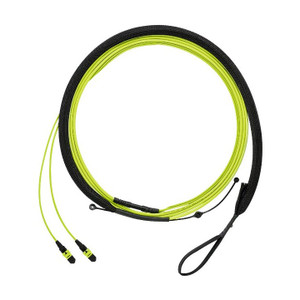
Panduit FWUYL7575KAM071 QuickNet OM5 24-Fiber Trunk Cable Assembly
The Panduit FWUYL7575KAM071 is a 71-meter OM5 wideband multimode trunk cable assembly engineered for high-density data center deployments where space, installation speed, and future-proofing matter. This 24-fiber trunk terminates PanMPO Female to PanMPO Female with Method A polarity, ships factory-tested to ultra insertion loss standards, and uses low smoke zero halogen (LSZH) jacketing for compliance in plenum-equivalent or international installations. The QuickNet platform delivers 30 to 40 percent space savings over traditional breakout assemblies, and the integrated pulling eye on one end simplifies deployment through conduit or overhead pathways. If you're building out 40G/100G spine fabrics, migrating to 200G/400G with shortwave wavelength division multiplexing (SWDM), or densifying existing racks without ripping out infrastructure, this trunk gives you the reach, performance, and installation efficiency to meet aggressive deployment timelines.
Key Features
- OM5 wideband multimode fiber (50 µm core) supports legacy 10G/40G/100G SR optics plus emerging SWDM 200G/400G transceivers on the same infrastructure
- 24-fiber count in a single trunk replaces twelve duplex LC patch cords, reducing pathway congestion and simplifying MACs in spine-leaf or storage fabrics
- PanMPO Female to PanMPO Female connectors (MTP/MPO compatible) with Method A polarity alignment for standards-compliant 40GBASE-SR4 and 100GBASE-SR4 deployments
- Ultra insertion loss specification (≤0.35 dB typical per connector) preserves link budget on extended 70-meter runs between distribution frames or across hot/cold aisle rows
- Low Smoke Zero Halogen (LSZH) outer jacket meets IEC 60332-1 and IEC 61034 for reduced toxicity and smoke density in occupied spaces or international fire codes
- HD Flex cable construction delivers 30–40% smaller cross-sectional area than standard trunks, freeing up overhead ladder rack or under-floor conduit capacity for power or future fiber expansions
- Factory-installed pulling eye on one end simplifies long-distance pulls through innerduct, vertical risers, or congested pathways without damaging connectors or exposing fibers
- 71-meter (232.94 ft) length spans typical row-to-EOR (end-of-row) or floor-to-floor distances in enterprise or colocation data centers without requiring mid-span splices
- Lime-green jacket color (OM5 standard per TIA-598-D) provides instant visual identification during installs, adds/moves, or troubleshooting in mixed-mode fiber plants
- Ships with individual test reports documenting insertion loss and return loss per fiber pair, supporting change-order documentation or customer acceptance testing
OM5 Wideband Multimode: Future-Proofing Without Forklift Upgrades
OM5 fiber extends the ISO/IEC 11801 and TIA-568 multimode roadmap by supporting shortwave wavelength division multiplexing (SWDM) in addition to traditional 850 nm vertical-cavity surface-emitting laser (VCSEL) transmission. Where OM3 and OM4 operate on a single 850 nm wavelength, OM5's wider effective modal bandwidth (EMB) across the 850–950 nm spectrum allows a single duplex or parallel fiber pair to carry four independent wavelengths simultaneously. This means 100GBASE-SR2 or 200GBASE-SR4 transceivers can deliver 100 Gb/s over two fibers or 400 Gb/s over eight fibers at reaches up to 100 meters, versus the four or eight fibers required by traditional parallel optics. For spine-leaf fabrics already populated with OM4 or planning a refresh, OM5 trunks like the FWUYL7575KAM071 provide backward compatibility with installed 10G/40G/100G SR optics today while enabling pay-as-you-grow migrations to 200G/400G SWDM optics tomorrow—no re-cabling, no downtime, no change orders to add new fiber runs.
PanMPO Connectivity and Method A Polarity
The FWUYL7575KAM071 terminates with Panduit's PanMPO connectors, a mechanically and optically compatible variant of the industry-standard MPO/MTP multi-fiber push-on interface defined in TIA-604-5 (FOCIS-5). Each PanMPO Female connector houses 12 fibers in a single row, and this 24-fiber trunk uses two 12-fiber connectors per end, wired in Method A (also called "straight-through" or "key-up to key-up") polarity. In a Method A deployment, Position 1 on Connector A maps to Position 1 on Connector B, Position 2 to Position 2, and so on. This polarity scheme is the TIA-568-C.0 Annex D standard for backbone trunks connecting cassettes, panels, or breakout modules—when you plug this trunk between two Method A cassettes (e.g., Panduit FAP or FQP modules), the transmit fibers on one cassette automatically align with the receive fibers on the opposite cassette via the cassette's internal crossover. The result: plug-and-play 40G or 100G connectivity without field polarity testing or custom pinouts. Both connectors ship with removable dust caps and are factory-inspected for end-face geometry per IEC 61300-3-35, so you're not troubleshooting contamination or scratches on day one.
Ultra Insertion Loss and Link Budget Preservation
Panduit specifies this trunk to an "ultra" insertion loss grade, meaning each mated PanMPO connector pair typically measures ≤0.35 dB insertion loss and ≥20 dB return loss across all 24 fibers. On a 71-meter cable, total channel loss (cable attenuation + two connector pairs) stays well below 1.5 dB—critical when your 100GBASE-SR4 transceiver's loss budget is only 1.9 dB per IEEE 802.3bm or when you're chaining this trunk through a mid-point cross-connect to reach 100+ meters total. The low insertion loss also preserves margin for future optics generations with tighter loss budgets (e.g., 400GBASE-SR8 at 1.5 dB max) or for installations where you must splice this trunk to existing plant fiber. Every FWUYL7575KAM071 ships with a serialized test report documenting insertion loss and return loss per fiber, measured at 850 nm and 1300 nm per TIA-526-14 OFSTP-14 methodology, so you can hand the report to your customer's acceptance team or archive it for warranty claims without re-testing in the field.
LSZH Jacketing for Safety and International Compliance
The FWUYL7575KAM071 uses a low smoke zero halogen outer jacket, replacing the PVC or plenum-rated FEP jackets common on North American fiber trunks. When exposed to fire, LSZH compounds produce significantly less smoke (per IEC 61034 smoke density test) and emit negligible hydrochloric acid or other halogenated gases that corrode electronics or pose inhalation hazards in occupied spaces. This makes LSZH the de facto requirement for data centers in the EU (CPR Euroclass), healthcare facilities under NFPA 99, or any installation where the authority having jurisdiction (AHJ) mandates low-toxicity materials in non-plenum horizontal pathways. In North America, LSZH trunks also simplify multinational deployments—stock one SKU for your US and EMEA sites instead of maintaining separate plenum and LSZH inventories. Note that while LSZH jackets meet IEC 60332-1 flame propagation (single vertical cable test), they do not carry UL 910 plenum ratings; if you're installing above drop ceilings in plenum air-return spaces under NEC Article 770, verify your AHJ accepts LSZH or specify Panduit's OFNP-rated trunks instead.
HD Flex Construction and Space Reclamation
Panduit's HD Flex trunk design reduces the cable's outer diameter by 30 to 40 percent compared to legacy round or flat trunk constructions, using smaller-diameter tight-buffered fibers (900 µm versus 2 mm or 3 mm) and a compact ribbon or loose-tube bundling method under the LSZH jacket. On a 24-fiber trunk, this translates to a cross-sectional area roughly equivalent to a 12-fiber traditional trunk, which directly impacts pathway fill calculations under NEC Article 770.113 (maximum 40% conduit fill) or TIA-569 (maximum 50% cable tray fill). In a densifying data center where you're adding 100G uplinks without expanding overhead ladder rack, reclaiming 35% of your existing pathway capacity can mean deferring a costly infrastructure upgrade or freeing space for redundant power feeds. The smaller diameter also reduces bend radius requirements—this trunk's minimum bend radius under load is typically 10× the cable OD (approximately 50 mm), allowing tighter routing around cabinet corners or through vertical wire managers without exceeding the 20× OD limit that triggers attenuation spikes or fiber breakage.
Integrated Pulling Eye and Installation Efficiency
One end of the FWUYL7575KAM071 ships with a factory-installed pulling eye, a reinforced loop attachment point that couples to standard cable-pulling grips or swivels. This feature is critical when you're pulling 71 meters of trunk through innerduct, vertical risers, or congested under-floor pathways where friction or bend radius can exceed the connector's mechanical limits. By attaching your pull rope or tape to the pulling eye instead of the connector boot, you transfer tensile load to the trunk's aramid strength members (Kevlar yarns embedded under the jacket), protecting the ferrule end-faces and internal fiber ribbons from crushing or end-separation. The pulling eye also simplifies two-person installs in overhead pathways—one technician feeds from the spool while the second pulls from the destination rack, maintaining constant tension to prevent mid-span sagging or kinking. Once the trunk is seated, simply remove the pulling eye (it's a detachable component, not a permanent stub) and install the connector dust cap until you're ready to mate to your cassette or panel.
Application Scenarios and Deployment Context
This trunk fits high-density data center fabrics where you need pre-terminated, factory-tested fiber between distribution points and speed matters more than custom field termination. Common deployments include (1) spine-leaf fabrics: connecting top-of-rack (ToR) switches to end-of-row (EOR) aggregation switches in a leaf layer, where each 24-fiber trunk breaks out to twelve duplex LC ports via cassettes, supporting twelve 10GBASE-SR or six 40GBASE-SR4 uplinks per trunk; (2) storage area networks: linking Fibre Channel switches or directors across hot-aisle/cold-aisle rows, where LSZH compliance and low loss preserve 16G/32G FC link margins on 70-meter runs; (3) inter-building backbones: spanning between main distribution frame (MDF) and intermediate distribution frame (IDF) in a campus environment, where the 71-meter length covers typical building-to-building distances without requiring outdoor-rated armor or mid-span fusion splicing; (4) colocation handoffs: connecting customer cabinets to meet-me rooms (MMRs) in multi-tenant data centers, where the lime OM5 jacket and serialized test report simplify acceptance testing and MAC audits. In all cases, the Method A polarity and PanMPO form factor assume you're mating to compatible cassettes or breakout modules—verify your existing panels support Method A (vs. Method B or Method C) and 12-fiber MPO interfaces before ordering, or plan to swap cassettes as part of the deployment.
Standards Compliance and Interoperability
The FWUYL7575KAM071 meets or exceeds TIA-568-C.3 (optical fiber cabling components), ISO/IEC 11801 (generic cabling for customer premises), TIA-604-5 FOCIS-5 (MPO connector intermateability), TIA-492-AAAD (OM5 fiber performance), and IEC 60793-2-10 Type A1a.3 (50/125 µm graded-index multimode fiber). The LSZH jacket complies with IEC 60332-1 (flame propagation) and IEC 61034 (smoke density), and the assembly is RoHS-compliant for lead-free, restricted-substance installations. Panduit does not publish a specific UL listing for this trunk (it's a premises-wiring component, not a plenum cable requiring UL 910), but the individual fibers and connectors carry the certifications required for TIA-568-C.1 horizontal and backbone channel compliance. For IEEE 802.3 Ethernet applications, this trunk supports 10GBASE-SR at 300 m (OM3 spec, OM5 extends to 300 m), 40GBASE-SR4 at 150 m, 100GBASE-SR4 at 150 m, and emerging 200GBASE-SR4 / 400GBASE-SR8 SWDM at up to 100 m, all per the OM5 reach tables in IEEE 802.3cm and 802.3bs. The 71-meter length of this trunk fits comfortably within all those application windows, leaving headroom for cassette-to-transceiver patch cords and mid-point cross-connects.
The Panduit FWUYL7575KAM071 ships as a single unit (package quantity 1, carton quantity 0 indicates no bulk packaging), includes the pulling eye on one end, and arrives with protective dust caps on all four PanMPO connectors plus the serialized insertion-loss test report. Lime jacket color (OM5 standard) ensures instant visual differentiation from aqua OM3, magenta OM4, or yellow singlemode trunks in mixed-fiber plants, reducing the risk of cross-patching multimode to singlemode optics during MACs or emergency restorations.