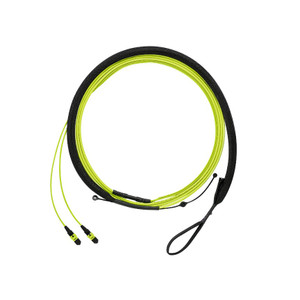
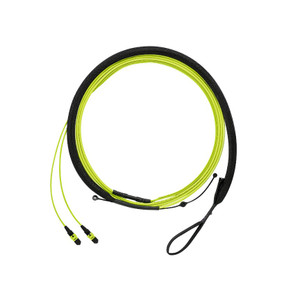
Panduit FWUYL7575LAM072 QuickNet OM5 24-Fiber Trunk Cable Assembly
When you're building or upgrading a data center backbone for 100G, 200G, or 400G Ethernet over multimode fiber, this Panduit QuickNet trunk delivers the headroom you need without ripping out infrastructure in three years. The FWUYL7575LAM072 is a factory-terminated 24-fiber OM5 assembly running 72 meters between PanMPO female connectors, spec'd for ultra insertion loss and built on Panduit's HD Flex small-diameter construction. OM5 wideband multimode fiber supports short-wave wavelength division multiplexing (SWDM), effectively quadrupling your lane capacity compared to OM4 at the same fiber count — critical when you're planning 400GBASE-SR8 or 200GBASE-SR4 deployments that need to scale without a complete rewire. The lime LSZH jacket provides instant visual identification of OM5 in mixed-generation installs and meets low-smoke zero-halogen flammability requirements for international and plenum-equivalent deployments.
Key Features
- OM5 wideband multimode fiber (50/125 µm) enables SWDM operation — 4 wavelengths per fiber pair for 4× effective bandwidth vs. OM4 using same physical infrastructure
- 24 fibers in PanMPO female-to-female configuration support 12-fiber duplex breakout or 24-fiber parallel optics (100G-SR4, 400G-SR8, 200G-SR4)
- 72-meter engineered length (236.2 ft) bridges typical main distribution area (MDA) to horizontal distribution area (HDA) runs in enterprise and colocation data centers
- Method B polarity (key-up to key-down) ensures correct transmit/receive pairing when mating with Method B cassettes or fanouts
- Ultra insertion loss performance — factory testing and certification guarantees <0.35 dB typical IL per mated connection, lower than field-terminated alternatives
- HD Flex small-diameter cable construction uses 30-40% less pathway space than standard trunk cables, critical for high-density overhead tray and underfloor conduit fills
- LSZH (Low Smoke Zero Halogen) jacket meets IEC 60332-1 and 60754 requirements for reduced toxicity and smoke generation during fire events
- Lime-green outer jacket provides instant visual differentiation from OM3 (aqua) and OM4 (erika violet) legacy fiber
- Integrated pulling eye on one end simplifies installation through long conduit runs or congested pathways without damaging connectors or fiber
- PanMPO connectors use Panduit's multi-fiber push-on design with low-profile housing, compatible with standard MPO infrastructure (IEEE 802.3, TIA-604-5 FOCIS-5)
OM5 fiber was standardized in TIA-492-AAAD and ISO/IEC 11801 specifically to support short-wave wavelength division multiplexing without requiring single-mode fiber's tighter tolerances and higher transceiver costs. Where OM3 and OM4 operate on a single 850 nm wavelength, OM5 is optimized for four wavelengths (850, 880, 910, 940 nm), allowing a single fiber pair to carry four independent 25G or 50G channels. This means a 24-fiber OM5 trunk like the FWUYL7575LAM072 can support twelve 100GBASE-SR4 links today using standard 100G-SR4 optics (4 lanes × 25G), or scale to 400GBASE-SR8 (8 lanes × 50G) using SWDM optics when you migrate to 400G switching — all without pulling new cable. At 72 meters, this assembly stays well within OM5's 440-meter reach spec for 400G-SR8 and the 100-meter limit for 100G-SR4, giving you flexibility to route through overhead ladder rack, underfloor trenches, or vertical riser shafts in multi-floor facilities. The ultra insertion loss spec (typically <0.35 dB per mated pair) preserves your link budget even when daisy-chaining through patch panels or zone enclosures — critical when you're connecting spine switches to leaf switches across multiple intermediate distribution frames. Method B polarity is the TIA-568 standard for parallel optics: the key-up connector at one end becomes key-down at the far end, flipping the fiber map so that transmit lanes on one side align with receive lanes on the other. This trunk is designed to mate directly with Method B MPO cassettes (e.g., Panduit's FAP series) or Method B breakout harnesses, eliminating the need for polarity-flip adapters or custom fiber mapping that introduce insertion loss and failure points.
Data center backbone cabling is a high-stakes install: it's expensive to pull, disruptive to change, and you're typically locked into your fiber choice for 7-10 years or longer. Small-diameter HD Flex construction becomes critical when you're filling 4-inch innerduct or overhead cable tray that's already carrying copper, power whips, and legacy fiber — especially in retrofit scenarios where you're adding 100G uplinks to racks originally built for 1G or 10G. A traditional 24-fiber trunk might measure 0.5 to 0.6 inches OD; Panduit's HD Flex cable is closer to 0.35 inches, letting you fit 30-40% more cables in the same pathway or avoid costly tray expansions, conduit upsizing, and AHJ permit amendments. The integrated pulling eye on this 72-meter assembly lets you attach a pull rope or fish tape without improvising a harness around the connector bodies — a common failure point that can crack ferrules, misalign fiber cores, or snap aramid strength members during long pulls through congested horizontal or vertical pathways. LSZH jacketing is required by NFPA 75 and IEC standards in many international facilities, and it's becoming standard practice in US colocation and hyperscale data centers even where not mandated by local code: during a fire event, LSZH cable produces significantly less smoke opacity and no halogen acid gases (hydrogen chloride, hydrogen fluoride) that corrode rack-mount equipment and harm occupants in enclosed spaces. The lime jacket is more than aesthetics — in a mixed-generation environment where you've got OM3 aqua, OM4 violet, and OS2 yellow single-mode all running in the same pathways, instant visual identification prevents costly mis-patching incidents (such as plugging OM3 into a link budgeted for OM5, which could cause intermittent packet loss or complete link failure at 400G rates).
The FWUYL7575LAM072 is engineered for spine-to-leaf architectures in Clos or distributed HDA topologies, MDA-to-EDA backbone runs in enterprise data centers, and high-density server interconnects in colocation or hyperscale environments planning 100G-to-400G migration paths. It's fully compliant with TIA-568-C.3, TIA-568-C.1, ISO/IEC 11801, IEC 60793-2-10 Type A1a.3 (OM5 fiber specification), and RoHS, and ships with Panduit's factory test report documenting insertion loss, return loss, and length for every fiber pair — certification you can hand directly to the customer or independent commissioning agent without field testing every termination. If you're running 40G or 100G today and planning 200G or 400G in the next refresh cycle, OM5 trunks like this let you install the physical layer once and upgrade optics later, avoiding the cost and downtime of rewiring production data center space.