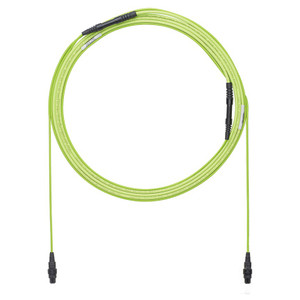
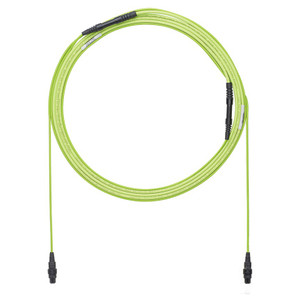
Panduit FWTYL7575LNM007 QuickNet™ 12-Fiber OM5 Trunk Cable Assembly
The Panduit FWTYL7575LNM007 is a 7-meter, 12-fiber OM5 trunk cable assembly engineered for high-density data center environments where rack space is at a premium and extended reach is non-negotiable. Part of Panduit's QuickNet™ pre-terminated fiber platform, this lime-jacketed assembly delivers wideband multimode performance up to 953 nm wavelength while consuming 30-40% less pathway space than legacy OM3/OM4 trunk designs—a critical advantage when you're managing dozens of parallel runs in congested horizontal or vertical pathways. Factory-terminated with precision-polished connectors and backed by Panduit's end-to-end test certification, it eliminates field termination variability and cuts deployment time from hours to minutes.
Key Features
- 12-fiber OM5 (50/125 µm) wideband multimode construction supporting 40G/100G SR4 and emerging SWDM applications up to 400G over extended distances
- 7-meter (22.97 ft) length optimized for intra-row data center links, middle-of-row to end-of-row runs, or short riser connections between adjacent floors
- Small-diameter trunk design reduces conduit fill and cable-tray congestion by 30-40% compared to standard jacketed assemblies—enables higher strand counts in the same 4-inch ladder rack
- LSZH (Low Smoke Zero Halogen) outer jacket meets IEC 60332-1 and 60754 for plenum and riser installations where toxic fume suppression is mandated by local fire codes
- Lime jacket color provides instant visual identification in mixed OM3/OM4/OM5 infrastructures, reducing cross-connect errors during adds/moves/changes
- Factory pre-terminated and tested to IL ≤0.35 dB, RL ≥-20 dB per TIA-568-C.3—ships with individual test reports traceable to serial number
- QuickNet™ modular breakout design supports MTP-to-LC, MTP-to-SC, or MTP trunk-to-trunk configurations depending on deployment topology
- RoHS compliant, manufactured in ISO 9001 facility with full material traceability for government and Fortune 500 procurement requirements
OM5 wideband multimode fiber represents the current evolution of 50 µm laser-optimized multimode technology, extending the spectral window from OM4's 850 nm single-wavelength operation to a four-channel SWDM (Short Wavelength Division Multiplexing) grid spanning 850, 880, 910, and 940 nm. This expansion allows a single OM5 duplex link to carry four independent 25G or 50G channels, delivering aggregate 100G or 200G bandwidth without requiring parallel optics—halving transceiver counts and port density requirements in spine-leaf architectures. For 40G/100G SR4 applications, OM5 maintains the same 100-meter OM4-equivalent reach at 850 nm, ensuring backward compatibility with installed QSFP+ and QSFP28 optics while future-proofing the physical layer for SWDM migration. The 50/125 µm core geometry supports effective modal bandwidth (EMBc) ≥2000 MHz·km at 850 nm, well above the TIA-492-AAAD minimum, which translates to lower insertion loss and improved link margin on high-speed protocols. Panduit's manufacturing process controls core concentricity to ≤0.5 µm and numerical aperture to 0.200 ± 0.015, ensuring consistent coupling efficiency across all twelve fibers in the trunk—critical when you're balancing optical budgets on 100-meter links operating near the -6.9 dB IEEE 802.3bm power budget ceiling.
The small-diameter trunk construction addresses a persistent pain point in hyperscale and co-location data centers: pathway exhaustion. Traditional 12-fiber trunk assemblies with individually jacketed breakout legs consume 1.5-2.0 inches of bend radius per cable; in a 40-fiber deployment (four trunks), that's 6-8 inches of horizontal tray width before accounting for service loop. Panduit's reduced-diameter design leverages a thin-wall LSZH jacket (2.0 mm nominal) and tight-buffered 900 µm fiber—the assembly's overall diameter is roughly 60% that of a legacy round trunk, allowing the same 40-fiber deployment to fit in 3.5-4.0 inches with proper dress. This isn't just a tidiness improvement; it has real thermal and compliance implications. NEC Article 300.6 and TIA-569-D mandate 40% maximum conduit fill and 50% cable-tray fill (per NEC 392.22) when calculating ampacity derating—exceeding these thresholds forces a pathway redesign or limits future expansion. By reducing per-cable volume, you preserve that expansion headroom without over-provisioning infrastructure. The lime LSZH jacket is specified for plenum (return air) and riser installations per IEC 60332-3C flame propagation and IEC 61034 smoke density limits; during combustion, it produces <0.5% hydrogen chloride by mass (vs. 20-30% for PVC), which matters in enclosed equipment rooms where corrosive off-gassing can destroy active electronics on adjacent racks even if the fire is contained.
Factory pre-termination is the definitive advantage of the QuickNet™ platform. Field termination of 12-fiber MTP connectors requires epoxy-polish procedures, precision cleave tools, and IPC-certified technicians—even under ideal conditions, expect 15-25 minutes per connector and 5-10% rework rates when insertion loss exceeds 0.50 dB on initial test. Panduit terminates these assemblies in a controlled environment using automated polishing stations and performs 100% IL/RL testing at 850 nm and 1300 nm per TIA-568-C.3 Annex B; each cable ships with a serialized test report showing per-fiber results and end-face geometry (radius of curvature, apex offset, fiber height). That traceability is non-negotiable for DCIM asset management systems and for satisfying warranty claims on optics failures—when a 100G link fails BER testing, you need to isolate whether the issue is the transceiver, the patch cord, or the trunk, and having factory baseline data cuts troubleshooting time from hours to minutes. The MTP interface provides 12-fiber connectivity in a single-row ferrule with push-pull latching; pair it with MTP-to-LC breakout cassettes at each end for 1U rack-mount fanout to individual switch ports, or use MTP trunk-to-trunk mating for ultra-low-loss spine interconnects in a structured cabling topology.
Standards compliance on this assembly spans TIA-568-C.1 (commercial building cabling), TIA-568-C.3 (optical fiber cabling components), ISO/IEC 11801 (generic cabling for customer premises), and TIA-492-AAAD (OM5 fiber performance specs). RoHS conformance under EU Directive 2011/65/EU ensures lead-free, cadmium-free construction—mandatory for equipment exported to EU markets or deployed in California state facilities under SB 20. For federal and defense integrators, the combination of material traceability, serialized test reports, and ISO 9001 manufacturing documentation satisfies FAR Part 46 quality assurance requirements and streamlines GSA Schedule procurement. Panduit's choice of LSZH jacket and OM5 fiber positions this trunk as the go-to solution for colocation providers managing multi-tenant environments (where diverse fire codes apply), healthcare data centers subject to NFPA 99 essential electrical system rules, and financial trading floors where every microsecond of latency and every dB of margin affects arbitrage performance—environments where the cost of a field termination failure or a pathway fill violation far exceeds the premium for factory-certified assemblies.