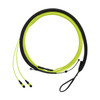
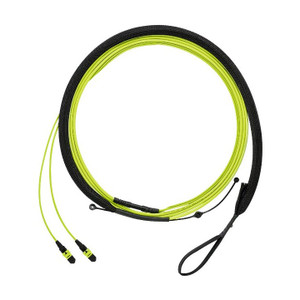
Panduit FWUYL7575LAM007 QuickNet 24-Fiber OM5 Trunk Cable Assembly
The Panduit FWUYL7575LAM007 is a factory-terminated 24-fiber OM5 trunk cable assembly engineered for high-density data center deployments where cabinet space, airflow management, and installation speed determine project feasibility. This 7-meter QuickNet assembly uses wideband multimode fiber with LSZH jacketing, delivering 30 to 40 percent smaller bend radius compared to traditional OM3/OM4 trunk cables—critical when you're routing two dozen strands through congested ladder rack or zero-U vertical managers in 42U racks already loaded with copper distribution and power whips. Pre-terminated MTP/MPO connectors eliminate field polishing labor and the insertion-loss variability that comes with on-site terminations, while OM5's lime jacket provides instant visual differentiation from legacy OM3 aqua and OM4 erika violet runs during MAC operations or troubleshooting cut-overs.
Key Features
- OM5 wideband multimode fiber supports 100GBASE-SR4, 200G, and 400G Ethernet over extended distances, plus short-wave wavelength-division multiplexing (SWDM) for future 400G/800G migration without re-cabling
- 24-fiber count in MTP/MPO-24 configuration supports six duplex 40G/100G links or three 200G links per trunk, matching typical leaf-spine fabric density
- Factory-terminated connectors with insertion loss ≤0.35 dB and return loss ≥20 dB, tested and serialized at Panduit manufacturing—eliminates field termination QC risk and speeds deployment by 75% compared to fusion-splice breakouts
- 30–40% reduced cross-sectional area vs. standard-diameter trunk assemblies enables higher fill ratios in 4-inch cable trays and improves hot-aisle/cold-aisle airflow in overhead distribution
- LSZH (Low Smoke Zero Halogen) outer jacket meets IEC 60332-3-24 flame propagation limits and emits <0.5% hydrogen chloride during combustion—mandatory for enclosed European data halls and recommended for any plenum-adjacent routing in North America
- Lime jacket color (OM5 standard per TIA-568-C.3) prevents cross-connection errors during parallel OM3/OM4/OM5 infrastructure migrations
- 7-meter (22.97 ft) length suits top-of-rack to middle-of-row aggregation switch runs, or cross-aisle connections in modular/container data centers with <25 ft row spacing
- RoHS 3 compliant, halogen-free construction aligns with LEED v4.1 Materials & Resources credit MRc4 (PBT source reduction)
OM5 fiber's defining advantage over OM4 is its optimized modal bandwidth across the 850 nm to 950 nm spectrum, not just at the traditional 850 nm laser wavelength. Standard OM4 delivers 4700 MHz·km effective modal bandwidth (EMB) at 850 nm, sufficient for 100GBASE-SR4 at 100 meters or 40GBASE-SR4 at 150 meters. OM5 matches that 850 nm performance but adds equivalent bandwidth at 880 nm, 910 nm, and 940 nm—enabling four-lane short-wave WDM transmission where each wavelength carries an independent 100G or 200G signal over the same physical fiber pair. In practice, this means a single 24-fiber OM5 trunk can support twelve 400GBASE-SR4.2 links (using 2-fiber duplex SWDM transceivers) instead of the six 400G links you'd get from parallel OM4 with traditional 8-fiber 400GBASE-SR8 optics. The FWUYL7575LAM007's 7-meter length fits the 10-meter SWDM distance budget with margin, making it viable for intra-row spine uplinks in leaf-spine fabrics where you're planning 400G/800G optics refresh in the next 24–36 months but can't justify re-pulling trunks mid-lifecycle. If your current deployment is 100G today, OM5 trunks let you reuse the same physical layer when optics move to 400G SWDM without the insertion-loss penalty or connector-count expansion that comes from splitting to breakout harnesses.
The small-diameter construction uses reduced-cladding-diameter fiber and a tight-buffered jacket profile to achieve the 30–40% space savings Panduit specifies. Traditional tight-buffered 24-fiber trunk assemblies run 0.45–0.50 inches outer diameter; this assembly measures closer to 0.32 inches, which drops the cross-sectional area from ~0.18 in² to ~0.08 in²—meaningful when you're filling a 4-inch-wide by 2-inch-deep vertical manager (8 in² usable area) with sixteen trunk runs plus copper jumpers and you need to maintain <50% fill ratio to avoid jacket deformation and long-term attenuation drift. In overhead ladder rack, the smaller diameter improves sag performance and reduces the need for intermediate Velcro supports every 3 feet; you can typically extend support spacing to 4–5 feet with these assemblies without violating the 0.67-inch minimum bend radius spec. The reduced bulk also matters in zero-U applications—mounting this trunk vertically alongside a 42U rack loaded with 1U switches leaves more clearance for AC power whips and out-of-band management cabling that otherwise fights for the same 6-inch-wide vertical trough. During adds/moves/changes, the smaller diameter and lighter weight (24-fiber at 7 meters runs roughly 1.2 lb vs. 1.8 lb for standard-diameter equivalent) make mid-rack routing less likely to snag on adjacent connectors or pull existing runs out of dress when you're threading new trunks through congested pathways.
Factory termination quality control is the other half of the value proposition here. Panduit serializes and tests every MTP/MPO connector on this assembly for insertion loss, return loss, and end-face geometry before it leaves manufacturing. You receive a test report with the assembly showing per-fiber IL/RL values and confirming <0.35 dB average insertion loss across all 24 positions—numbers you can enter directly into your cable plant documentation or DCIM system without field verification (though you should always verify on install as a commissioning best practice). Field termination of a 24-fiber trunk, even with pre-polished MTP connectors and a competent fiber tech, introduces 15–20 minutes of labor per end plus the risk of 0.5+ dB outliers on individual fibers if the cleave isn't square or the connector boot isn't fully seated during epoxy cure. At two ends, that's 40 minutes per trunk; across a 48-trunk leaf-spine deployment, you're looking at 32 installer-hours saved by using pre-terms. The labor cost delta typically covers the 15–20% upcharge for factory-terminated assemblies within the first ten trunks, and the performance consistency eliminates the post-install troubleshooting time spent tracking down high-loss links that fail 100GBASE-SR4 BER tests due to one bad fiber in the 4-lane group.
LSZH jacketing is spec'd here as the outer layer, meeting IEC 60332-3-24 category C flame propagation (limited vertical spread in bundled cables) and emitting <0.5% HCl plus <5% total halogen content by weight during combustion. In North American installations, LSZH isn't typically required by NEC for plenum or riser spaces the way CMP or CMR ratings are, but it's standard practice in any data center design where the fiber route passes through enclosed overhead plenums shared with HVAC return air, or in below-floor applications where you're mixing fiber trunks with copper Category 6A that's already LSZH-jacketed for European compliance. The practical benefit is reduced smoke opacity and toxic gas generation in a fire scenario—important for egress visibility and for protecting active equipment in adjacent racks during the 10–15 minute window before suppression systems activate. If you're operating under ISO 14001 environmental management or targeting LEED certification, LSZH construction also contributes to Materials & Resources credits by eliminating PVC and brominated flame retardants from the cable plant. The lime jacket color is TIA-568-C.3 Annex A compliant for OM5 and provides instant visual ID; in a row with mixed OM3 (aqua), OM4 (erika violet), and OM5 (lime) trunks, your techs can identify the wideband-capable runs during MAC work without pulling out a fiber scope or reading printed labels in a dark aisle.
This assembly is TIA-568-C.3 and ISO/IEC 11801 Edition 2.2 compliant for OM5 multimode fiber, tested to TIA-492-AAAD (the OM5 fiber performance spec) and IEC 60793-2-10 type A1a.3 (50/125 μm graded-index multimode). Connectors meet TIA-604-5 (FOCIS-5) for MTP/MPO physical-contact interface geometry. The assembly ships with protective dust caps on both MTP connectors and includes a serialized label showing the Panduit manufacturing lot, test date, and per-connector IL/RL summary—retain this label in your cable plant records for warranty and audit trail purposes.