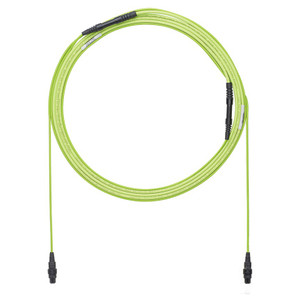
Panduit FWTYL7575KAM037 QuickNet™ 12-Fiber OM5 Trunk Cable Assembly
The Panduit FWTYL7575KAM037 is a factory-terminated 12-fiber OM5 trunk cable assembly engineered for high-density data center backbone deployments where pathway space is constrained and rapid installation is critical. Built on wideband multimode OM5 fiber with 50µm core diameter, this 37-meter (121.4 ft) trunk supports current 10G/40G/100G Ethernet architectures and future-proofs for emerging 400G and 800G shortwave wavelength-division multiplexing (SWDM) applications. The QuickNet™ pre-terminated design eliminates field splicing and fusion work, cutting deployment time from hours to minutes while ensuring factory-grade insertion loss and return loss performance across all twelve fibers. LSZH jacketing meets international fire-safety standards for enclosed spaces, making this trunk suitable for plenum pathways, riser shafts, and equipment rooms where halogen emissions are prohibited. The lime outer jacket provides instant visual identification in mixed-media environments—critical for MAC operations in live production networks.
Key Features
- OM5 Wideband Multimode Fiber: 50µm core diameter optimized for shortwave WDM transmission, backward-compatible with OM3/OM4 systems and ready for 400GBASE-SR4.2 and 800G parallel optics roadmaps
- 12-Fiber Trunk Configuration: Factory-terminated with precision-polished connectors, delivering guaranteed insertion loss ≤0.35 dB per mated pair and return loss performance exceeding TIA-568-C.3 Category OM5 requirements
- 37-Meter Backbone Reach: Ideal length for intra-building vertical risers, row-to-EOR (end-of-row) runs in hyperscale pods, or cross-connect to distribution-area links in enterprise campuses
- High-Density Small-Diameter Construction: 30–40% reduced cross-sectional area compared to legacy 12-fiber loose-tube designs, maximizing pathway fill ratios in congested ladder rack and overhead tray installations
- LSZH Outer Jacket: Low smoke zero halogen compound meets IEC 60332-1 and IEC 61034 flame and smoke density standards, ensuring compliance with European EN 50575 CPR (Construction Products Regulation) Class B2ca requirements
- QuickNet™ Pre-Terminated System: Plug-and-play deployment eliminates field fusion splicing, mechanical splices, and on-site connector termination—reducing labor cost, skill requirements, and installation risk in mission-critical uptime environments
- Standards-Compliant Performance: Meets or exceeds ISO/IEC 11801 Ed. 2.2, TIA-568-C.3, TIA-604-5 (FOCIS-5) connector geometry, TIA-492-AAAD OM5 fiber specifications, and IEC 60793-2-10 Type A1a.3 multimode fiber standards
- Lime High-Visibility Jacket: Distinct color coding per TIA-598-D fiber optic cable color standards, enabling rapid circuit tracing and reducing mis-patching errors during add/move/change workflows
Datacenter and enterprise network deployments increasingly face the dual challenge of explosive bandwidth growth and shrinking physical infrastructure space. Traditional field-terminated fiber systems introduce variability in connector performance, extend installation schedules, and require certified fusion-splicing technicians whose availability and cost can bottleneck project timelines. The FWTYL7575KAM037 addresses these constraints through Panduit's factory-controlled termination process, where each fiber is cleaved, polished, and insertion-loss tested under controlled conditions before leaving the manufacturing line. The result is a trunk assembly that delivers deterministic performance—no field rework, no surprise failures during acceptance testing, and no dependency on individual installer skill levels. For contractors managing fast-track builds or retrofit projects in operational facilities, this translates to tighter project schedules and lower risk of cost overruns tied to re-termination labor.
The OM5 fiber specification is particularly relevant for organizations planning multi-year network roadmaps. While OM3 and OM4 multimode fibers remain viable for 10GBASE-SR and 40GBASE-SR4 over typical datacenter distances, OM5's wider effective modal bandwidth (EMB) at 953 nm enables shortwave WDM transmission schemes that multiplex four 100G or 200G wavelengths over a single fiber pair. This capability is foundational to emerging 400GBASE-SR4.2 and 800GBASE-SR8 standards, where OM5 fiber can support 400G links at 150 meters and 800G links at 100 meters using SWDM optics. For network architects sizing structured cabling systems today, deploying OM5 trunks future-proofs the physical layer against optics roadmap shifts—avoiding costly re-cabling when switch fabrics migrate from 100G to 400G or 800G leaf-spine interconnects. The 37-meter length of the FWTYL7575KAM037 maps well to common datacenter topologies: vertical riser runs between stacked network closets, horizontal backbone spans in single-story colocation suites, or EOR-to-MOR (middle-of-row) aggregation links in pod-based hyperscale layouts.
Small-diameter trunk construction directly impacts pathway utilization economics. In retrofit scenarios where existing cable tray or conduit is fully subscribed, the 30–40% cross-sectional area reduction claimed by Panduit's design can mean the difference between adding new circuits within existing infrastructure versus costly pathway expansion work—cutting concrete, pulling new conduit, or adding overhead tray structures. This space efficiency also improves airflow in high-density equipment racks and overhead plenum spaces, reducing the risk of heat-trapping cable congestion that can compromise cooling effectiveness in hot-aisle containment designs. The LSZH jacket is non-negotiable for installations governed by European fire-safety codes, increasingly common in multinational datacenter operators' global design standards, and often required by insurance underwriters for high-value equipment rooms. Unlike PVC-jacketed cables that release hydrochloric acid and dense black smoke when burning, LSZH compounds produce minimal smoke opacity and no corrosive halogen gases, preserving egress visibility and reducing equipment damage during fire events.
The QuickNet™ system architecture extends beyond individual trunk cables to encompass modular cassette-based connectivity, enabling rapid reconfiguration of fiber patch fields without disturbing backbone infrastructure. Installers planning MTP/MPO-based structured cabling systems will appreciate the factory-installed connectors' compliance with TIA-604-5 (FOCIS-5) geometry standards, ensuring reliable mating with cassette modules, breakout harnesses, and direct-attach transceiver assemblies from any standards-compliant vendor. Lime jacket color follows TIA-598-D Appendix A recommendations for OM5 fiber identification, providing instant visual differentiation from aqua OM3, erika violet OM4, and legacy orange OM1/OM2 cables in mixed-generation installations—a practical advantage during troubleshooting or circuit tracing in densely populated cable trays.
Pre-terminated trunk assemblies like the FWTYL7575KAM037 are specified by network designers who have moved away from field termination for backbone infrastructure, reserving fusion splicing only for horizontal breakout runs or custom-length exceptions. This approach aligns with the design philosophy of treating structured cabling as prefabricated infrastructure—analogous to electrical bus duct or pre-insulated HVAC ductwork—where factory quality control and predictable lead times outweigh the flexibility of field customization. For project managers pricing labor-intensive fiber termination work at $50–$100 per connector endpoint (materials, labor, testing, and rework), a 12-fiber trunk with 24 factory-terminated ends represents $1,200–$2,400 in avoided field labor, often justifying the premium over raw bulk cable even before accounting for schedule compression and quality assurance benefits.
Compliance with ISO/IEC 11801, TIA-568-C.3, and IEC 60793-2-10 Type A1a.3 standards ensures this trunk assembly will pass third-party acceptance testing by commissioning agents using OTDR (optical time-domain reflectometry) or light-source/power-meter certification tools. RoHS compliance addresses procurement requirements for organizations with environmental purchasing policies or operating in jurisdictions enforcing hazardous substance restrictions. For datacenter operators managing spares inventory across multiple sites, Panduit's global distribution network and consistent product numbering simplify logistics and reduce the risk of accidentally deploying incompatible cable assemblies during emergency repairs or rapid expansion projects.