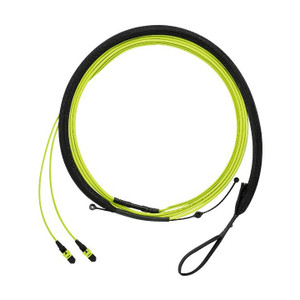
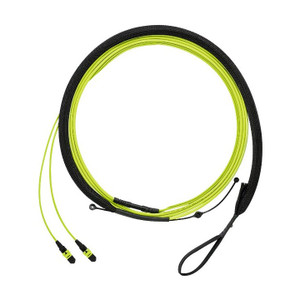
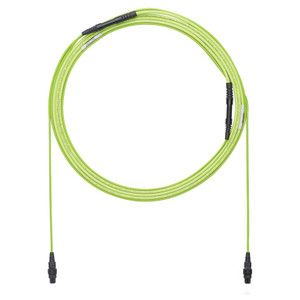
Panduit FWTYL7575LAM093 QuickNet OM5 12-Fiber Trunk Cable Assembly
The Panduit FWTYL7575LAM093 is a QuickNet OM5 12-fiber trunk cable assembly engineered for high-density data center deployments where space constraints and extended-reach 100G/400G connectivity intersect. This 93-meter (305-foot) assembly terminates PanMPO Female on both ends with Method B polarity, HD Flex transition modules, and ultra insertion loss performance. The lime-colored LSZH jacket meets international low-smoke zero-halogen safety standards while the small-diameter trunk design consumes 30-40% less pathway space than conventional assemblies—critical when every cubic inch of overhead raceway counts. A factory-installed pulling eye on one end simplifies installation through congested cable trays and vertical risers without risk of connector damage.
Key Features
- OM5 wideband multimode fiber supports 40G/100G SR4 and emerging 400G SR8 applications up to 440 meters at 850nm, with backward compatibility to OM3/OM4 infrastructure
- 12-fiber count in PanMPO-to-PanMPO configuration delivers four duplex channels per trunk, reducing cable congestion by 75% versus individual LC duplex patch cords
- Ultra insertion loss specification (typically ≤0.35 dB) maintains link budget headroom for longer spans, passive splitters, or future network expansion
- Low Smoke Zero Halogen (LSZH) jacket compound meets IEC 60332-1 and IEC 60754 flammability and toxicity standards—required for European installations and increasingly mandated in North American return-air plenums under evolving fire codes
- High-density flex design uses reduced-diameter jacket and bend-insensitive 50μm fiber to achieve 30-40% pathway space savings versus legacy trunk cables—enables compliance with TIA-942 Rated-4 density targets
- Factory-terminated with Method B polarity (key-up to key-down) aligns with TIA-568-C.0 Annex D guidelines for duplex channel mapping in structured MPO deployments
- Integrated pulling eye on one end permits installer to attach pull rope or fish tape directly to the assembly, eliminating field-fabricated strain-relief rigs that risk connector endface damage during long pulls
- 93-meter length addresses horizontal-to-EOR (End-of-Row) or EOR-to-MDA (Main Distribution Area) spans in large colocation facilities or campus data centers where standard 30m assemblies fall short
- Lime jacket color provides instant visual identification of OM5 infrastructure per TIA-598-D color code, preventing accidental cross-connection with OM3 aqua or OM4 erika violet cables
- Meets or exceeds ISO/IEC 11801, TIA-568-C.3, TIA-604-5 (FOCIS-5), and RoHS directives—ensures compatibility with multinational procurement standards and environmental regulations
Panduit's QuickNet trunk cable assemblies address the core challenge facing hyperscale, colocation, and enterprise data center operators: delivering terabit-scale bandwidth density without exceeding pathway fill ratios or triggering costly infrastructure retrofits. Traditional LC duplex patch cord strategies—where each 40GBASE-SR4 link requires four discrete cables—quickly overwhelm overhead ladder rack and under-floor conduit capacity. The FWTYL7575LAM093 consolidates four duplex 10G/25G channels (or one 40G/100G multi-lane link) into a single trunk assembly, reducing physical cable count by 75% while the HD Flex small-diameter construction further cuts cross-sectional area by an additional 30-40%. This compounding space efficiency is the difference between meeting TIA-942 Rated-4 density targets with existing pathways versus a six-figure retrofit to add supplemental cable tray. The assembly's ultra insertion loss specification—achieved through Panduit's SigCore 50/125μm fiber and precision MPO ferrule geometry—delivers typical endface-to-endface loss below 0.35 dB. In a duplex channel utilizing two connectors (one at each end), total insertion loss remains well under 0.70 dB, preserving 2+ dB of link budget margin for 100GBASE-SR4 applications at maximum 100-meter reach or enabling passive optical LAN splitter insertion without exceeding receiver sensitivity thresholds. For 400GBASE-SR8 deployments, the OM5 wideband fiber extends parallel optics reach to 150 meters at 850nm, supporting contemporary spine-leaf architectures where leaf-to-spine distances frequently exceed OM4's 100-meter limit. The Method B polarity configuration (key-up on one end, key-down on the opposite) implements TIA-568-C.0 Annex D straight-through mapping, ensuring Fiber 1 on Connector A maps to Fiber 12 on Connector B—the correct pairing for duplex transceivers in a 12-fiber array. This factory-verified polarity eliminates the field guesswork and post-installation troubleshooting that plague installations using unmarked or incorrectly keyed assemblies.
Deployment context for the 93-meter length centers on medium-to-large data center topologies where horizontal cabling or EOR-to-MDA backbone spans exceed the 30-meter assemblies commonly stocked for in-row applications but don't justify the expense and lead time of 150+ meter custom builds. In a typical raised-floor colocation facility with 12-meter row spacing and centralized MDA located 60 meters from the furthest equipment row, a 93-meter assembly provides adequate slack for vertical rise into overhead cable tray, horizontal routing along the main pathway, descent into the MDA hot aisle, and 10-15% service loop at each termination point—all without requiring field splicing or mid-span patch panels that introduce additional insertion loss and failure points. The LSZH jacket compound becomes non-negotiable in European Union installations (where halogenated materials are broadly restricted under CPR Construction Products Regulation EN 50575) and increasingly relevant in North American projects as building codes evolve to address toxic smoke generation in high-occupancy or critical infrastructure facilities. Unlike PVC jackets that release hydrochloric acid gas when burning, LSZH formulations produce minimal smoke opacity and virtually no corrosive or toxic halogen byproducts—reducing both life-safety risk during evacuation and post-fire damage to adjacent electronic equipment. The factory-installed pulling eye on one end is a field-labor detail that separates professional-grade assemblies from economy alternatives: installers can attach pull rope or fish tape directly to the reinforced eye, distributing pull tension across the entire cable structure rather than concentrating stress on the connector boot or internal fiber. In a vertical riser pull spanning four floors (40+ meters of elevation change), this detail prevents the connector boot separation or fiber strain that frequently occurs when installers improvise strain relief using cable ties or tape wrapped around the connector body. The lime jacket color coding per TIA-598-D ensures that three years into a network's operational life—when the original installation team has turned over and documentation has drifted—a technician troubleshooting a link can instantly identify the fiber type without needing to trace back to a label that may have fallen off or faded. This visual differentiation prevents the costly mistake of patching OM5 infrastructure into OM3-grade optics under the assumption that "multimode is multimode," an error that silently degrades link margin and surfaces only during capacity upgrades or when bit error rates climb unexpectedly.
The FWTYL7575LAM093 represents Panduit's response to the operational reality that data center fiber infrastructure typically outlives three to four generations of active electronics—meaning the cabling decisions made today will constrain (or enable) network capacity in 2030 and beyond. OM5's wideband multimode specification, ratified in TIA-492-AAAD and IEC 60793-2-10 Type A1a.3, supports short-wave wavelength-division multiplexing (SWDM) that transmits four distinct wavelengths (850/880/910/940nm) over a single fiber pair, quadrupling effective bandwidth without adding physical fibers. While contemporary 100G/400G optics rely on parallel lanes across multiple fibers, emerging 800G and 1.6T transceiver roadmaps increasingly leverage SWDM to hit cost and power targets—making OM5 infrastructure a hedge against obsolescence. The QuickNet family's ultra insertion loss performance further futureproofs installations by preserving link budget margin that can be traded for extended reach, passive optical splitting (for test access or monitoring taps), or higher-loss next-generation connector interfaces. For procurement teams evaluating lifecycle cost, the 30-40% pathway space savings compounds across every subsequent cable addition: a data center designed to 60% fill ratio with HD Flex trunks can absorb 50% more circuits before hitting the 80% NEC fill limit, deferring or eliminating a pathway expansion project that would otherwise cost $400-600 per linear foot when factoring in disruption to live circuits and permitting delays.