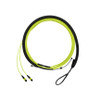
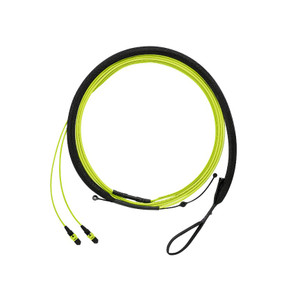
Panduit FWUYL7575KAM093 QuickNet OM5 24-Fiber Trunk Cable Assembly
The Panduit FWUYL7575KAM093 is a 93-meter OM5 wideband multimode trunk cable assembly engineered for high-density data center spine-leaf architectures and 40G/100G/400G migration paths. This 24-fiber PanMPO-to-PanMPO trunk uses HD Flex small-diameter construction to reduce pathway congestion by 30 to 40 percent compared to traditional trunk cables, while maintaining ultra-low insertion loss performance for extended reach applications. The lime LSZH jacket meets international fire safety standards, and the integrated pulling eye on one end simplifies installation in congested overhead or underfloor pathways. Factory-terminated to Method A polarity, this trunk integrates directly into structured cabling systems using Panduit cassettes and breakout modules without field rework or polarity mapping.
Key Features
- OM5 wideband multimode fiber (50/125 μm) optimized for shortwave wavelength division multiplexing (SWDM) and extended 40G/100G/400G reach
- 24-fiber capacity in PanMPO female-to-female configuration for high-port-density switch and server connectivity
- HD Flex small-diameter trunk construction reduces pathway fill by 30–40% vs. standard trunk cables, critical for cooling airflow in dense deployments
- Method A polarity (straight-through key-up-to-key-up) for standard structured cabling deployments with cassette-based polarity inversion
- Ultra insertion loss grade guarantees ≤0.35 dB per mating interface, preserving link budget for multi-patch-point channels
- Low Smoke Zero Halogen (LSZH) jacket compliant with IEC 60332-3-24 for enclosed-space safety and plenum-equivalent applications
- Factory-terminated PanMPO connectors tested to TIA-568-C.3 and ISO/IEC 11801 with traceable insertion loss and return loss data
- Integrated pulling eye on one end distributes tensile load across cable jacket for safe installation through conduit, cable tray, and vertical risers
- 93-meter (305 ft) length supports mid-rise floor-to-floor runs, horizontal spine interconnects, and SAN extensions
- QuickNet system-certified for plug-and-play interoperability with Panduit FHD cassettes, panels, and enclosures
- Lime-green jacket provides instant visual identification per TIA-598-D OM5 color coding, preventing cross-connection with OM3/OM4 infrastructure
OM5 wideband multimode fiber extends the useful life of multimode infrastructure by enabling SWDM transmission at four distinct wavelengths (850, 880, 910, 940 nm) over a single fiber pair. This allows 40GBASE-SR4, 100GBASE-SR4, and emerging 400GBASE-SR8 applications to achieve 150-meter reach on OM5 versus 100 meters on OM4, eliminating the need for costly single-mode migration in many mid-sized data centers. The FWUYL7575KAM093's ultra insertion loss rating guarantees ≤0.35 dB per mating interface (≤0.70 dB total for the end-to-end trunk), which preserves link budget for installations requiring multiple patch points between active equipment—common in leaf-spine fabrics where a trunk connects an end-of-row switch to a centralized patch panel before breakout to individual servers. At 93 meters, this assembly consumes approximately 2.79 dB of the typical 7.0 dB OM5 link budget for 100GBASE-SR4 (assuming 3.0 dB/km attenuation), leaving 4.2 dB margin for connectors, splices, and equipment interfaces—adequate for channels with up to six mated pairs.
The HD Flex cable construction uses a reduced-diameter jacket (approximately 6.4 mm versus 9.2 mm for standard 24-fiber round trunk) and optimized fiber ribbon packing that achieves 30 to 40 percent smaller cross-section than traditional trunk cables. In a fully populated 4-inch ladder rack supporting 144 trunk cables (six 24-strand trunks per 1U row across 24 rows), this size reduction frees approximately 38 cubic inches of airflow cross-section—equivalent to reducing cable-induced air impedance by one-third. This matters in hyperscale and colocation facilities where every CFM of obstructed cold-aisle air increases cooling costs and limits rack power density. The smaller diameter also simplifies routing through tight-radius conduit bends (minimum bend radius 10× cable diameter during installation, 5× at rest) and reduces the footprint of cable coils stored above ceiling grids or below raised floors. The lime-green jacket provides instant visual identification of OM5 cabling per TIA-598-D color coding standards, reducing the risk of accidental cross-connection with OM3 (aqua) or OM4 (erika violet) infrastructure during moves, adds, and changes—a common error in mixed-generation data centers that can limit link distance or prevent autonegotiation on 100G optics expecting OM5 performance.
Method A polarity (key-up-to-key-up straight-through) aligns with the most common structured cabling deployment model, where fiber position 1 on end A maps to fiber position 1 on end B, and polarity inversion occurs at the cassette or breakout module rather than within the trunk itself. This simplifies troubleshooting because insertion loss testing with a standard MPO test reference cord (key-up both ends) produces valid results without polarity adapters, and visual fault locators illuminate the expected fiber positions without requiring a polarity lookup table. In a typical deployment, this trunk connects a 24-fiber key-up port on a spine switch MTP/MPO module to a key-up port on a Panduit FHD cassette in the main distribution area; the cassette internally converts Method A trunk polarity to twelve duplex LC outputs with correct transmit-receive pairing for 10G/25G/100G server connections. The factory-installed pulling eye on one end of the assembly provides a secure attachment point for fish tape or pull rope, distributing tensile load across the entire cable jacket rather than stressing the connector bodies—essential when routing through tight-radius conduit bends or vertically rising pathways in multi-story data centers where cable weight and friction can exceed 50 pounds of pull tension. The pulling eye location (one end only) allows the opposite connector to be fed through smaller openings first, then pulled through with the cable body, rather than forcing the rigid PanMPO connector housing through the tightest constriction point.
The low smoke zero halogen jacket complies with IEC 60332-3-24 Category C flame propagation limits and produces minimal toxic or corrosive gas when exposed to fire, meeting plenum-equivalent safety requirements in European and Asia-Pacific markets where PVC-jacketed cable is restricted in occupied spaces and return-air pathways. LSZH jackets contain no halogens (fluorine, chlorine, bromine, iodine) that would otherwise decompose into hydrochloric acid or hydrofluoric acid vapors during combustion—critical in equipment rooms and communication closets where toxic smoke can damage electronics and obstruct emergency egress. The cable also meets RoHS heavy-metal restrictions (lead, mercury, cadmium, hexavalent chromium) for disposal compliance in EU and California markets. Factory endface inspection per IEC 61300-3-35 ensures each of the 24 fibers meets geometry and contamination limits before shipping: core-to-ferrule offset ≤50 μm, ferrule endface radius of curvature 10–25 mm, and zero scratches or particles >5 μm in the fiber core zone. This eliminates the field rework and re-polishing common with site-terminated MPO connectors, where a single contaminated fiber in a 24-strand array can fail an entire trunk during acceptance testing.
The FWUYL7575KAM093 integrates directly with Panduit's QuickNet cassette modules (FHD, FAP, FMT series) for rapid deployment of pre-terminated fiber infrastructure. A typical installation uses these 93-meter trunks for vertical riser runs between floors or horizontal spine runs between server pod aggregation switches and the main distribution area, with cassettes at each end converting the 24-fiber trunk to twelve duplex LC, six duplex MPO, or twenty-four simplex LC server connections depending on the application. Because all connectors are factory-installed and tested, deployment labor drops to cable pulling and cassette insertion—eliminating the fusion splicing, mechanical splicing, or field termination steps that traditionally consume 70 percent of fiber installation time. This assembly is particularly suited for leaf-spine fabrics in software-defined storage environments, where non-blocking 100G uplinks and deterministic low latency require pristine fiber performance across hundreds of parallel links. The 93-meter length accommodates floor-to-floor rises of approximately 240–270 feet after accounting for vertical cable management, horizontal runs to patch panels, and service loops, making it ideal for mid-rise colocation facilities (3–5 stories) and campus data centers where spine switches reside in a centralized equipment room serving edge leaf switches distributed across multiple floors or buildings.