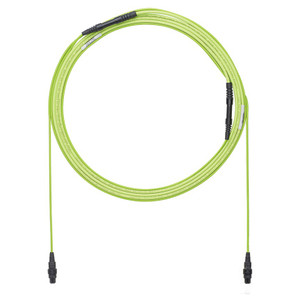
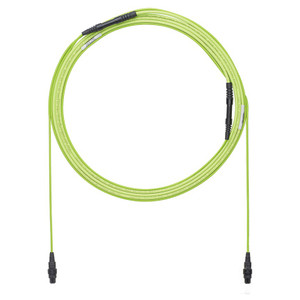
Panduit FWTYL7575LAM066 12-Fiber OM5 66-Meter Trunk Cable Assembly
The Panduit FWTYL7575LAM066 is a factory-terminated 12-fiber OM5 trunk cable assembly engineered for high-density data center backbone and horizontal distribution applications requiring extended reach and rapid deployment. This 66-meter (218 ft) QuickNet pre-terminated trunk delivers plug-and-play connectivity between distribution frames, zone enclosures, and equipment racks while consuming 30 to 40 percent less pathway space than traditional trunk designs. OM5 wideband multimode fiber supports short-wave division multiplexing (SWDM) for 400G and future 800G Ethernet over distances up to 150 meters at 850 nm, making this assembly future-ready for evolving 100G, 200G, and 400G migration paths. LSZH jacketing meets plenum and riser fire safety requirements for enclosed data halls and equipment rooms where combustion byproducts pose evacuation risk.
Key Features
- 12-fiber OM5 wideband multimode trunk rated for 40G/100G/400G Ethernet with SWDM wavelength support
- 66-meter (216.54 ft) factory-terminated length spans typical data center row-to-MDA or MDA-to-EDA runs without field splicing
- QuickNet pre-terminated design eliminates field termination labor, fusion splicing, and test time—install in minutes instead of hours
- Small-diameter trunk construction reduces conduit fill and cable tray congestion by 30–40% compared to 50 μm legacy designs
- LSZH (Low Smoke Zero Halogen) outer jacket rated for plenum and enclosed spaces—critical for data halls, telecom rooms, and under-floor pathways
- Lime green jacket provides instant visual identification of OM5 fiber type per TIA-568 color coding standards
- 50 μm core diameter optimized for VCSEL transceiver applications (SFP28, QSFP28, QSFP56, QSFP-DD)
- Factory testing and insertion loss certification included—ships with test report documenting end-to-end performance
- Meets ISO/IEC 11801, TIA-568-C.3, TIA-604-5 (FOCIS-5), and IEC 60793-2-10 A1a.3 standards for multimode fiber infrastructure
- RoHS compliant and halogen-free formulation reduces environmental impact and disposal restrictions
OM5 wideband multimode fiber represents the latest generation of laser-optimized 50 μm multimode technology, engineered specifically to support short-wave division multiplexing (SWDM) transmission schemes that use four discrete wavelengths (850, 880, 910, 940 nm) simultaneously over a single fiber pair. This capability allows 100GBASE-SR4 and 400GBASE-SR8 Ethernet to run over fewer fibers—reducing transceiver port count, fiber pair requirements, and overall cost per gigabit. The Panduit FWTYL7575LAM066 leverages this advancement by delivering twelve OM5 fibers in a compact, bend-insensitive trunk assembly that maintains <1.5 dB insertion loss across the 850–950 nm spectrum. Core-to-core crosstalk is minimized through precision fiber buffering and optimized cable geometry, ensuring that each fiber pair delivers independent 100G channels without modal noise or inter-channel interference. For 400G deployments, this trunk supports eight active fibers in duplex pairs (four transmit, four receive) with four spare fibers for redundancy or future capacity expansion. Effective modal bandwidth (EMB) at 850 nm exceeds 4,700 MHz·km, which translates to 150-meter reach for 400GBASE-SR8 and 100-meter reach for 400G-BiDi applications using QSFP-DD BiDi transceivers.
The 66-meter length is purpose-engineered for data center topologies that extend beyond the 30-meter zone typically covered by duplex patch cords. Common deployment scenarios include Main Distribution Area (MDA) to Equipment Distribution Area (EDA) links in spine-leaf architectures, cross-aisle connectivity between hot-aisle containment pods, and backbone runs between adjacent data halls or co-location suites. This length eliminates the need for mid-span fusion splicing or field-terminated breakout kits—both of which introduce insertion loss, mechanical vulnerability, and installation time penalties. QuickNet factory termination ensures that all twelve fibers are cleaved, polished, and tested to FOCIS-5 endface geometry specifications (radius of curvature 10–25 mm, apex offset <50 μm, fiber height −60 to +80 nm). Each connector ferrule is individually inspected under 400× magnification for scratches, pits, and contamination, then mated and tested at 850 nm and 1300 nm to verify <0.5 dB insertion loss per mated pair. This factory discipline is impossible to replicate in the field, where dust, humidity, and technician variability introduce defect rates that exceed 10 percent on first-pass terminations. By contrast, factory-terminated trunks achieve >99.5 percent first-install success rates, reducing truck rolls and eliminating the need for field test equipment, fusion splicers, or polishing stations.
LSZH jacketing is a non-negotiable requirement for enclosed data center environments, telecom closets, and under-floor plenum spaces where PVC combustion byproducts (hydrogen chloride, carbon monoxide) pose life-safety risk during fire events. LSZH formulations replace PVC and halogenated flame retardants with mineral-filled thermoplastic compounds that emit <0.5 percent hydrochloric acid and <5 percent light-obscuring smoke when exposed to open flame per IEC 61034 testing. This matters in high-value data halls where evacuation time is measured in seconds and where breathing apparatus is not standard PPE. Beyond safety, LSZH jackets eliminate the corrosive residue that PVC combustion leaves on circuit boards, backplane connectors, and metal cable trays—corrosion that can remain dormant for months post-incident before triggering cascading equipment failures. The lime green color coding per TIA-568 Annex E allows technicians to distinguish OM5 trunks from OM3 (aqua) and OM4 (purple/aqua) infrastructure at a glance, reducing mis-patching risk during MACs (Moves, Adds, Changes) and preventing accidental connection of 400G transceivers to OM3 links that cannot support the required bandwidth-distance product.
Small-diameter trunk construction addresses the chronic space constraints in modern hyperscale and enterprise data centers, where cable tray fill ratios routinely exceed 40 percent and under-floor pathway congestion limits airflow velocity to the point of thermal throttling. Traditional 12-fiber trunks using 900 μm tight-buffered fibers measure 12–15 mm in overall diameter; the FWTYL7575LAM066 reduces this to approximately 8–9 mm through optimized buffer wall thickness, stranded dielectric strength members, and precision extrusion control. This 30–40 percent diameter reduction translates directly to conduit fill capacity gains—allowing four OM5 trunks in the same 1-inch EMT conduit that previously accommodated three legacy trunks. In cable tray environments, the reduction improves airflow around bundled cables, lowers friction during installation pulls, and reduces the sag that occurs when hundreds of meters of trunk cable are suspended horizontally across 20-foot tray spans. Bend radius performance is maintained at 10× cable diameter (approximately 90 mm) under no-load conditions and 20× diameter (180 mm) during installation pulls, ensuring that tight 90-degree transitions around vertical cable managers and through cabinet knock-outs do not degrade optical performance or induce microbending attenuation.
This trunk assembly ships as a continuous 66-meter run with factory-installed connectors on both ends—no breakout legs, no furcation kits, no mid-span splice enclosures. The installation workflow is plug-and-play: route the trunk through conduit or tray, dress the ends into fiber distribution panels or cassette modules, insert connectors into MTP/MPO adapter plates or LC breakout cassettes, and verify link light. Total installation time for a two-person crew is typically under 20 minutes, compared to 3–4 hours for field-terminated or fusion-spliced alternatives. The time savings compound in large deployments—outfitting a 40-rack pod with six 66-meter MDA-to-EDA trunks drops from a full-day effort to a two-hour task, freeing installation crews to focus on horizontal patching, transceiver provisioning, and switch configuration. The elimination of field termination also removes the single largest source of fiber network failures: bad connectors. Industry data shows that 60–70 percent of fiber troubleshooting truck rolls trace back to contaminated, scratched, or mis-polished endfaces introduced during field termination. Factory connectors eliminate this failure mode entirely, shifting the defect window from installation (where failures are costly and disruptive) to manufacturing (where QA intercepts defects before shipment).
Compliance with TIA-568-C.3 and ISO/IEC 11801 ensures that this trunk integrates seamlessly into structured cabling systems designed and installed per commercial building and data center standards. TIA-568-C.3 specifies performance requirements for OM5 fiber (minimum 4,700 MHz·km EMB at 850 nm, <3 dB/km attenuation at 850 nm, <1.5 dB insertion loss for permanent links up to 90 meters), connector endface geometry per TIA-604-5 (FOCIS-5), and color coding per Annex E. ISO/IEC 11801 Ed. 2.2 extends these requirements internationally, adding specifications for OM5 channel performance in Class FA (application-agnostic multimode channel), maximum allowable loss budgets for 40G/100G/400G Ethernet, and polarity management for duplex and parallel optics. The trunk's RoHS compliance addresses EU Restriction of Hazardous Substances directives that limit lead, mercury, cadmium, and brominated flame retardants in electronic products sold or installed in European Union member states—critical for multinational enterprises, co-location providers, and hyperscalers operating facilities in EMEA regions. Halogen-free construction further aligns with corporate sustainability initiatives and green building certifications (LEED v4, BREEAM) that award points for low-emission materials and reduced environmental impact across the product lifecycle.
The Panduit FWTYL7575LAM066 is purpose-built for commercial integrators and data center infrastructure teams deploying 40G/100G/400G Ethernet backbones in enterprise campuses, co-location facilities, and hyperscale compute environments where installation speed, density optimization, and long-term reliability determine total cost of ownership. The 66-meter length eliminates mid-span splicing for row-to-distribution and cross-aisle links, QuickNet factory termination delivers plug-and-play deployment in under 20 minutes per trunk, and OM5 wideband fiber ensures compatibility with current 100G optics and future 400G/800G SWDM transceivers through 2030 and beyond.